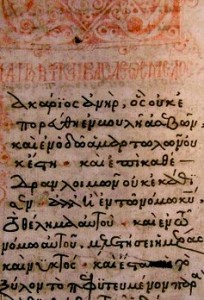
 3. THE CASE OF THE MISSING PROPHET
We have written in a previous article (“The Neutralization of the Netherworld”) that the Septuagint translation of the Old Testament represents an ancient and authentic Hebrew tradition.
Due to the fact that there were variances in the Hebrew texts, the textual tradition that the Septuagint translation presents often differs widely from the Masoretic Hebrew text of today.
But there are also some surprises.
In very ancient times, it seems some anonymous rabbis felt that they needed to take some liberties with the sacred texts, mostly — it appears – out of embarrassment.
For example, in the Book of Judges, we are told that the children of Dan fell into idolatry (Judges 18:30-31). This is what the Septuagint says:
“And the children of Dan set up the graven image for themselves; and Jonathan, the son of Gerson [Gershom], the son of Manasses, he and his son were priests to the tribe of Dan till the time of the carrying away of the nation [literally: the land]. And they set up for themselves the graven image which Michaias [Micah] made, all the days that the House of God was in Selom [Shiloh].”
This, essentially, is what the Masoretic says also. The only problem here is that Gerson [Gershom] was not the son of Manasses. He was the son of the Prophet Moses! How embarrassing! The grandson of Israel’s most prominent prophet fell into idolatry! This is what author Charles D. Provan (Christian News, May 7, 2007) writes:
“…The rabbis themselves wrote that they deliberately changed some passages [of the Old Testament]. Among the most definite[changes] is Judges 18:30 where the rabbis admit they changed the text from Moses to Manasseh in order to protect Moses!”*
The teachers of Israel felt this fall on the part of the Prophet’s grandson would cast reproach on the reputation of the great Moses, so they changed the name. The translators of the Septuagint inherited this variant in the text they were given, and so they faithfully rendered this ancient rabbinical redaction into Greek.
So, two cheers to the translators of the Septuagint for their fidelity to the text they received.
4. THE CASE OF THE MISSING PROPHECY
In the Gospel of St. Matthew, we read the following prophetic passage:
“And having been warned in a dream not to go back to Herod, they returned to their country by another route. When they had gone, an angel of the Lord appeared to Joseph in a dream. Get up, he said, and take the child and his mother and escape to Egypt. Stay there until I tell you, for Herod is going to search for the child to kill him. So he got up, took the child and his motherduring the night and left for Egypt, where he stayed until the death of Herod. And so was fulfilled what the Lord had said through the prophet: OUT OF EGYPT I CALLED MY SON.” (Matt. 2:12-15)
Many Protestants believe that this prophecy is found in the Old Testament book of the Prophet Hosea (chap. 11, verse 1). But this cannot be true. Why? If you read the Hosea passage in its entirety, you realize that this particular passage is speaking about God’s disobedient son, the nation of Israel. This cannot be said of our Saviour Jesus Christ, the Son of God.
There is only one Old Testament passage that clearly fulfills all the qualifications for being the prophecy that the Gospel of St. Matthew is referring to. That is Numbers 24:2-9, in the Septuagint text:
“And Balaam lifted up his eyes, and sees Israel encamped by their tribes; and the Spirit of God came upon him. And he took up his parable and said: Balaam says to the sons of Beor, the man who sees truly says, He who hears the oracle of the Mighty One speaks, who saw a vision of God in sleep; his eyes were opened: How goodly are thy habitations, Jacob, and thy tents, Israel! As shady groves, and as gardens by a river, and as tents which God pitched, and as cedars by the waters. There shall come a man out of his seed, and he shall rule over many nations; and the kingdom of Gog shall be exalted, and his kingdom shall be increased. God led him out of Egypt; he has as it were the glory of a unicorn: he shall consume the nations of his enemies, and he shall drain their marrow, and with his darts he shall shoot through the enemy. He lay down, he rested as a lion, and as a young lion; who has stirred him up? They that bless thee are blessed, and they that curse thee are cursed.”
Scholar Charles Provan writes,
“…Though the sojourn [in Egypt] may be obtained in the Masoretic text, yet it is much easier to derive it from the Greek version. Indeed, that Numbers 24 is a Messianic prophecy is so obvious that it jumps off the page, as does the Egyptian sojourn of the Messiah.”
And also:
“Notice also that one name [of our Saviour] in the New Testament is The Lion from the Tribe of Judah (Revelation 5:5 ). Though there are Messianic prophecies in which it is stated that Christ would come from the Tribe of Judah, I am aware of none which refer directly to Christ as a Lion, except the Numbers 24 prophecy of Balaam. This is obtainable from the Masoretic text, but is unavoidable in Greek.”
Two and a half cheers for the Septuagint text!
5. THE CASE OF THE MISSING KINSMEN
As C. Provan points out,
“There are differences….between the Septuagint Old Testament and the Old Testament of the Rabbinic Jews [the Masoretic text]. To make matters worse, many Christians now suppose that since the Old Testament was written in Hebrew, the Hebrew Bible kept by the Rabbinic Jews is, in fact, the ‘original Hebrew’. In fact, it is not the original Hebrew, and it is not too old either. You see, the rabbis had very particular orders concerning the copying of the Old Testament. Among their rules is the command that all old, used copies of the Old Testament are to be destroyed. Hence, the oldest complete copy of the Hebrew Old Testament dates to about 1100 A. D. The Greek Old Testament is very much older than that.”
Some of the differences that we find between the Septuagint and Masoretic texts are the following:
In the Gospel of St. Luke, in the genealogy of Christ, in chapter three, verses 36 and 37, there are two Cainans mentioned. The Septuagint Greek Old Testament also mentions two Cainans in Genesis 10:24. The Hebrew Masoretic text, however, mentions only one.
When the Dead Sea scrolls were discovered in the middle of the last century, the Hebrew text of some two thousand years ago was examined, and that text — like the text of the New Testament and the Septuagint — had two Cainans! What happened?
C. Provan tells us the following:
“According to ancient Jewish literature, the second Cainan was involved in the reintroduction of astrology into the post-flood world. By eliminating the second Cainan [from the genealogies], Noah’s great grandson is eliminated as a problem since he was esteemed a great sinner.”
That is how the second Cainan disappeared from the genealogy of the Masoretic text! Does this remind us of the Soviet method of air-brushing the “enemies of the people” from old photographs? Apparently, some rabbis who worked on the Masoretic text felt they had even more divine authority than God!
Then, there is Acts 7:14. There, the God-inspired St. Stephen the First Martyr,
“filled with Holy Spirit” (Acts 7:54),
tells us that all the members of the Patriarch Jacob’s family were seventy-five in number. The Septuagint text also says “seventy-five“. But the Masoretic Hebrew text in Genesis 46:27 says “seventy.” Who is correct? If we check the Dead Sea scrolls, we find that they confirm what the Septuagint and the New Testament say:
“seventy-five”!
Three cheers for the Septuagint text!
6. THE CASE OF THE MISSING VERSE
Psalm 144 (Ps. 145 in the Masoretic text) is an “acrostic Psalm” in Hebrew, that is, each of its verses begins with a letter of the Hebrew alphabet. But there is a problem in today’s Hebrew Masoretic text. The verse that should begin with the Hebrew letter “N” is missing.
At the same time, people have noted that in the Greek version of the Book of Psalms (i.e. the Septuagint text), there is an “extra” verse where the missing letter “N” should be in the Hebrew text. By “reverse translating” this verse from the Greek back into Hebrew, the verse begins with the missing letter “N”!! Furthermore, when the Dead Sea Scrolls were discovered, the ancient Hebrew text of the Psalms had the verse exactly where the Septuagint had it.
In the Septuagint, the so-called “extra” verse is:
“Faithful is the Lord in all His words, and holy in all His works.” (Ps. 144:14)
In the Dead Sea Scrolls, the so-called “missing” Hebrew verse says:
“God is faithful in His words, and gracious in all His deeds.”
A twenty-one gun salute for the Septuagint!!
7. THE CASE OF THE MISSING FEAST
The Jewish people love the feast of Hanukkah. It is their answer to Santa Claus and Rudolph the Red-nosed Reindeer.
But there is a little problem here.
The Feast of Hanukkah is nowhere to be found in the present-day Hebrew Scriptures. Oy! Well, where can we find it? You guessed it: It is based on an oral tradition which, in turn, is based on an incident found only in the Greek Septuagint text!!! — the First Book of Maccabees (4:36-59).
Yes, the feast that is one of the most beloved for the Jewish people today is based on a text found only in the sacred Scriptures of the Orthodox Christians, the New Israel.
Happy Hanukkah to all!
8. GOD’S LANGUAGE
We have written about the differences between today’s Masoretic text of the Old Testament and the ancient Septuagint translation of the Old Testament. Actually, since the Septuagint translation was finished about 290 years before Christ, and the contemporary Hebrew Masoretic text was only completed a millennium after Christ, the Septuagint version is almost 1,300 years older than the current Masoretic edition!
The Dead Sea Scrolls, discovered in the middle of the last century, sometimes favor the Septuagint text and sometimes the Masoretic text. As far as the Septuagint is concerned, it is important to remember that it was done by scholars of the Jewish faith almost 300 years before Christ. So it cannot possibly be argued that it has a pro-Christian bias. In the case of the Masoretic text, however, it was done in the centuries after Christ, so there are always suspicions about an anti-Christian bias in the choice of the variant Hebrew texts that were picked in order to create the Masoretic edition. These suspicions are especially strong when passages in the Septuagint which lend themselves readily to a Christian interpretation are substantially different, or even disappear entirely, in the Masoretic text.
But, the truth be told, and to be fair, there are passages in the Masoretic text that really are very beautiful and more eloquent than the Septuagint version. And, the fact of the matter is that the Septuagint is, after all, a translation of the Hebrew text. As we know, every translation from one language into another is, in reality, an interpretation. Every language has words whose full range of nuances and implications cannot possibly be translated accurately into another language.
This is especially true when we are talking about God’s language. What language does God speak? Well, it would be helpful for us to know, first of all, that God speaks in a very ancient language. This language is known by the name “Uncreated Divine Grace.” This language does not translate well into our Semitic or Indo-European languages, or, for that fact, into any manmade language. Many fine men and women have thrown up their hands in despair trying to translate God’s language (and yet, oddly, children sometimes have no problem at all understanding it).
Furthermore, nobody can duplicate the sounds of God’s language; it seems to have no vowels or consonants that human beings can articulate.
In the article, “Rationalism and Fundamentalism,” we quoted what some Saints of the Church had to say about conveying God’s language into ours.
In his work, The Hexaemeron, St. Basil the Great says the following:
“It must be well understood that when we speak of the voice, of the word, of the command of God, this divine language does not mean to us a sound which escapes from the organs of speech, a collision of air struck by the tongue; it is a simple sign of the will of God, and, if we give it the form of an order, it is only the better to impress the souls whom we instruct.” (Hexaemeron II: 7)
St. Gregory of Nyssa, on his part, has this to say:
“…human speech finds it impossible to express the reality which transcends all thought and all concept; and he who obstinately tries to express it in words, unconsciously offends God.” (Commentary on Ecclesiastes, Homily 7)
And, again, he writes:
“Lifted out of himself by the Spirit, (the Prophet David) glimpsed in that blessed ecstasy God’s infinity and incomprehensible beauty. He saw as much as a mere mortal can see, leaving the covering of the flesh, and by thought alone entering into the divine vision of that immaterial and spiritual realm. And though yearning to say something which would do justice to his vision, he can only cry out (in words that all can echo after him): I said in mine ecstasy, every man is a liar (Psalm 115:2 ). And this I take to mean that anyone who attempts to portray that ineffable Light in language is truly a liar — not because of any abhorrence of the truth, but merely because of the infirmity of his explanation.” (From the Homily on Virginity)
What does all this have to do with the Septuagint and the Masoretic texts? Simply this: as feeble attempts to translate God’s language into our man-made languages, both versions fall short. Each one has its own strong points, and its weak points, but neither one can adequately convey the revelation of God’s ineffable grace into our earth-bound languages. As for the differences between the Greek and Hebrew texts — except for the fact that there was some open tampering with the Old Testament texts in the Masoretic — both versions, with certain qualifications, might often simply represent different textual traditions of the Hebrew Old Testament.
Having in mind what the Saints of the Church have said about the limitations of our human languages in dealing with divine revelation (see above), it is no surprise that Orthodox Christians do not get bent out of shape, as Roman Catholic or Protestant textual critics seem to do, about textual differences and variations in the Holy Scriptures.
However, the reason why Orthodox Christians prefer the Septuagint is simply because it represents an ancient, authentic and unbiased text of the Old Testament, translated and embraced by the Jewish people themselves for almost 400 years. Since we hold ourselves to be the New Israel, we feel pretty strongly about upholding this tradition of the God of our Fathers.
Amen. So be it.
___________
* The Bibilical scholar Charles D. Provan has written many fine articles about the need to correct the contemporary Masoretic Old Testament text according to the texts of the Septuagint and the Dead Sea Scrolls. He cites many passages where the Septuagint Old Testament is correct, whereas the Masoretic text is faulty or has been altered.
thanks to:
https://preachersinstitute.com/2010/10/20/why-orthodox-christians-prefer-the-septuagint-part-2/

