Total Pageviews

Search This Blog

Wednesday, February 27, 2019

When Saints do not really stand out...


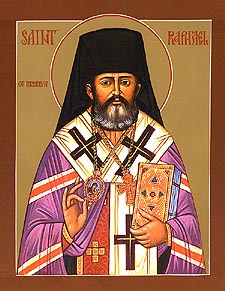
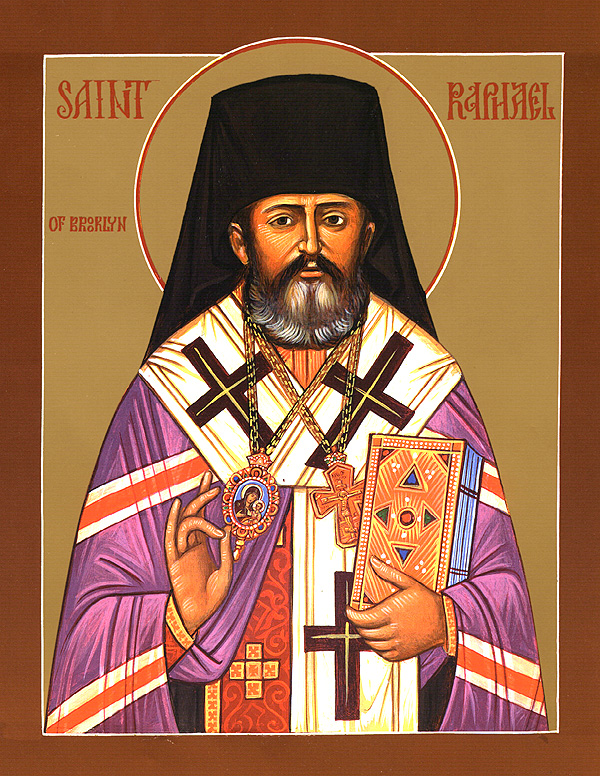
Saint Raphael of Brooklyn

Sometimes there seems to be a saint who doesn’t really stand out, believe it or not. They are laborers in God’s vineyard, and their ‘claim to fame’ is for something other than what they’ve done. They just seem to have been in the right place at the right time. At first glance, that sums up Saint Raphael of Brooklyn perfectly. He was multi-talented, but nothing really stood out – he founded (and wrote a large number of articles for) what is still the official publication of the Antiochian Orthodox Church of North America, The Word (al—Kalimet), and published fourteen books. He was a teacher – before he came to this continent, he taught Arabic in Russia. He was an able assistant to several of his superior hierarchs. He was an organizer, and worked tirelessly to establish thirty parishes all over the continent in places as far apart as Montreal, Quebec, and Mexico City. He traveled all over the United States, establishing parishes of Arabic Orthodox from Texas to Nebraska to Washington D.C., and of course, the most famous: St. Nicholas Cathedral in Brooklyn, New York.
So far, he’s right in line with all the other missionary saints – St. Nina, St. Innocent, with whom he’s often compared, St. Tikhon, St. Arseny of Winnipeg. There were no wonderworking miracles that occurred during his lifetime: he had no startling visions, there were no miraculous cures when he prayed, neither the Prime Minister of Canada nor the President of the U.S.  dramatically converted as a result of his work. What he’s also known for, of course, is being the first bishop to be consecrated on North American soil. Even his brother bishop, Innocent (Pustynskii), who shared vicar bishop duties with him under St. Tikhon, traveled to Moscow for his consecration. It seems as though Saint Raphael was just in the right place at the right time – a beneficiary of circumstances and happenstance. He was canonized in 2000 and his feast day is celebrated on February 27 or, in the Antiochian Church, on the first Saturday in November.
But with God, there are no “just happens.” When we look into the Saint’s work and life, what we find is a dedicated man who simply got on with the job with little fanfare, who cared deeply about his people. He was Syrian by birth (around Nov 8, 1860) and devoted to the Arabic Church and its people to the point where he was suspended from his priestly duties for speaking out about non-Arabic patriarchs. He later repented and was reinstated, but his devotion to his people was what led him to accept, in 1895, the pastorship of the Syrian-Arabic community in New York City.
His traveling across the continent began long before he became bishop – it’s part of what led to his consecration. As one source notes, “Raphael set out in mid-1896 on a monumental pastoral journey, in order to acquaint himself with some 4,000 Arabic-speaking Christians in thirty cities along the main rail lines between New York and San Francisco.” He would talk with Arabic people wherever he was, finding out what they wanted and needed pastorally. He made notes and at his own expense would buy and mail the prayer books, prayer ropes, and other items of piety to them, along with letters of support and encouragement.
He was a visionary. As early as 1867, he realized the need for clergy fluent in English and the adoption of English for liturgical purposes. He established classes – in English – to teach the Arabic youth about their spiritual heritage and as bishop decreed that the liturgical service books would be in English.
Saint Raphael might also have been one of the most open minded saints to live and work on our continent. Because of the mix of Christian and other faiths in both Canada and the U.S., Orthodox hierarchs had to deal with other religions, something many of them had not had to do in their home countries. “Only in America was the reality of having to live in ‘peaceful coexistence’ with other faiths encountered. Raphael quickly adapted to this situation and became highly esteemed for his grace and tact.”
On one level, a quiet worker in the vineyards. On another, a man who brought his faith to action, by shepherding the people he loved, by working toward understanding and respect for all, by doing what was set before him. Modest and humble, he simply got on with what he had to do. And perhaps that’s the best thing we can learn from him – not to worry about our progress along the path to God, but to simply do the jobs set before us to the best of our ability. It’s human nature to want approval and notice and accolades from our fellows (which Saint Raphael received – he was approached numerous times to accept Arabic dioceses, and turned them all down so he could continue his work in America.) It’s normal to want to be noticed for the work we do and the effort we put in. It’s normal to want to know that we’re on track and doing what we’re supposed to.
And most of us are so separate from God that we can’t feel His presence most of the time. So perhaps desiring praise from our brothers and sisters is a way of trying to feel the love God has for us. What Saint Raphael teaches us is not to worry about that praise. God sees, God knows, and God will reward in His own time. We may not all be officially made saints of the Orthodox church if we do that, but we will always be saints to the One who counts most, and rewards best.
NOTE: The difference in feast days is due, according to the Antiochian church, to avoid having Saint Raphael’s feast day overshadowed by another feast, as happens with the Feb. 27 date. See http://www.angelfire.com/pa3/straphaelcanonized/lives/DateFeast.html for full explanation.
Sources:
http://orthodoxwiki.org/Raphael_of_Brooklyn
This site is comprehensive and includes clippings and news releases from the following:
on his consecration: San Franciso Call, Monday May 14, 1904, pg. 31,
on his canonization: OCA, Word Magazine, Proclamation of Canonization: Holy Synod of the OCA, March 29, 2000.
lots of photos of him over the years.
 Thanks to:
http://myocn.net/saint-raphael-of-brooklyn/

St Raphael the Bishop of Brooklyn Commemorated on February 27


Repose of St Raphael the Bishop of Brooklyn

Saint Raphael, Bishop of Brooklyn (+1915)
Proclamation on the Glorification of Our Holy Father Bishop RAPHAEL (30-Apr-2000)
Our holy Father Raphael was born in Syria in 1860 to pious Orthodox parents, Michael Hawaweeny and his second wife Mariam, the daughter of a priest of Damascus. The exact date of Raphael’s birth is not known, but he estimated it to be on or near his Name Day, the Synaxis of the Holy Archangels Michael and Gabriel and all the Bodiless Powers of Heaven (November 8). Due to the violent persecution of Christians, at which time their parish priest, Saint Joseph of Damascus (July 10) and his companions were martyred, the Hawaweeny family was forced to flee to Beirut for their safety. It was here that the future saint first saw the light of day, and not in the city of his parents. Indeed, as the child’s life unfolded, it was evident that he would have no continuing city in this world, but would seek the city which is to come (Heb 13:14).
On the Feast of Theophany in 1861, he was baptized with the name Rafla, and later that spring the family was able to return to Damascus. The child attended elementary school, where he did very well, but in 1874 it appeared that Michael Hawaweeny would no longer be able to afford his son’s tuition. Fortunately, help came from Deacon Athanasius Atallah (later Metropolitan of Homs), who recommended to Patriarch Hierotheus of Antioch that Rafla be accepted as a student of the Patriarchate in preparation for the priesthood.
He was such a good student that he was selected to be a substitute teaching assistant in 1877. The following year he was appointed as a teacher of Arabic and Turkish. On March 28, 1879 he was tonsured as a monk by Patriarch Hierotheus, and served as His Beatitude’s personal attendant.
Since the Balamand Seminary had been closed in 1840, Patriarch JOACHIM III of Constantinople invited the Patriarch of Antioch to send at least one deserving student to study on scholarship at the School of Theology at Halki, and Saint Raphael was the one who was selected to go.
On December 8, 1885, he was ordained to the diaconate at the school chapel. In July of 1886, the young deacon received his Certificate of Theology, and returned to his homeland in the hope of serving the Church there. Patriarch Gerasimus of Antioch was impressed with Deacon Raphael, and often took him along on his pastoral visitations of his parishes. When His Beatitude could not be present, Deacon Raphael was asked to preach the Word of God to the people.
Deacon Raphael was not satisfied with the extent of his knowledge, and thirsted to learn even more. This did not stem from personal pride or ambition, but came from his fervent desire to benefit others. Truly, the words of King Solomon could be applied to Saint Raphael: “Give an opportunity to a wise man, and he will be wiser; instruct a just man, and he will receive more instruction” (Proverbs 9:9). Therefore, he asked Patriarch Gerasimus to permit him to do graduate studies at a school in Russia, promising to return and serve as the Patriarch’s Russian-language secretary. The Patriarch gave his blessing, and Deacon Raphael was accepted as a student at the Theological Academy of Kiev.
In 1889 Patriarch Gerasimus ordered the young deacon to take over as head of the Antiochian representation church in Moscow. He was ordained to the holy priesthood by Bishop SYLVESTER, the rector of the Academy, at the request of Patriarch Gerasimus. A month later, he was raised to the rank of archimandrite by Metropolitan IOANNIKII of Moscow, and was confirmed as head of the Antiochian representation church. After two years, Archimandrite Raphael was able to reduce the representation’s 65,000 ruble debt by 15,000 rubles. He also arranged for twenty-four Syrian students to come to Russia to further their education, hoping that they would return to Syria and teach others.
When Patriarch Gerasimus resigned in order to accept the See of Jerusalem, Archimandrite Raphael regarded this as an opportunity to free the Church of Antioch from its domination by foreign hierarchs. Burning with love for the Church of Antioch, and wishing to restore the administration of the church to its own native clergy and people, Archimandrite Raphael began a campaign of writing letters to some Antiochian bishops and influential laymen. He also wrote articles in the Russian press, drawing attention to the plight of Antioch. His courageous efforts did not meet with success, however, and there was a price to pay for his outspoken criticism.
In November of 1891 Metropolitan SPYRIDON, a Greek Cypriot, was elected as Patriarch of Antioch. Many Arabs believed that he had purchased the election by distributing 10,000 lira to several notable people in Damascus. Archimandrite Raphael refused to commemorate the new Patriarch during services at the representation church. As a result, he was suspended from his priestly functions by Patriarch SPYRIDON. Saint Raphael accepted his suspension, but continued to write articles in Russian newspapers in defense of the Antiochian cause. The Patriarchs of Antioch, Constantinople, Alexandria, and Jerusalem successfully petitioned the Tsar to forbid Russian newspapers from publishing his articles. With this door closed to him, Saint Raphael began to publish his writings in book form.
Eventually, Patriarch SPYRIDON wrote to the Assistant Overprocurator of Russia, a friend of Saint Raphael’s, asking him to persuade Father Raphael to ask for the Patriarch’s forgiveness. He did so, and the suspension was lifted. Saint Raphael was allowed to transfer from the jurisdiction of Antioch to the Church of Russia, and to remain there. He went to Kazan, taking a position as instructor in Arabic studies at the theological academy. He remained there until 1895 when he was invited by the Syrian Orthodox Benevolent Society of New York to come to that city to be the pastor of the Arab Orthodox community.
When the holy Apostle Paul had a vision of a man entreating him to come to Macedonia to help them (Acts 16:10), he set off on a great missionary journey. When Saint Raphael heard of the needs of his countrymen who were scattered in a strange land, he crossed the ocean to labor in yet another foreign country.
Archimandrite Raphael arrived in New York on November 2, 1895, and was welcomed by a delegation of Arab Christians who were awaiting their leader from Russia. On November 5, his first Sunday in America, he assisted Bishop NICHOLAS in serving the Divine Liturgy at the Russian church in New York city. Less than two weeks after his arrival, Archimandrite Raphael found a suitable place in lower Manhattan to set up a chapel, and furnished it with ecclesiastical items that he had brought with him from Russia. Bishop NICHOLAS blessed the new chapel, which was dedicated to Saint Nicholas of Myra.
This zealous pastor remained in New York teaching, preaching, and celebrating the divine services for his parishioners. It was not long, however, before he heard of smaller communities of Arab Christians scattered throughout the length and breadth of North America. Since these Arab immigrants had no pastor to care for them, it was not surprising that some should turn to other Christian traditions, or completely neglect their religious duties. This was an ongoing concern for Saint Raphael throughout the course of his ministry. Although he was not opposed to dialogue with non-Orthodox Christians, nor to friendly relations based on shared beliefs, Saint Raphael never lost sight of the clear line of distinction that exists between the Orthodox and the heterodox. He always insisted that any church unity must be based on the teachings of the seven Ecumenical Councils.
The Orthodoxy of Saint Raphael’s life and teaching was demonstrated over and over again by his words and his actions. He always upheld and defended the spotless Faith which was “delivered to the saints” (Jude 3). Although at first he did not understand the teachings of the heterodox, he later discovered how far removed they were from Orthodox doctrine. When he realized this, he took steps to protect his flock from harmful influences. He directed his people not to attend heterodox services lest they become confused by “divers and strange doctrines” (Heb 13:9). He believed it would be preferable for the head of the household to read the Hours at home from the Service Book when it was not possible to attend an Orthodox church.
In the summer of 1896, Saint Raphael undertook the first of several pastoral journeys across the continent. He visited thirty cities between New York and San Francisco, seeking out the Master’s lost sheep in cities, towns, and on isolated farms. He fed the spiritually hungry people with the Word of God in each place where he stopped. He performed marriages, baptisms, heard confessions, and celebrated the Divine Liturgy in the homes of the faithful where there was no church building. In other words, he zealously fulfilled his ministry as a preacher of the Gospel, enduring many hardships and afflictions, and he was watchful in all things concerning the care of his flock (2 Tim 4:5).
In 1898, with the blessing of Bishop Nicholas, Saint Raphael produced his first book in the New World -- an Arabic language Service Book called The Book of True Consolation in the Divine Prayers. This book of liturgical services and prayers was very useful to priests in celebrating the divine services, and also to the people in their personal prayer life. The English version published by Archimandrite Seraphim Nassar is still being used today.
Between May-November 1898, Saint Raphael set off on his second pastoral tour. During this trip he became convinced of the need for Arabic-speaking priests to serve in the new churches he had established. When he returned to New York, he made a report to Bishop NICHOLAS expressing these concerns. With Bishop NICHOLAS’s blessing Saint Raphael was able to bring qualified priests from Syria. He also sought out educated laymen whom he could recommend for ordination. Both as an archimandrite and later as bishop, Saint Raphael would appoint pastors only after obtaining the blessing of the Russian hierarch who headed the American Mission.
This was the normal state of affairs in America at the time. Archimandrite Raphael welcomed Bishop Tikhon when the latter replaced Bishop NICHOLAS as the ruling bishop in America. On December 15, Saint Tikhon came to serve the Liturgy at the Syrian church of Saint Nicholas. Raphael told his people that their new Archpastor was one who “has been sent here to tend the flock of Christ -- Russians, Slavs, Syro-Arabs, and Greeks -- which is scattered across the entire North American continent.” At that time, of course, there were no parallel jurisdictions based on nationality. The Church united those of diverse backgrounds under the omophorion of the Russian Archbishop. This was the norm until the Russian Revolution disrupted church life in Russia, and also in America.
In March of 1899, Saint Raphael received permission from Bishop Tikhon to start collecting funds for a cemetery, and for building a new church to replace the chapel which was located in an old building on a dirty street. In the spring he left on another pastoral tour of forty-three cities and towns. Traveling by land and sea, and undeterred by the obstacles and difficulties before him, he spent seven months in the northeastern, southern, and midwestern regions of the United States. Saint Raphael ministered to Greeks and Russians as well as Arabs, performing weddings and baptisms, and regularizing the weddings of Orthodox people who had been married by non-Orthodox clergy. He also chrismated some children who had been baptized by Catholic priests.
In Johnstown, PA he reconciled those whose personal enmity threatened to divide the Arabic community. Although civil courts had been unable to make peace, Saint Raphael restored calm and put an end to the bitter feud. While in Johnstown, he received a telegram informing him that Metropolitan Meletios (Doumani), had been elected Patriarch of Antioch. With great joy Saint Raphael told his people that for the first time in 168 years, a native Arab had been chosen as primate of the Antiochian Church.
After the new Patriarch had been installed, Archimandrite Raphael was proposed to succeed Meletios as Metropolitan of Latakia. The Patriarch, however, stated that the Holy Synod could not elect Father Raphael because of his important work in America. In 1901, Metropolitan GABRIEL of Beirut wrote to Archimandrite Raphael asking him to be his auxiliary bishop, but he declined, saying that he could not leave his American flock. First, he wanted to build a permanent church, and to acquire a parish cemetery. The latter goal was achieved in August of 1901 when Father Raphael purchased a section of Mt Olivet cemetery on Long Island.
In December of 1901 Archimandrite Raphael was elected as Bishop of Zahleh. Patriarch Meletios sent a telegram congratulating him and asking him to return. Father Raphael thanked the Patriarch, but again declined higher office. He said that he wished to complete the project of building a temple for the Syrian community in New York. The following year, he bought an existing church building on Pacific Street in Brooklyn, and had it remodeled for Orthodox worship. Bishop Tikhon consecrated the church to the great joy of the faithful in attendance. Thus, Saint Raphael’s second major project was finished.
Since the number of parishes within the Diocese of North America was growing, Bishop Tikhon found it impossible to visit all of them. The diocese had to be reorganized in order to administer it more efficiently. Therefore, Bishop Tikhon submitted a plan to the Russian Holy Synod which would transfer the See from San Francisco to New York because most parishes and individuals were concentrated in the east. Since various ethnic groups required special attention and pastoral leadership, Bishop Tikhon proposed that Archimandrite Raphael be made his second vicar bishop (the Bishop of Alaska would be his first).
In 1903, the Holy Synod of Russia unanimously elected Archimandrite Raphael to be the Bishop of Brooklyn while retaining him as head of the Syro-Arab Orthodox Mission in North America. The Holy Synod announced the election to Patriarch Meletios, who was pleased by their decision. Bishop Tikhon wrote to Saint Raphael to inform him of his election, and Father Raphael sent him a letter of acceptance. Meanwhile, Father Innocent Pustynsky was consecrated as Tikhon’s first auxiliary bishop at Saint Petersburg’s cathedral of Our Lady of Kazan.
On the third Sunday of Lent in 1904, Saint Raphael became the first Orthodox bishop to be consecrated on American soil. Bishop Tikhon and Bishop Innocent performed the service at Saint Nicholas Cathedral in Brooklyn. The new bishop’s vestments were a gift from Tsar Nicholas II. Following his consecration, Bishop Raphael continued his pastoral labors, ordaining priests and assigning them to parishes, and helping Bishop Tikhon in the administration of the diocese.
At the end of 1904, Bishop Raphael announced his intention to publish a magazine called Al-Kalimat (The Word) as the official publication of the Syro-Arab mission. This would help to link the people and parishes of his diocese more closely together. Bishop Raphael knew that he could not visit all Orthodox Christians across North America in person, but through the ministry of the printed word, he could preach the word of salvation even to people he would never meet. The content was to be spiritual, moral, and churchly so that the magazine could reinforce people in their Faith. The Word would focus on five primary topics: dogmatic truths, ethical teaching, historical and contemporary ecclesiastical subjects, a chronicle of baptisms, weddings, etc., and official pronouncements. The first issue was printed in January 1905, and Saint Raphael considered this milestone as one equal in importance to the acquisition of Saint Nicholas Cathedral and the parish cemetery.
In July of 1905 Bishop Raphael consecrated the grounds for Saint Tikhon’s Monastery and blessed the orphanage at South Canaan, PA. Three days later, he presided at a conference of diocesan clergy at Old Forge, PA, because Archbishop Tikhon was in San Francisco. Among the clergy in attendance were three who would also be numbered among the saints: Father ALEXIS Toth, Father Alexander Hotovitzky, and Father John Kochurov (the last two would die as martyrs in Russia).
For the next ten years Bishop Raphael tended his growing flock. With the growth of his New York community came an increase in the number of children, and he was concerned about their future. He wanted to establish an evening school to educate them in a Christian atmosphere, because the future of the Church in this country depended upon the instruction of the youth. Children who did not speak Arabic were already going to non-Orthodox churches where Sunday school classes were conducted in English. Bishop Raphael saw the absolute necessity for using English in worship and in education for the future progress of the Syro-Arab Mission.
Taking heed of Saint Paul’s words to pray in a language that people understood (1 Cor.14:15-19), Saint Raphael recommended the use of the Service Book of the Holy Orthodox Catholic Apostolic Church (translated by Isabel Hapgood) in all of his parishes.
In March of 1907 Saint Tikhon returned to Russia and was replaced by Archbishop PLATON. Once again Saint Raphael was considered for episcopal office in Syria, being nominated to succeed Patriarch GREGORY as Metropolitan of Tripoli in 1908. The Holy Synod of Antioch removed Bishop Raphael’s name from the list of candidates, citing various canons which forbid a bishop being transferred from one city to another.
On the Sunday of Orthodoxy in 1911, Bishop Raphael was honored for his fifteen years of pastoral ministry in America. Archbishop PLATON presented him with a silver-covered icon of Christ and praised him for his work. In his humility, Bishop Raphael could not understand why he should be honored merely for doing his duty (Luke 17:10). He considered himself an “unworthy servant,” yet he did perfectly the work that fell to him (Saint Ignatius of Antioch, Letter to the Ephesians).
Toward the end of 1912, Bishop Raphael became ill while working in his office. Doctors diagnosed him with a heart ailment that eventually caused his death. After two weeks he felt strong enough to celebrate the Liturgy in his cathedral.
In 1913-1914 this missionary bishop continued to make pastoral visitations to various cities. In 1915 he fell ill again and spent two months at home, bearing his illness with patience. At 12:40 AM on February 14/27 he rested from his labors. They called him, but he did not answer. They shook him, but he was gone.
From his youth, Saint Raphael’s greatest joy was to serve the Church. When he came to America, he found his people scattered abroad, and he called them to unity. He never neglected his flock, but traveled throughout America, Canada, and Mexico in search of them so that he might care for them. He kept them from straying into strange pastures, and he protected them from spiritual harm. During twenty years of faithful ministry he nurtured them and helped them to grow. At the time of his death, the Syro-Arab Mission had thirty parishes with 25,000 faithful.
He was also a scholar, and the author of several books. He wrote many, if not most, of the articles that appeared in The Word. He served his own Arabic community, and also reached out to Greeks and Russians, speaking to them in their own language. He became fluent in English, and encouraged its use in church services and educational programs.
Saint Raphael came into contact with all sorts of people, and was a gentle father to them. He gained their love and respect by first loving them, and also through his charming personality and excellent character. He was always kind and merciful to others, but was strict with himself. He accomplished many good things during his earthly life, and now he joins the holy angels in offering ceaseless prayer and praise to God.
Through the prayers of the holy Bishop Raphael, may we also be made worthy of the heavenly Kingdom. Amen.
thanks to:

https://oca.org/saints/lives/2016/02/27/100610-repose-of-st-raphael-the-bishop-of-brooklyn

Friday, January 25, 2019

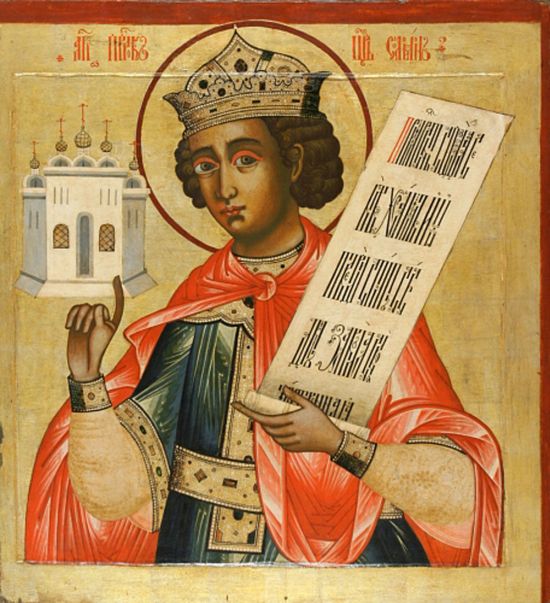
Prophet Solomon Commemorated December 17th


Prophet Solomon

No information available at this time.


Thanks to:

https://oca.org/saints/lives/2006/12/17/613-prophet-solomon


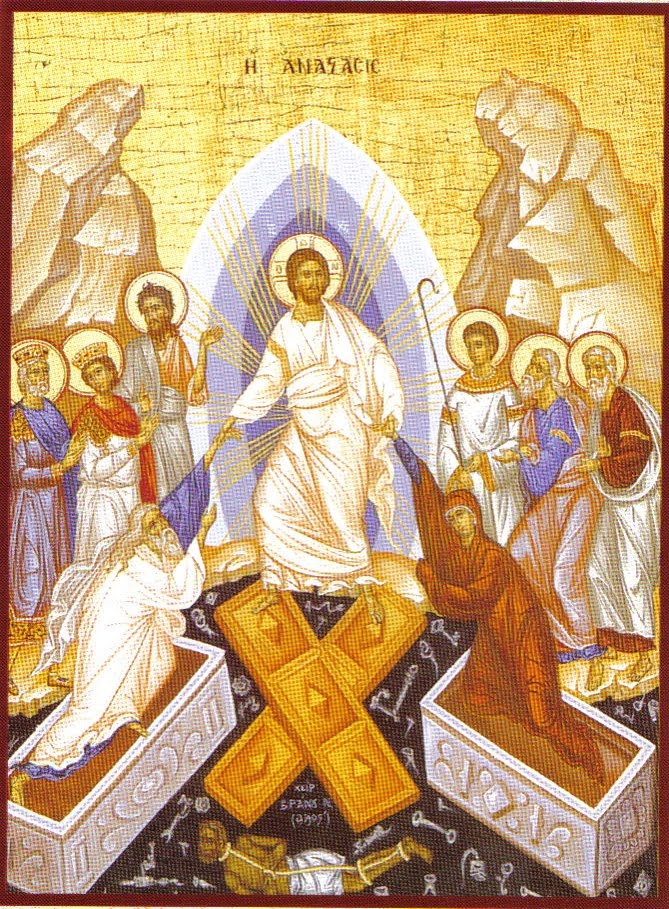
This icon shows King Solomon on the left in red (right of King David) with his father King David (far left) and in green (bottom) St. John the Forerunner. They are all recognizing Christ in hades lifting Adam and Eve from the grave:


Related image


Image result for descent into hades icon


Image result for descent into hades icon

Thoughts on King Solomon by Archpriest Father Gennady


Ecclesiastes Asks the Question, the Gospel Gives the Answer

ARCHPRIEST GENNADY FAST | 24 NOVEMBER 2012
Who among us has not heard or repeated such phrases as: “vanity of vanities, all is vanity,” “the wind returneth again according to his circuits,” or “there is no new thing under the sun”? Many people know that these are from the Book of Ecclesiastes (or, The Preacher) in the Bible. In most cases, those who have read this book enjoy its melancholy poetry with its vivid, surprising imagery. Others wonder what is Christian about this book and why the Church has accepted it as one of its sacred texts.
Quite brief compared to other Old Testament texts, Ecclesiastes (Qoheleth in Hebrew) was studied and commented on by the Holy Fathers of the Church; many volumes of modern studies have likewise been dedicated to it. We will discuss it here with Archpriest Gennady Fast, rector of the Church of Sts. Constantine and Helen in Abakan (capital of the Republic of Khakassia, Russia), biblical scholar, and author of many books about the Old Testament, including the recently published Commentary on the Book of Ecclesiastes [in Russian, 2009].
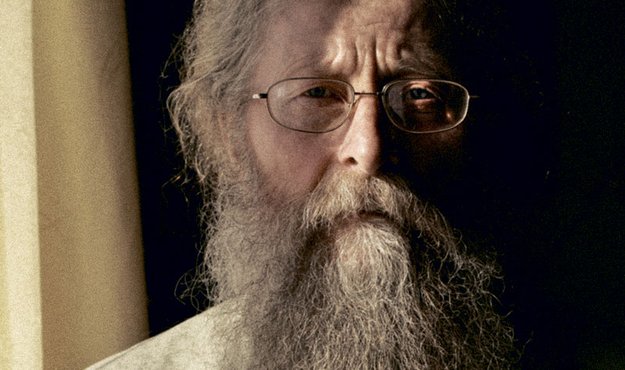
Archpriest Gennady Fast was born in 1954 in the Novosibirsk Oblast (in Siberia) into a deeply religious Lutheran family of exiled Russian Germans and was named Heinrich. After being expelled from Karaganda State University for his religious convictions, he studied physics at Tomsk University and later worked on the faculty of theoretical physics. Before graduating from university he converted to Orthodoxy and was baptized with the name Gennady. After being expelled from Tomsk University, he became a priest. He served in Tuva, in the Kemerovo Oblast, and in the Krasnoyarsk Krai. For many years he was rector of the ancient Dormition Church in Yeniseisk. He has trained scores of Siberian priests. He was, and remains, one of today’s most outstanding and well-known Orthodox missionaries. He is a biblical scholar and author of a number of books that have received wide distribution. At present he is rector of the Church of Sts. Constantine and Helen in Abakan.
Fr. Gennady Fast
Fr. Gennady, let us begin with authorship. Many of our readers will be surprised by the claim that the author of Ecclesiastes is the wise King Solomon, son of King David and builder of the Jerusalem Temple; in other words, that the unnamed Preacher and Solomon are one and the same person. One learns from your commentary that in his old age Solomon left his royal palace and his riches, dressed in rags, took up his staff, and went wandering along the roads, contemplating the vanity of all earthly things. Yet this is not in the Bible, just as there is no indication of Solomonic authorship. 
In 3 [1] Kings 11, it says that Solomon died and was buried in Jerusalem. Moreover, he died under unfortunate circumstances: under the influence of his wives, he fell into idolatry and provoked God’s wrath. It was only for the sake of David, Solomon’s father, that the Lord spared Israel and Jerusalem in those days. Nowhere is it written that Asmodeus cast Solomon from the Holy City and that he set out wandering along the roads… 
Indeed, there is a theory that Ecclesiastes came into being after the Babylonian captivity and was written by a later Hellenized Jew. This is due in part to the author’s philosophical inclination, which is much more characteristic of the culture of Greek antiquity than of Jewish culture. Likewise, philological analysis of the text forces one to consider a later origin. But this hypothesis can neither be proven nor disproven. Personally, I hold to the traditional, patristic point of view that the author of Ecclesiastes is Solomon. In patristic literature, Ecclesiastes was always viewed as being King Solomon’s repentance, the book he wrote after committing idolatry.
As far as the wandering along the roads with a staff is concerned, this is an ancient Judaic tradition contained in the Haggadah. The Holy Fathers accepted ancient Judaic traditions, many of which passed into patristic literature. I made use of this image – that of the stranger-king, of the king who rejects his kingdom for a pauper’s bundle – as a backdrop for reflecting on Ecclesiastes-Qoheleth. I think that this book could have arisen in just this way.
Yet there are no penitential motives in the text of Ecclesiastes, such as David’s Psalm 50… 
Yes, this is not David’s repentance! This is more likely a philosopher’s repentance, a reexamination of his entire life. The word “repentance” is here best used in the Greek sense: metanoia, turnabout, change. There were several turnabouts in Solomon’s life: his ardent love for God and Divine Wisdom in his youth; his active life in adulthood; and later, towards the end of his life, a surfeit of wealth and pleasure leading to questionable actions. We do not entirely know how deeply he fell into idolatry, but it is clear that he became bogged down by his polygamy and flirted with paganism. He was later overtaken not by the heartfelt contrition of his father David, but by a certain philosophical reevaluation of his existence.
So I was great, and increased more than all that were before me in Jerusalem: also my wisdom remained with me. And whatsoever my eyes desired I kept not from them; I withheld not my heart from any joy: for my heart rejoiced in all my labour; and this was my portion of all my labour. Then I looked on all the works that my hands had wrought, and on the labour that I had laboured to do: and behold, all was vanity and vexation of spirit, and there was no profit under the sun (Ecclesiastes 2:9-11).
Why did the question of the meaning of life arise in him, who was fully a man of the Old Testament? Why did it not arise among Abraham, Isaac, and Jacob, or among Moses, Joshua, Samuel, and David, among others? 
This is like asking why it was specifically Einstein who came up with the theory of relativity. Or why was it was specifically Pushkin who wrote Eugene Onegin. People are different; each has his own path and calling on this earth. The righteous of the Old Testament you list were deeply religious, but none of them chose wisdom as their main principle of life; they did not ask God for an understanding heart, as did Solomon at Gibeon (cf. 3 [1] Kings 3:9). Having received wisdom from God, Solomon served it all his life – and it is precisely this that never changed! He served wisdom when judging people, when he composed the Song of Songs, when he wrote Proverbs – the entire body of Solomonic books might be called books of wisdom. Therefore, it is not surprising that the philosophical problem of the overall meaning of life would arise specifically for Solomon.
Then said I in my heart, As it happeneth to the fool, so it happeneth even to me, and why was I then more wise? Then I said in my heart, that this also is vanity. For there is no remembrance of the wise more than of the fool for ever; seeing that which now is, in the days to come shall be forgotten. And how dieth the wise man? as the fool (Ecclesiastes 2:15-16).
The Righteous Prophet and King Solomon
But this might also be put differently. Solomon’s precursors in sacred history, the righteous of the Old Testament, were devoid of painful reflection. They knew how to live. They loved life. They were neither oppressed by its finitude nor frightened by death: they died with remarkable calm and had very little interest in what would happen to them after their deaths, or whether there would be anything at all. They were joyful when children were born to them, and it never entered their heads to ask: why was this child born, given that it will die anyway? When all is said and done, they were healthy! Compared to them, Solomon seems like a tortured intellectual, almost Chekhovian… 
Indeed, Solomon’s predecessors did not resemble him. They lived by faith and love for live, with which they were perfectly satisfied. They were not philosophers. The philosophical view of life is generally uncharacteristic of ancient Israel. The books of the Old Testament are not philosophical; they are historical and prophetic. The Ecclesiast is something of an exception. He really does seem to belong to another culture. This has provided the grounds for biblical criticism to doubt the identification of the Ecclesiast with Solomon. The Ecclesiast or Qoheleth – or, as we believe, Solomon – is someone who may not have had a deep religiosity. The Song of Songs makes no mention of the Creator. The Wisdom of Solomon could, with light editing, be used by atheists. God is mentioned there, but He is not central, and it is not He who governs all things. In this sense, Solomon is consistent: this is who he is, and he could be no other way. It is no accident that you draw a parallel between him and the Russian intelligentsia of the nineteenth century. That century we had St. Philaret of Moscow, the Optina Elders, Theophan the Recluse and, finally, Gogol and Dostoevsky, who led their readers – if not always evenly and smoothly – along the path of the Orthodox faith. We also had Leo Tolstoy, however. It is very hard to answer the question of what, for the Count, was lacking in Orthodoxy, or why he had so much dislike for it. In the case of the Qoheleth, we can say that God made us of him – and, by the way, God also made use of Tolstoy. I know many people who read Tolstoy during the Soviet era, because his work was easily accessible, and through him began to reflect on deeper spiritual problems. And this served as the impetus, in the long run, for them to come to Orthodoxy. On the contrary, I do not know of a single Orthodox person who, after having read Tolstoy, left Orthodoxy for Tolstoyanism. If Tolstoy had only known!
I said in my heart concerning the estate of the sons of men, that God might manifest them, and that they might see that they themselves are beasts. For that which befalleth the sons of men befalleth beasts; even one thing befalleth them: as the one dieth, so dieth the other; yea, they have all one breath, so that a man hath no pre-eminence above a beast: for all is vanity(Ecclesiastes 3:18-19).
Why, and on what religious basis, did Ecclesiastes become what it is? 
It became what it is because, in essence, it is asking a question. Ecclesiastes asks the question, the Gospel gives the answer. Neither Moses nor David asks questions; they are satisfied with what they receive directly from God. The Prophet Elias says: The Lord God of Israel liveth, before whom I stand (3 [1] Kings 17:1). What questions can he possibly have? But with Solomon… He was not an atheist, of course; he was a believing person, but he came close to the very edge of the abyss in which there is no God. At certain moments for him it is as if God vanishes. But God needs just such a person so that the question might be asked. Solomon is ruthlessly candid, and cannot find comfort in such customary phrases as “God will provide…” or “It’s all God’s will…”
He is, by the way, not entirely alone. The long-suffering Job likewise asks questions and likewise finds no comfort in such phrases. Nor does the Prophet Habakkuk find comfort in them: he climbs the tower and offers his complaint to God. But Solomon, unlike Job and Habakkuk, has no complaint for God. Perhaps they had these complaints because they felt God so closely. In comparison with them, Solomon is in some sense a wordly person; his complaint is not directed to God, but to a life that is completely meaningless. He had everything that this life can offer: immeasurable wealth, power, glory, honor – but now he sees no meaning in any of it. Ecclesiastes is not even about the meaning of life; it is about life’s meaninglessness. The author has an honest view, he is free of all self-delusion, he sees this meaninglessness without embellishment. Where is divine revelation in Ecclesiastes? Here is the paradox: it is in the fact that it leaves one without God. It allows one to see clearly what life without God is like. That is why this text is so dramatic, why there is the strain, intensity, and drama of a human soul that has lost all meaning.
I was struck by a phrase from your book: “Only in the desert of Ecclesiastes can one find the oasis of the Gospel.” However, this too is perplexing. Is it really only possible to approach God through the condition of the Ecclesiast, through the experience of meaninglessness and emptiness? Are there no other ways? 
You are not the only one who is perplexed. One journalist, who was outraged by my statement, said: neither Sergius of Radonezh, nor Seraphim of Sarov, nor John of Kronstadt needed any such desert in order to score the source of living water. But these words, which I have nonetheless left in the book, do not necessarily imply a chronological order: first the experience of desertedness, emptiness, meaninglessness – and then the Gospel. It happens in this order with some, but not with all. The saints mentioned here experienced the Ecclesiast’s desert in this sense: they experienced deeply the vanity and futility of this world and therefore renounced it. Otherwise they would not have had the revelations that were given to them. Whoever is perfectly satisfied with this world will never become a Sergius or a Seraphim, even if he knows the entire Psalter by heart. The emptiness of this world without God needs to be experienced inwardly so that it can later be filled by God.
Ecclesiastes is very current, very relevant to our times. It defines someone who participates in the consumer race, in the pursuit of pleasure, success, and empty amusements. Today I know people who have come to Christianity specifically through the Preacher’s book. By reading it one sees the godlessness of the world and sets off in search of God, finding Him in the Gospel. It is a great pity, of course, that people (the faithful included, alas!) today read so little and prefer lighter reading. But Ecclesiastes remains very much in demand and is still read, even if it is not wholly understood.
For God giveth to a man that is good in his sight, wisdom, and knowledge, and joy: but to the sinner he giveth travail, to gather and to heap up, that he may give to him that is good before God. This also is vanity and vexation of spirit (Ecclesiastes 2:26).
What is necessary in order to understand Ecclesiastes? 
A key of sorts to Ecclesiastes is the Hebrew word yitron, which appears nowhere else in the Bible. It means “remainder” or “profit.” It is what we sometimes call the bottom line. It answers the question: “With all this, what do we really have left?” The Ecclesiast needs an answer to this question and so puts everything to the test: wealth, poverty, women, wine, creative work, power, even piety. But the bottom line is that there is nothing left: everything is “vanity of vanities” and vexation of spirit.
For what hath man of all his labour, and of the vexation of his heart, wherein he hath laboured under the sun? For all his days are sorrows, and his travail grief; yea, his heart taketh not rest in the night. This is also vanity. There is nothing better for a man, than that he should eat and drink, and that he should make his soul enjoy good in his labour. This also I saw, that it was from the hand of God (Ecclesiastes 2:22-24).
But how is there nothing left? Solomon built the Temple, after all! In the Temple a miracle was manifest on the very first day and Solomon prayed for his people for generations to come (cf. 3 [1] Kings 8) – these pages cannot be forgotten! The Temple was still standing at that moment in history. It had not yet been destroyed! 
The Temple was standing. But this did not change anything. This is often the case in life. When we read Solomon’s prayer at the dedication of the Temple, we see that the Temple was filled with the divine presence – truly the Shekhinah. But then nothing was left. Solomon-Ecclesiast does not even mention the Temple a single time! (This, incidentally, causes biblical critics to doubt King Solomon’s authorship. But, in some sense, this is of no importance to us.) The Apostle Paul warns us that it is quite possible to preach to others and remain a castaway oneself (cf. 1 Corinthians 9:27). Such tragedies happen to people, even to priests – there is such a thing as burnout. I have seen burned-out priests, among whom were men who were talented, intelligent, and by no means devoid of moral qualities. They had all been quite zealous in their time. But then some inner disillusionment came along and the mundane crept into their lives. The same thing happened with the Ecclesiast. He built the Temple, but he did not gain the higher good – the yitron.
But a burned-out priest most likely has himself to blame, and so too with the Ecclesiast… 
Perhaps. If Solomon had always maintained the temperament he had on the day the Temple was dedicated, would idols have appeared in Jerusalem? But they did appear. Yes, the Ecclesiast’s story is that of a fall or emptying. He was full and became empty. For nothing under the sun has this yitron. For in fact, yitron is what is above the sun.
But besides the word yitron, there is another key word needed for understanding Ecclesiastes: tov. Unlike the first word, it is common in both ancient Hebrew and in Holy Scripture, beginning with the first chapters of Genesis. It means “good” or “fine.” That which is good is tov. Everything, as we have already said, that Solomon tested – riches, glory, women, wine, labor, piety – was in fact good, tov. Reading the text of Ecclesiastes, we see how he repeatedly tries to climb to the summit in order to reach the desired yitron, but for some reason is unable. Not wanting to fall all the way to the bottom, where there is sin and perdition, he settles into a kind of average human happiness, into this tov. But for some reason, the philosopher cannot stay for long in this common human happiness. Again clambering to the summit, he again falls down and looks for comfort in the common tov, which he does not find. It is this hovering between the ordinary good and the loftier, imperishable good that defines the state of soul of the Qoheleth, the philosopher.
Behold that which I have seen: it is good and comely for one to eat and to drink, and to enjoy the good of all his labor that he taketh under the sun all the days of his life, which God giveth him: for it is his portion (Ecclesiastes 5:18).
Was it not this drama that attracted Christian ascetics to Ecclesiastes?
It served as a sort of justification for what they were doing. After all, Ecclesiastes is a book about the meaninglessness of life in its more positive aspects. Note that the author does not reflect on suffering, illness, crime, war, and so on. He reflects on the normal, positive condition of man – what is normally considered happiness. Happiness is that same tov in which there is no yitron. In the Gospel there is no concept of happiness whatsoever; rather, there is a different concept: blessedness. Blessedness is yitron, a loftier attainment. Remember the rich youth who went away from Christ sorrowful (cf. Matthew 19:16-22; Mark 10:17-22; Luke 18:18-23)? He was offered tov – average wellbeing and piety (“keep the commandments”). But this did not satisfy him. But to part with his wellbeing and wealth for the sake of blessedness and treasure in heaven – this he could not do (cf. Matthew 19:21).
Christian ascetics consciously gave up the world in its vain manifestations, denying themselves seemingly blameless and God-created pleasures – but this was not a rejection of sin. This was a rejection of tov, of the good, because in this good, there is no yitron, the highest good.
You dedicate an entire chapter of your book to the Ecclesiast’s antimonies, the most famous of which is: A time to cast away stones, and a time to gather stones together (Ecclesiastes 3:5). What is their moral and spiritual meaning? 
To everything there is a season, and a time to every purpose under the heaven (Ecclesiastes 3:1). People often do not know which season it now is, or they think that an entire season is for one thing alone. But life is dialectical; the laws of dialectics have never been repealed. Someone who is a Christian, who lives in the Holy Spirit, should be able to feel the season with particular sensitivity. His actions might be contradictory: he might punish or forgive, strike out or give healing. There is a well-known incident from the life of St. Luke (Voyno-Yasenetsky) of Crimea: he saw some members of the Komsomol [Young Communist League] placing a ladder against the wall of a church in order to climb onto the roof and remove the cross. The saint wrathfully shook the ladder and they fell down and were hurt. Then he took them to the hospital and treated them: to everything there is a season. Or take Admiral Ushakov, about whom many people still ask why he was glorified among the saints and where his holiness lies. His cannons destroyed the Turkish squadron and the Turks started drowning – so he sent his sailors out on lifeboats to saves them and pull them out of the water: it was the season to show mercy. Divine Sophia, Wisdom, is manifest in a person when he knows the season.
Ecclesiastes has a very powerful moral charge. Its author is a very moral person – in other words, a man of righteousness. For him a wise life is a righteous life. But there is also the assertion that righteousness is meaningless. How do these things go together? 
This is the Ecclesiast’s tragedy! He is unable to live immorally, he encourages piety, but all the while he sees the futility of piety without God. Here we can call to mind our Communists, among whom were people of high morals, people who gave their life in the war… But those whom I was able to encounter could no longer believe in any sort of communism. They urged people to work, to live honorably and according to the laws of communist morality, and they did not feel any discomfort in this – so long as they did not look inward, so long as they were not inclined to Russian soul-searching. They were like the Preacher, which again confirms that every time and generation can see itself in the Ecclesiast.
God does not lose people who have lost Him. Someone might not have God and has emptiness instead, but God does not leave him because he lives morally; he neither can nor wants to fall below a certain moral level. In principle, this is characteristic of any person; even criminals create their own moral code, which they call “living by the rules.”
I returned, and saw under the sun, that the race is not to the swift, nor the battle to the strong, neither yet bread to the wise, nor yet riches to men of understanding, nor yet favour to men of skill; but time and chance happenteth to them all. For man also knoweth not his time: as the fishes that are taken in an evil net, and as the birds that are caught in the snare; so are the sons of men snared in an evil time, when it falleth suddenly upon them (Ecclesiastes 9:11-12).
Solomon was a wise man and a philosopher, but not a prophet… Yet you write that there is testimony concerning the coming Messiah in his book… 
There is a text that allows for messianic interpretation, in chapter 4, beginning with verse 13, about the child who is born poor into his kingdom: There is no end of all the people, even of all that have been before them: they also that come after shalt not rejoice in him. Surely this also is vanity and vexation of spirit (4:16).
But how is this messianic, if it is all vanity? 
Many walk with this Child, with Christ – this is the mass conversion of the nations to Christianity. They that come after that will not rejoice – this is apostasy, growing cool, falling away. For how many nations today is faith in Christ only a vestige, only the remains of a tradition? Christmas, the beloved winter holiday for families, no longer has anything to do with Christ. We live in an epoch that is called post-Christian… The text of Ecclesiastes shows that Christianity itself is no exception, that its historical path follows the same cycle: rise is followed by decline, ardor by frigidity. Although ultimately the gates of hell shall not prevail against the Church (cf. Matthew 16:18) and the Bridegroom will come for His bride. Everything done for the Lord’s sake is good; Orthodox empires with magnificent churches are good. But then enemies come, or rebellion breaks out, and the churches are emptied and destroyed. The way out of this cycle is only the Eighth Day, when the cycle will be completed with the appearance of the Lord in glory. But for us, living today, the way out is holiness, it is the Kingdom of God that we await as coming, but which we have already now. When in the Liturgy we exclaim “Blessed is the Kingdom,” we are blessing the Kingdom that is here and now, in which we are. This is the way out of the vicious circle, including the cycle of Christian history, that Solomon did not see. Ultimately, yitron is the Lord Himself – the Lord, Who is everywhere and in everything. An ancient Paterikon tells the story of a monk who could attend the Paschal services because every year he was assigned to the kitchen. This was a serious deprivation for him, and he dreamed of at least hearing how they sang “Christ is Risen.” But the Lord consoled him with apples from Paradise, with which he was able to treat the brethren returning from the service in the morning.
Interview conducted by Marina Biriukova.
Translated from the Russian.
thanks to: 
http://www.pravmir.com/ecclesiastes-asks-the-question-the-gospel-gives-the-answer/