Total Pageviews

Search This Blog

Friday, June 12, 2020

Sayings by Justice Scalia


"The difficulty of overcoming the effects of past discrimination is as nothing compared with the difficulty of eradicating from our society the source of those effects, which is the tendency -- fatal to a Nation such as ours -- to classify and judge men and women on the basis of their country of origin or the color of their skin. A solution to the first problem that aggravates the second is no solution at all."


-Justice Scalia's judgement in the case City of Richmond v. J. A. Croson Co.: January 23, 1989


https://www.mtholyoke.edu/~jesan20l/classweb/pright.html

Saturday, June 6, 2020

Orthodox differences with Roman Catholic on Purgatory and Indulgences


(green italics added by me)


Purgatory and Indulgences

The teaching on purgatory is one of the characteristic differences that distinguish the Roman Catholic confession from the Orthodox Church. According to the teaching of the Catholics, the souls of Christians who have died, if the Lord deems them pure, are sent straight to paradise, while the souls of men who are weighed down by mortal sins are sent to Hades. But Catholics also believe that in the life beyond the grave there exists as well the so-called purgatory (from the Latin, purgatorium) - a special state between paradise and Hades, wherein are found the souls of those who died with repentance for their sins, but who did not succeed on earth in offering satisfaction to God for their sins, and also of those who for some reason or other did not repent of their sins of little importance, for which it would be cruel to send them to eternity in Hades, but impossible also to allow them straight into paradise. In purgatory, the souls burn in a purifying fire; when their sins are expiated, they can receive admittance to paradise. Here, in the course of a certain period, depending on the importance and quantity of their sins, the souls of the dead suffer various tortures, and by these torments they pay for their sins committed on earth, but not yet paid for. When the period of torments ends, when the debt to God's justice is paid in full, the soul passes from purgatory to paradise. Purgatory will exist until the Second Coming of Christ; but the souls of sinners that go thither will not await the Dread Judgement there. Each soul will stay in purgatory as much time as necessary to expiate its sins. The lot of the soul in purgatory depends not only on its repentance, but also on the prayers raised up for it on earth. With the help of masses, prayers and good works performed in memory of the dead by the faithful on earth, the lot of the soul in purgatory can be alleviated and the period of its stay there can be shortened.
As proof of the existence of purgatory and the possibility of forgiveness of some sins in the life beyond the grave, Catholics cite mainly two passages from Sacred Scripture: 1) "And whosoever speaketh a word against the Son of man, it shall be forgiven him: but whosoever speaketh against the Holy Ghost, it shall not be forgiven him, neither in this world, neither in the world to come" (Matthew 12:32); 2) "Every man's work shall be made manifest: for the day shall declare it, because it shall be revealed by fire; and the fire shall try every man's work of what sort it is (I Corinthians 3:13). In the first passage, Catholics see a distinction between sins forgiven during earthly life and sins forgiven in the life beyond the grave. They understand the second citation, about the fire that tries every man's works, in a literal and not in a figurative sense. The Orthodox Church understands the Apostle Paul's words, "the fire shall try", in that sense in which the Fathers of the Church of the post-apostolic age explain them, i.e., in the sense of experience or trial, but not in the sense of fiery torments (see, for example, "The Teaching of the Twelve Apostles").
The teaching on purgatory was elaborated and developed in detail by Thomas Acquinas and finally accepted as dogma at the Council of Florence in 1439.
Some confuse the Latin teaching on purgatory with the Orthodox teaching on the custom houses. The custom houses are only the figurative representations of the particular judgment, which is inescapable for each man; the way from purgatory is to paradise, while the way from the custom houses is both to paradise and to Hades. Nevertheless, in its basic idea, the Latin teaching on paradise has some similarity to the Orthodox teaching on the state of dead men's souls until the general resurrection. This similar-ity lies in the common teaching that the souls of some of the dead, having undergone torments for their sins, can, however, receive forgiveness of sins and alleviation of their torments or even full release from them. According to the teaching of the Orthodox Church, this alleviation of torments or even the complete release from them is received by the soul of one who has fallen asleep by virtue of the prayers and benefactions of members of Christ's Church, whereas, according to the Latin teaching, the souls of dead men receive forgiveness of sins in purgatory by virtue of the purgatorial torments themselves, by which they personally offer satisfaction to God's justice and through this purify their sins.
The period of torments in purgatory can be shortened, according to the teaching of the Catholics, by way of papal indulgences. An indulgence is the forgiveness or the reduction of the temporal punishment that a sinner must undergo for the satisfaction of God's righteousness, after his guilt and the eternal punishment for sins are absolved, through his assimilation, by means of the Roman bishop, of the Saviour's surplus merits and the supererogatory good works of the Theotokos and the saints, outside of the sacrament of repentance. These indulgences are given to living men, who are released by them from the obligation to offer satisfactions and to fulfill penances for certain sins, and to the dead, for whom the period of torment in purgatory is shortened. These indulgences, in accordance with God's great mercy and in accordance with the pope's condescension, can be given out gratis for some pious deed - a journey to holy places (to Rome, for example), for beneficial social undertakings, for some service and donation in the pope's behalf. Indulgences are plenary, which extend to one's whole life and to all one's sins, and partial - to several days or years. Additionally, there are great indulgences, which are given at a certain time to the whole Catholic world, or to a whole country, or to all Christians who are in Rome on some special occasions: for example, during the solemn celebration of jubilees in the Roman Church or during the election of a new pope. These indulgences are given personally by the pope himself, or through the cardinal penitentiary or through bishops and other members of the ecclesiastical hierarchy. In Catholic countries there are special, privileged churches, chapels, altars, icons and statues before which everyone who desires may pray and receive an indulgence for several days. The grace of indulgences may be acquired in certain types of medals, rosaries and crosses hallowed in Rome.
The profitableness of indulgences led to their greater and greater growth and to the search for new occasions for granting them. Not without the influence of financial motives was the theory of indulgences itself worked out as well - frankly, their advocates and sellers were guided by monetary interests. Already long ago, all this evoked a protest against indulgences themselves and against the papacy's trafficking in them. Attacks on indulgences were some of the first features of the reformation movement. It goes without saying that this mediæval teaching on indulgences was completely unknown in the ancient, undivided Church and is unacceptable to us, since it contradicts the whole spirit of Orthodoxy.
©V. Potapov, 1996-98


thanks to:


Tuesday, June 2, 2020

Suffering ~ Christ the Eternal Tao

CHRIST The Eternal Tao

I give you no formulas, says the Way,
I give you no equations.

But I will heal you in my own time,
In my own way,
Imperceptible to you.
Your mind races, seeking a solution;
But there is no solution that can be grasped by the mind.
Your mind tries every avenue,
Thinking that at least one will open up suddenly on the 
    longed-for goal:
Freedom from pain.
But every avenue is a dead-end;
You are up against the wall,
That is because the pain is there for a reason.
It is like a maddening fever that burns up and drives out
  disease.
By it alone do I heal you:
Without it you will die in your sickness.
By it alone do I change you unto perfection:
Without it you will be as a foreigner in my Kingdom.

Seek no formula
Seek no equation.

Only be patient:
Wait on me
While I do my unseen work inside you.
When you are changed and fit for my Kingdom,
You will know that something happened,
And that is all you will know.
But there is no need for thought.
Enter, then, into my joy,
You who have waited, in devotion, in my pain.


CHRIST The Eternal Tao ~ Hieromonk Damascene
(Chapter 71 pg. 196-97 )

Thanks also to Lao Tzu, Gi-Ming Shien and Fr. Seraphim Rose

Wednesday, March 25, 2020

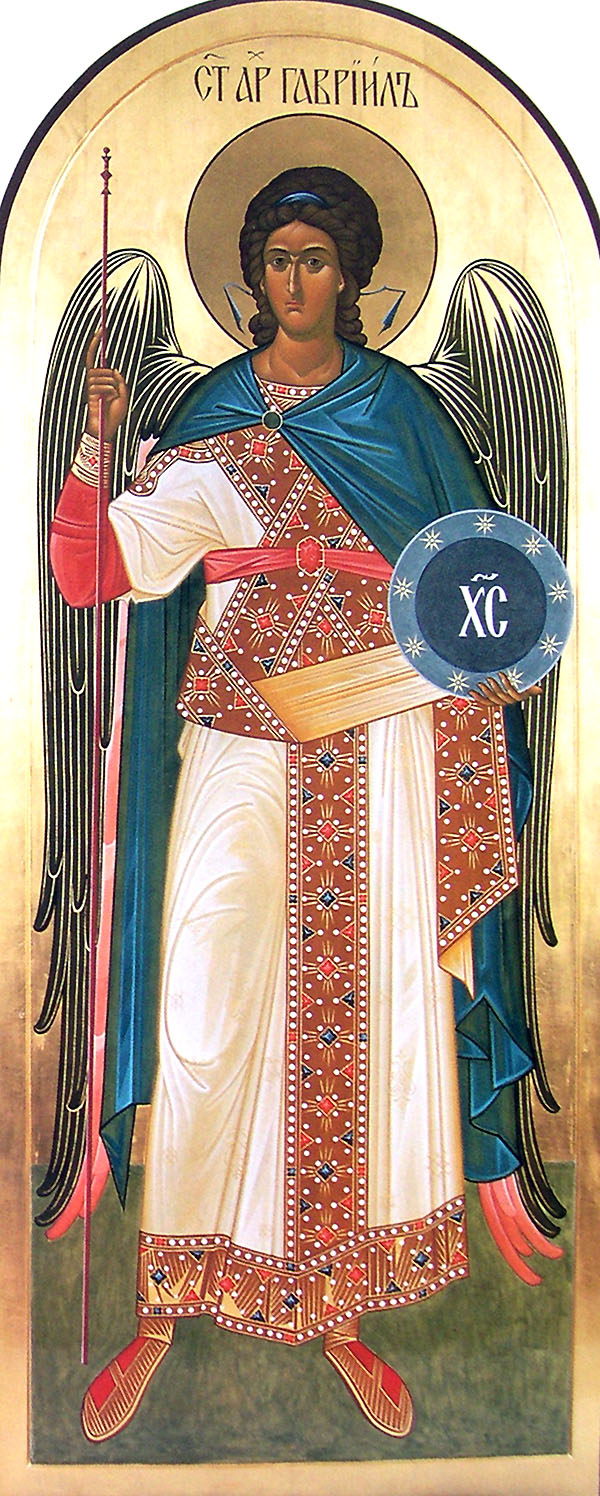
Synaxis of the Archangel Gabriel ~ Commemorated on March 26


Synaxis of the Archangel Gabriel

Synaxis of the Holy Archangel Gabriel: The Archangel Gabriel was chosen by the Lord to announce to the Virgin Mary about the Incarnation of the Son of God from Her, to the great rejoicing of all mankind. Therefore, on the day after the Feast of the Annunciation, the day on which the All-Pure Virgin is glorified, we give thanks to the Lord and we venerate His messenger Gabriel, who contributed to the mystery of our salvation.
Gabriel, the holy Archistrategos (Leader of the Heavenly Hosts), is a faithful servant of the Almighty God. He announced the future Incarnation of the Son of God to those of the Old Testament; he inspired the Prophet Moses to write the Pentateuch (first five books of the Old Testament), he announced the coming tribulations of the Chosen People to the Prophet Daniel (Dan. 8:16, 9:21-24); he appeared to Saint Anna (July 25) with the news that she would give birth to the Virgin Mary.
The holy Archangel Gabriel remained with the Holy Virgin Mary when She was a child in the Temple of Jerusalem, and watched over Her throughout Her earthly life. He appeared to the Priest Zachariah, foretelling the birth of the Forerunner of the Lord, Saint John the Baptist.
The Lord sent him to Saint Joseph the Betrothed in a dream, to reveal to him the mystery of the Incarnation of the Son of God from the All-Pure Virgin Mary, and warned him of the wicked intentions of Herod, ordering him to flee into Egypt with the divine Infant and His Mother.
When the Lord prayed in the Garden of Gethsemane before His Passion, the Archangel Gabriel, whose very name signifies “Man of God” (Luke. 22:43), was sent from Heaven to strengthen Him.
The Myrrh-Bearing Women heard from the Archangel the joyous news of Christ’s Resurrection (Mt.28:1-7, Mark 16:1-8).
Mindful of the manifold appearances of the holy Archangel Gabriel and of his zealous fulfilling of God’s will, and confessing his intercession for Christians before the Lord, the Orthodox Church calls upon its children to pray to the great Archangel with faith and love.
The Synaxis of the Holy Archangel Gabriel is also celebrated on July 13. All the angels are commemorated on November 8.

Thanks:

Friday, March 13, 2020

On Fasting ~ St. Symeon the New Theologian


...for fasting is the beginning and foundation of every spiritual activity'.
  

Symeon the New Theologian: the Discourses, pub. Paulist Press. pp. 168-169.


thanks to:
http://www.abbamoses.com/fasting.html

Wednesday, February 26, 2020

Saint Porphyrius, Bishop of Gaza ~ Commemorated on February 26


Saint Porphyrius, Bishop of Gaza

Saint Porphyrius, Archbishop of Gaza, was born about the year 346 at Thessalonica. His parents were people of substance, and this allowed Saint Porphyrius to receive a fine education. Having the inclination for monastic life, he left his native region at twenty-five years of age and set off for Egypt, where he lived in the Nitrian desert under the guidance of Saint Macarius the Great (January 19). There he also met Saint Jerome (June 15), who was then visiting the Egyptian monasteries. He went to Jerusalem on pilgrimage to the holy places, and to venerate the Life-Creating Cross of the Lord (September 14), then he moved into a cave in the Jordanian wilderness for prayer and ascetic deeds.
After five years, Saint Porphyrius was afflicted with a serious malady of the legs. He decided to go to the holy places of Jerusalem to pray for healing. As he lay half-conscious at the foot of Golgotha, Saint Porphyrius fell into a sort of trance. He beheld Jesus Christ descending from the Cross and saying to him, “Take this Wood and preserve it.”
Coming out of his trance, he found himself healthy and free from pain. Then he gave away all his money to the poor and for the adornment of the churches of God. For a time he supported himself by working as a shoemaker. The words of the Savior were fulfilled when the saint was forty-five years old. The Patriarch of Jerusalem ordained Saint Porphyrius to the holy priesthood and appointed him custodian of the Venerable Wood of the Cross of the Lord.
In 395 the bishop of the city of Gaza (in Palestine) died. The local Christians went to Caesarea to ask Metropolitan John to send them a new bishop who would be able to contend against the pagans, which were predominant in their city and were harassing the Christians there. The Lord inspired the Metropolitan to summon the priest Porphyrius. With fear and trembling the ascetic accepted the office of bishop, and with tears he prostrated himself before the Life-Creating Wood and went to fulfill his new obedience.
In Gaza there were only three Christian churches, but there were a great many pagan temples and idols. During this time there had been a long spell without rain, causing a severe drought. The pagan priests brought offerings to their idols, but the woes did not cease. Saint Porphyrius imposed a fast for all the Christians; he then served an all-night Vigil, followed by a church procession around the city. Immediately the sky covered over with storm clouds, thunder boomed, and abundant rains poured down. Seeing this miracle, many pagans cried out, “Christ is indeed the only true God!” As a result of this, 127 men, thirty-five women and fourteen children were united to the Church through Holy Baptism, and another 110 men soon after this.
The pagans continued to harass the Christians. They passed them over for public office, and burdened them with taxes. Saint Porphyrius and Metropolitan John of Caesarea journeyed to Constantinople to seek redress from the emperor. Saint John Chrysostom (September 14, January 27 and 30) received them and assisted them.
Ss. John and Porphyrius were presented to the empress Eudoxia who was expecting a child at that time. “Intercede for us,” said the bishops to the empress, “and the Lord will send you a son, who shall reign during your lifetime”. Eudoxia very much wanted a son, since she had given birth only to daughters. Through the prayer of the saints an heir was born to the imperial family. As a result of this, the emperor issued an edict in 401 ordering the destruction of pagan temples in Gaza and the restoration of privileges to Christians. Moreover, the emperor gave the saints money for the construction of a new church, which was to be built in Gaza on the site of the chief pagan temple.
Saint Porphyrius upheld Christianity in Gaza to the very end of his life, and guarded his flock from the vexatious pagans. Through the prayers of the saint numerous miracles and healings occurred. The holy archpastor guided his flock for twenty-five years, and reposed in 420 at an advanced age.

thanks to:

Wednesday, February 5, 2020

Sayings ~ On Fasting


Sayings on Fasting

St Symeon the New Theologian:'Let each one of us keep in mind the benefit of fasting... For this healer of our souls is effective, in the case of one to quieten the fevers and impulses of the flesh, in another to assuage bad temper, in yet another to drive away sleep, in another to stir up zeal, and in yet another to restore purity of mind and to set him free from evil thoughts. In one it will control his unbridled tongue and, as it were by a bit, restrain it by the fear of God and prevent it from uttering idle and corrupt words. In another it will invisibly guard his eyes and fix them on high instead of allowing them to roam hither and thither, and thus cause him to look on himself and teach him to be mindful of his own faults and shortcomings. Fasting gradually disperses and drives away spiritual darkness and the veil of sin that lies on the soul, just as the sun dispels the mist. Fasting enables us spiritually to see that spiritual air in which Christ, the Sun who knows no setting, does not rise, but shines without ceasing. Fasting, aided by vigil, penetrates and softens hardness of heart. where once were the vapors of drunkenness it causes fountains of compunction to spring forth. I beseech you, brethren, let each of us strive that this may happen in us! Once this happens we shall readily, with God's help, cleave through the whole sea of passions and pass through the waves of the temptations inflicted by the cruel tyrant, and so come to anchor in the port of impassibility.
  'My brethren, it is not possible for these things to come about in one day or one week! They will take much time, labor, and pain, in accordance with each man's attitude and willingness, according to the measure of faith and one's contempt for the objects of sight and thought. In addition, it is also in accordance with the fervor of his ceaseless penitence and its constant working in the secret chamber of his heart that this is accomplished more quickly or more slowly by the gift and grace of God. But without fasting no one was ever able to achieve any of these virtues or any others, for fasting is the beginning and foundation of every spiritual activity'.
  — Symeon the New Theologian: the Discourses, pub. Paulist Press. pp. 168-169.

Mother Gavrilia of blessed memory spent much time traveling in the service of Christ to places that separated her from the daily liturgical life of the Church. Especially during these times, the advice of her spiritual father Archimandrite Lazarus Moore stood her in good stead:
  'Fasting is one of our greatest weapons against the Evil One. I will repeat what Father Lazarus told me once. In 1962, I went to the USA. I stayed there a long time and travelled to many states. The letters of Father Lazarus were a great help... He used to say: "Go anywhere you like, do whatever you like, as long as you observe Fasting"... Because not a single arrow of the Evil One can reach you when you fast. Never.'
  — Ascetic of Love, the biography of Mother Gavrilia, pub. Series Talanto. pg. 200.

St Seraphim of Sarov on Fasting: 'Once there came to him a mother who was concerned about how she might arrange the best possible marriage for her young daughter. When she came to Saint Seraphim for advice, he said to her: "Before all else, ensure that he, whom your daughter chooses as her companion for life, keeps the fasts. If he does not, then he is not a Christian, whatever he may consider himself to be."'
  — From a sermon of Metropolitan Philaret, quoted in The Ladder of Divine Ascent, pub. Holy Trinity Monastery, pg.xxxiii.

Abba Daniel of Sketis: 'In proportion as the body grows fat, so does the soul wither away.'

notes:

The rules given here are of course only one part, the most external part, of a true fast, which will include increased prayer and other spiritual disciplines, and may include resolutions to set aside other aspects of our day-to-day life (such as caffeine or television), or to take up practices such as visiting the sick.

Obviously, many Orthodox do not keep the traditional rule. If you adopt it, beware of pride, and pay no attention to anyone's fast but your own. As one monastic put it, we must "keep our eyes on our own plates."

Do not substitute the notion of "deciding what to give up for Lent" for the rule that the Church has given us. First, keep the Church's fasting rule as well as you are able, then decide on additional disciplines, in consultation with your priest.

We are always advised to fast according to our strength, and you may find from experience that you need to modify the fasting rule to fit your own strength and situation. But do not assume beforehand that the rule is too difficult for you. The Lord is our strength, and can uphold us in marvelous and unforseen ways.

Those who attempt to keep the Church's traditional fast will find that, though the temptations to pride and legalism are real, the spiritual benefits are great. A return to more diligent fasting could play a large part in the spiritual renewal of our Orthodox churches.

thanks to:
and if you want to read more...