CHRIST The Eternal Tao
I give you no formulas, says the Way,
I give you no equations.
But I will heal you in my own time,
In my own way,
Imperceptible to you.
Your mind races, seeking a solution;
But there is no solution that can be grasped by the mind.
Your mind tries every avenue,
Thinking that at least one will open up suddenly on the
longed-for goal:
Freedom from pain.
But every avenue is a dead-end;
You are up against the wall,
That is because the pain is there for a reason.
It is like a maddening fever that burns up and drives out
disease.
By it alone do I heal you:
Without it you will die in your sickness.
By it alone do I change you unto perfection:
Without it you will be as a foreigner in my Kingdom.
Seek no formula
Seek no equation.
Only be patient:
Wait on me
While I do my unseen work inside you.
When you are changed and fit for my Kingdom,
You will know that something happened,
And that is all you will know.
But there is no need for thought.
Enter, then, into my joy,
You who have waited, in devotion, in my pain.
CHRIST The Eternal Tao ~ Hieromonk Damascene
(Chapter 71 pg. 196-97 )
Thanks also to Lao Tzu, Gi-Ming Shien and Fr. Seraphim Rose
Tuesday, June 2, 2020


Wednesday, March 25, 2020
Synaxis of the Archangel Gabriel ~ Commemorated on March 26
Synaxis of the Archangel Gabriel
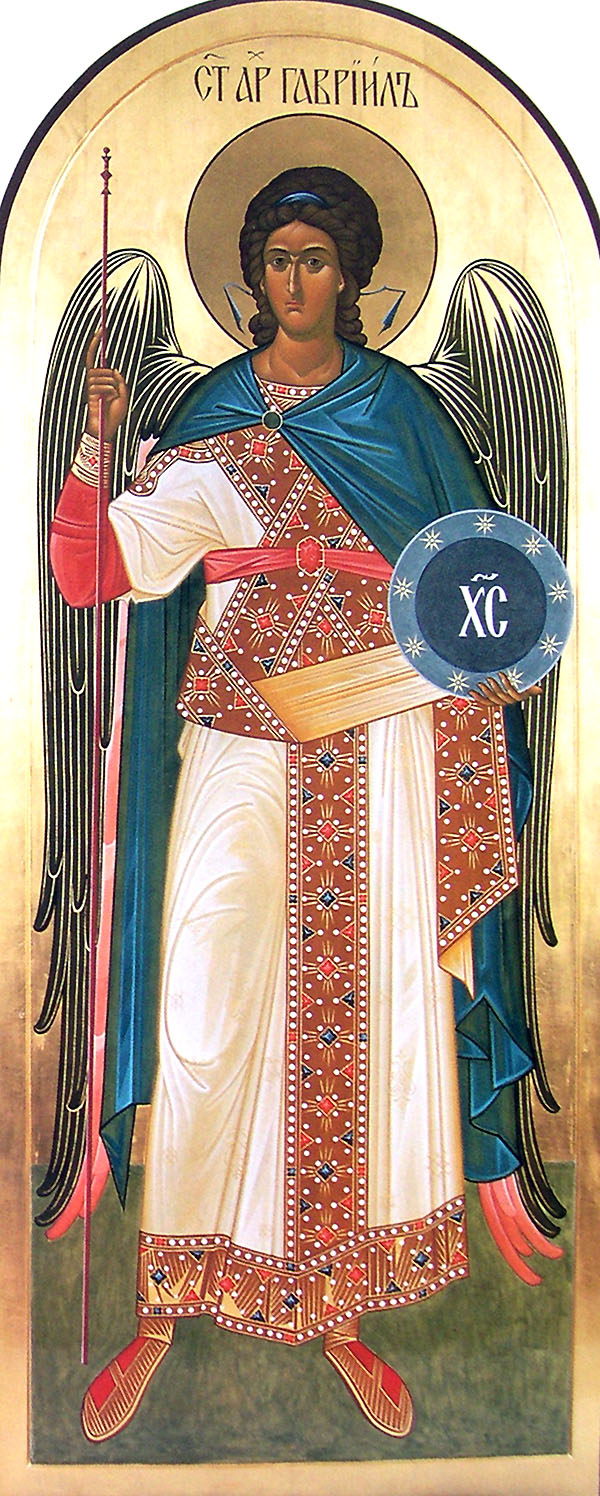

Synaxis of the Holy Archangel Gabriel: The Archangel Gabriel was chosen by the Lord to announce to the Virgin Mary about the Incarnation of the Son of God from Her, to the great rejoicing of all mankind. Therefore, on the day after the Feast of the Annunciation, the day on which the All-Pure Virgin is glorified, we give thanks to the Lord and we venerate His messenger Gabriel, who contributed to the mystery of our salvation.
Gabriel, the holy Archistrategos (Leader of the Heavenly Hosts), is a faithful servant of the Almighty God. He announced the future Incarnation of the Son of God to those of the Old Testament; he inspired the Prophet Moses to write the Pentateuch (first five books of the Old Testament), he announced the coming tribulations of the Chosen People to the Prophet Daniel (Dan. 8:16, 9:21-24); he appeared to Saint Anna (July 25) with the news that she would give birth to the Virgin Mary.
The holy Archangel Gabriel remained with the Holy Virgin Mary when She was a child in the Temple of Jerusalem, and watched over Her throughout Her earthly life. He appeared to the Priest Zachariah, foretelling the birth of the Forerunner of the Lord, Saint John the Baptist.
The Lord sent him to Saint Joseph the Betrothed in a dream, to reveal to him the mystery of the Incarnation of the Son of God from the All-Pure Virgin Mary, and warned him of the wicked intentions of Herod, ordering him to flee into Egypt with the divine Infant and His Mother.
When the Lord prayed in the Garden of Gethsemane before His Passion, the Archangel Gabriel, whose very name signifies “Man of God” (Luke. 22:43), was sent from Heaven to strengthen Him.
The Myrrh-Bearing Women heard from the Archangel the joyous news of Christ’s Resurrection (Mt.28:1-7, Mark 16:1-8).
Mindful of the manifold appearances of the holy Archangel Gabriel and of his zealous fulfilling of God’s will, and confessing his intercession for Christians before the Lord, the Orthodox Church calls upon its children to pray to the great Archangel with faith and love.
The Synaxis of the Holy Archangel Gabriel is also celebrated on July 13. All the angels are commemorated on November 8.
Thanks:
Friday, March 13, 2020
On Fasting ~ St. Symeon the New Theologian
...for fasting is the beginning and foundation of every spiritual activity'.
~ Symeon the New Theologian: the Discourses, pub. Paulist Press. pp. 168-169.
thanks to:
http://www.abbamoses.com/fasting.html
thanks to:
http://www.abbamoses.com/fasting.html
Wednesday, February 26, 2020
Saint Porphyrius, Bishop of Gaza ~ Commemorated on February 26
Saint Porphyrius, Bishop of Gaza


Saint Porphyrius, Archbishop of Gaza, was born about the year 346 at Thessalonica. His parents were people of substance, and this allowed Saint Porphyrius to receive a fine education. Having the inclination for monastic life, he left his native region at twenty-five years of age and set off for Egypt, where he lived in the Nitrian desert under the guidance of Saint Macarius the Great (January 19). There he also met Saint Jerome (June 15), who was then visiting the Egyptian monasteries. He went to Jerusalem on pilgrimage to the holy places, and to venerate the Life-Creating Cross of the Lord (September 14), then he moved into a cave in the Jordanian wilderness for prayer and ascetic deeds.
After five years, Saint Porphyrius was afflicted with a serious malady of the legs. He decided to go to the holy places of Jerusalem to pray for healing. As he lay half-conscious at the foot of Golgotha, Saint Porphyrius fell into a sort of trance. He beheld Jesus Christ descending from the Cross and saying to him, “Take this Wood and preserve it.”
Coming out of his trance, he found himself healthy and free from pain. Then he gave away all his money to the poor and for the adornment of the churches of God. For a time he supported himself by working as a shoemaker. The words of the Savior were fulfilled when the saint was forty-five years old. The Patriarch of Jerusalem ordained Saint Porphyrius to the holy priesthood and appointed him custodian of the Venerable Wood of the Cross of the Lord.
In 395 the bishop of the city of Gaza (in Palestine) died. The local Christians went to Caesarea to ask Metropolitan John to send them a new bishop who would be able to contend against the pagans, which were predominant in their city and were harassing the Christians there. The Lord inspired the Metropolitan to summon the priest Porphyrius. With fear and trembling the ascetic accepted the office of bishop, and with tears he prostrated himself before the Life-Creating Wood and went to fulfill his new obedience.
In Gaza there were only three Christian churches, but there were a great many pagan temples and idols. During this time there had been a long spell without rain, causing a severe drought. The pagan priests brought offerings to their idols, but the woes did not cease. Saint Porphyrius imposed a fast for all the Christians; he then served an all-night Vigil, followed by a church procession around the city. Immediately the sky covered over with storm clouds, thunder boomed, and abundant rains poured down. Seeing this miracle, many pagans cried out, “Christ is indeed the only true God!” As a result of this, 127 men, thirty-five women and fourteen children were united to the Church through Holy Baptism, and another 110 men soon after this.
The pagans continued to harass the Christians. They passed them over for public office, and burdened them with taxes. Saint Porphyrius and Metropolitan John of Caesarea journeyed to Constantinople to seek redress from the emperor. Saint John Chrysostom (September 14, January 27 and 30) received them and assisted them.
Ss. John and Porphyrius were presented to the empress Eudoxia who was expecting a child at that time. “Intercede for us,” said the bishops to the empress, “and the Lord will send you a son, who shall reign during your lifetime”. Eudoxia very much wanted a son, since she had given birth only to daughters. Through the prayer of the saints an heir was born to the imperial family. As a result of this, the emperor issued an edict in 401 ordering the destruction of pagan temples in Gaza and the restoration of privileges to Christians. Moreover, the emperor gave the saints money for the construction of a new church, which was to be built in Gaza on the site of the chief pagan temple.
Saint Porphyrius upheld Christianity in Gaza to the very end of his life, and guarded his flock from the vexatious pagans. Through the prayers of the saint numerous miracles and healings occurred. The holy archpastor guided his flock for twenty-five years, and reposed in 420 at an advanced age.
thanks to:
Wednesday, February 5, 2020
Sayings ~ On Fasting
Sayings on Fasting
St Symeon the New Theologian:'Let each one of us keep in mind the benefit of fasting... For this healer of our souls is effective, in the case of one to quieten the fevers and impulses of the flesh, in another to assuage bad temper, in yet another to drive away sleep, in another to stir up zeal, and in yet another to restore purity of mind and to set him free from evil thoughts. In one it will control his unbridled tongue and, as it were by a bit, restrain it by the fear of God and prevent it from uttering idle and corrupt words. In another it will invisibly guard his eyes and fix them on high instead of allowing them to roam hither and thither, and thus cause him to look on himself and teach him to be mindful of his own faults and shortcomings. Fasting gradually disperses and drives away spiritual darkness and the veil of sin that lies on the soul, just as the sun dispels the mist. Fasting enables us spiritually to see that spiritual air in which Christ, the Sun who knows no setting, does not rise, but shines without ceasing. Fasting, aided by vigil, penetrates and softens hardness of heart. where once were the vapors of drunkenness it causes fountains of compunction to spring forth. I beseech you, brethren, let each of us strive that this may happen in us! Once this happens we shall readily, with God's help, cleave through the whole sea of passions and pass through the waves of the temptations inflicted by the cruel tyrant, and so come to anchor in the port of impassibility.
'My brethren, it is not possible for these things to come about in one day or one week! They will take much time, labor, and pain, in accordance with each man's attitude and willingness, according to the measure of faith and one's contempt for the objects of sight and thought. In addition, it is also in accordance with the fervor of his ceaseless penitence and its constant working in the secret chamber of his heart that this is accomplished more quickly or more slowly by the gift and grace of God. But without fasting no one was ever able to achieve any of these virtues or any others, for fasting is the beginning and foundation of every spiritual activity'.
— Symeon the New Theologian: the Discourses, pub. Paulist Press. pp. 168-169.
'My brethren, it is not possible for these things to come about in one day or one week! They will take much time, labor, and pain, in accordance with each man's attitude and willingness, according to the measure of faith and one's contempt for the objects of sight and thought. In addition, it is also in accordance with the fervor of his ceaseless penitence and its constant working in the secret chamber of his heart that this is accomplished more quickly or more slowly by the gift and grace of God. But without fasting no one was ever able to achieve any of these virtues or any others, for fasting is the beginning and foundation of every spiritual activity'.
— Symeon the New Theologian: the Discourses, pub. Paulist Press. pp. 168-169.
Mother Gavrilia of blessed memory spent much time traveling in the service of Christ to places that separated her from the daily liturgical life of the Church. Especially during these times, the advice of her spiritual father Archimandrite Lazarus Moore stood her in good stead:
'Fasting is one of our greatest weapons against the Evil One. I will repeat what Father Lazarus told me once. In 1962, I went to the USA. I stayed there a long time and travelled to many states. The letters of Father Lazarus were a great help... He used to say: "Go anywhere you like, do whatever you like, as long as you observe Fasting"... Because not a single arrow of the Evil One can reach you when you fast. Never.'
— Ascetic of Love, the biography of Mother Gavrilia, pub. Series Talanto. pg. 200.
'Fasting is one of our greatest weapons against the Evil One. I will repeat what Father Lazarus told me once. In 1962, I went to the USA. I stayed there a long time and travelled to many states. The letters of Father Lazarus were a great help... He used to say: "Go anywhere you like, do whatever you like, as long as you observe Fasting"... Because not a single arrow of the Evil One can reach you when you fast. Never.'
— Ascetic of Love, the biography of Mother Gavrilia, pub. Series Talanto. pg. 200.
St Seraphim of Sarov on Fasting: 'Once there came to him a mother who was concerned about how she might arrange the best possible marriage for her young daughter. When she came to Saint Seraphim for advice, he said to her: "Before all else, ensure that he, whom your daughter chooses as her companion for life, keeps the fasts. If he does not, then he is not a Christian, whatever he may consider himself to be."'
— From a sermon of Metropolitan Philaret, quoted in The Ladder of Divine Ascent, pub. Holy Trinity Monastery, pg.xxxiii.
— From a sermon of Metropolitan Philaret, quoted in The Ladder of Divine Ascent, pub. Holy Trinity Monastery, pg.xxxiii.
Abba Daniel of Sketis: 'In proportion as the body grows fat, so does the soul wither away.'
notes:
The rules given here are of course only one part, the most external part, of a true fast, which will include increased prayer and other spiritual disciplines, and may include resolutions to set aside other aspects of our day-to-day life (such as caffeine or television), or to take up practices such as visiting the sick.
Obviously, many Orthodox do not keep the traditional rule. If you adopt it, beware of pride, and pay no attention to anyone's fast but your own. As one monastic put it, we must "keep our eyes on our own plates."
Do not substitute the notion of "deciding what to give up for Lent" for the rule that the Church has given us. First, keep the Church's fasting rule as well as you are able, then decide on additional disciplines, in consultation with your priest.
We are always advised to fast according to our strength, and you may find from experience that you need to modify the fasting rule to fit your own strength and situation. But do not assume beforehand that the rule is too difficult for you. The Lord is our strength, and can uphold us in marvelous and unforseen ways.
Those who attempt to keep the Church's traditional fast will find that, though the temptations to pride and legalism are real, the spiritual benefits are great. A return to more diligent fasting could play a large part in the spiritual renewal of our Orthodox churches.
thanks to:
and if you want to read more...
Tuesday, January 28, 2020
Maximus the Confessor ~ Commemorated January 21
Venerable Maximus the Confessor
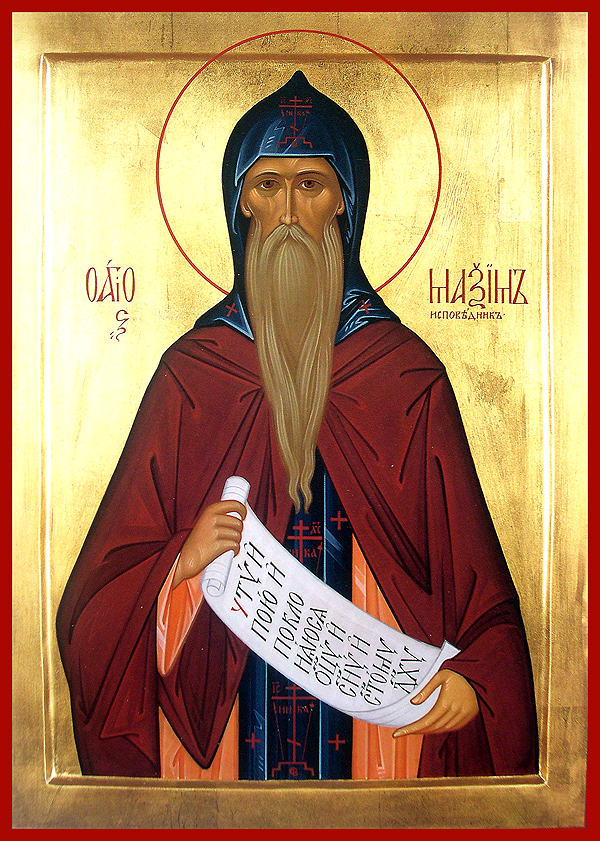
Saint Maximus the Confessor was born in Constantinople around 580 and raised in a pious Christian family. He received an excellent education, studying philosophy, grammar, and rhetoric. He was well-read in the authors of antiquity and he also mastered philosophy and theology. When Saint Maximus entered into government service, he became first secretary (asekretis) and chief counselor to the emperor Heraclius (611-641), who was impressed by his knowledge and virtuous life.
Saint Maximus soon realized that the emperor and many others had been corrupted by the Monothelite heresy, which was spreading rapidly through the East. He resigned from his duties at court, and went to the Chrysopolis monastery (at Skutari on the opposite shore of the Bosphorus), where he received monastic tonsure. Because of his humility and wisdom, he soon won the love of the brethren and was chosen igumen of the monastery after a few years. Even in this position, he remained a simple monk.
In 638, the emperor Heraclius and Patriarch Sergius tried to minimize the importance of differences in belief, and they issued an edict, the “Ekthesis” (“Ekthesis tes pisteos” or “Exposition of Faith),” which decreed that everyone must accept the teaching of one will in the two natures of the Savior. In defending Orthodoxy against the “Ekthesis,” Saint Maximus spoke to people in various occupations and positions, and these conversations were successful. Not only the clergy and the bishops, but also the people and the secular officials felt some sort of invisible attraction to him, as we read in his Life.
When Saint Maximus saw what turmoil this heresy caused in Constantinople and in the East, he decided to leave his monstery and seek refuge in the West, where Monothelitism had been completely rejected. On the way, he visited the bishops of Africa, strengthening them in Orthodoxy, and encouraging them not to be deceived by the cunning arguments of the heretics.
The Fourth Ecumenical Council had condemned the Monophysite heresy, which falsely taught that in the Lord Jesus Christ there was only one nature (the divine). Influenced by this erroneous opinion, the Monothelite heretics said that in Christ there was only one divine will (“thelema”) and only one divine energy (“energia”). Adherents of Monothelitism sought to return by another path to the repudiated Monophysite heresy. Monothelitism found numerous adherents in Armenia, Syria, Egypt. The heresy, fanned also by nationalistic animosities, became a serious threat to Church unity in the East. The struggle of Orthodoxy with heresy was particularly difficult because in the year 630, three of the patriarchal thrones in the Orthodox East were occupied by Monothelites: Constantinople by Sergius, Antioch by Athanasius, and Alexandria by Cyrus.
Saint Maximus traveled from Alexandria to Crete, where he began his preaching activity. He clashed there with a bishop, who adhered to the heretical opinions of Severus and Nestorius. The saint spent six years in Alexandria and the surrounding area.
Patriarch Sergius died at the end of 638, and the emperor Heraclius also died in 641. The imperial throne was eventually occupied by his grandson Constans II (642-668), an open adherent of the Monothelite heresy. The assaults of the heretics against Orthodoxy intensified. Saint Maximus went to Carthage and he preached there for about five years. When the Monothelite Pyrrhus, the successor of Patriarch Sergius, arrived there after fleeing from Constantinople because of court intrigues, he and Saint Maximus spent many hours in debate. As a result, Pyrrhus publicly acknowledged his error, and was permitted to retain the title of “Patriarch.” He even wrote a book confessing the Orthodox Faith. Saint Maximus and Pyrrhus traveled to Rome to visit Pope Theodore, who received Pyrrhus as the Patriarch of Constantinople.
In the year 647 Saint Maximus returned to Africa. There, at a council of bishops Monotheletism was condemned as a heresy. In 648, a new edict was issued, commissioned by Constans and compiled by Patriarch Paul of Constantinople: the “Typos” (“Typos tes pisteos” or “Pattern of the Faith”), which forbade any further disputes about one will or two wills in the Lord Jesus Christ. Saint Maximus then asked Saint Martin the Confessor (April 14), the successor of Pope Theodore, to examine the question of Monothelitism at a Church Council. The Lateran Council was convened in October of 649. One hundred and fifty Western bishops and thirty-seven representatives from the Orthodox East were present, among them Saint Maximus the Confessor. The Council condemned Monothelitism, and the Typos. The false teachings of Patriarchs Sergius, Paul and Pyrrhus of Constantinople, were also anathematized.
When Constans II received the decisions of the Council, he gave orders to arrest both Pope Martin and Saint Maximus. The emperor’s order was fulfilled only in the year 654. Saint Maximus was accused of treason and locked up in prison. In 656 he was sent to Thrace, and was later brought back to a Constantinople prison.
The saint and two of his disciples were subjected to the cruelest torments. Each one’s tongue was cut out, and his right hand was cut off. Then they were exiled to Skemarum in Scythia, enduring many sufferings and difficulties on the journey.
After three years, the Lord revaled to Saint Maximus the time of his death (August 13, 662). Three candles appeared over the grave of Saint Maximus and burned miraculously. This was a sign that Saint Maximus was a beacon of Orthodoxy during his lifetime, and continues to shine forth as an example of virtue for all. Many healings occurred at his tomb.
In the Greek Prologue, August 13 commemorates the Transfer of the Relics of Saint Maximus to Constantinople, but it could also be the date of the saint’s death. It may be that his memory is celebrated on January 21 because August 13 is the Leavetaking of the Feast of the Transfiguration of the Lord.
Saint Maximus has left to the Church a great theological legacy. His exegetical works contain explanations of difficult passages of Holy Scripture, and include a Commentary on the Lord’s Prayer and on Psalm 59, various “scholia” or “marginalia” (commentaries written in the margin of manuscripts), on treatises of the Hieromartyr Dionysius the Areopagite (October 3) and Saint Gregory the Theologian (January 25). Among the exegetical works of Saint Maximus are his explanation of divine services, entitled “Mystagogia” (“Introduction Concerning the Mystery”).
The dogmatic works of Saint Maximus include the Exposition of his dispute with Pyrrhus, and several tracts and letters to various people. In them are contained explanations of the Orthodox teaching on the Divine Essence and the Persons of the Holy Trinity, on the Incarnation of the Word of God, and on “theosis” (“deification”) of human nature.
“Nothing in theosis is the product of human nature,” Saint Maximus writes in a letter to his friend Thalassius, “for nature cannot comprehend God. It is only the mercy of God that has the capacity to endow theosis unto the existing... In theosis man (the image of God) becomes likened to God, he rejoices in all the plenitude that does not belong to him by nature, because the grace of the Spirit triumphs within him, and because God acts in him” (Letter 22).
Saint Maximus also wrote anthropological works (i.e. concerning man). He deliberates on the nature of the soul and its conscious existence after death. Among his moral compositions, especially important is his “Chapters on Love.” Saint Maximus the Confessor also wrote three hymns in the finest traditions of church hymnography, following the example of Saint Gregory the Theologian.
The theology of Saint Maximus the Confessor, based on the spiritual experience of the knowledge of the great Desert Fathers, and utilizing the skilled art of dialectics worked out by pre-Christian philosophy, was continued and developed in the works of Saint Simeon the New Theologian (March 12), and Saint Gregory Palamas (November 14).
Thanks to source:
Friday, January 10, 2020
Saint Gregory of Nyssa ~ Commemorated January 10
Saint Gregory, Bishop of Nyssa


Saint Gregory, Bishop of Nyssa, was a younger brother of Saint Basil the Great (January 1). His birth and upbringing came at a time when the Arian disputes were at their height. Having received an excellent education, he was at one time a teacher of rhetoric. In the year 372, he was consecrated by Saint Basil the Great as bishop of the city of Nyssa in Cappadocia.
Saint Gregory was an ardent advocate for Orthodoxy, and he fought against the Arian heresy with his brother Saint Basil. Gregory was persecuted by the Arians, by whom he was falsely accused of improper use of church property, and thereby deprived of his See and sent to Ancyra.
In the following year Saint Gregory was again deposed in absentia by a council of Arian bishops, but he continued to encourage his flock in Orthodoxy, wandering about from place to place. After the death of the emperor Valens (378), Saint Gregory was restored to his cathedra and was joyously received by his flock. His brother Saint Basil the Great died in 379.
Only with difficulty did Saint Gregory survive the loss of his brother and guide. He delivered a funeral oration for him, and completed Saint Basil’s study of the six days of Creation, the Hexaemeron. That same year Saint Gregory participated in the Council of Antioch against heretics who refused to recognize the perpetual virginity of the Mother of God. Others at the opposite extreme, who worshipped the Mother of God as being God Herself, were also denounced by the Council. He visited the churches of Arabia and Palestine, which were infected with the Arian heresy, to assert the Orthodox teaching about the Most Holy Theotokos. On his return journey Saint Gregory visited Jerusalem and the Holy Places.
In the year 381 Saint Gregory was one of the chief figures of the Second Ecumenical Council, convened at Constantinople against the heresy of Macedonius, who incorrectly taught about the Holy Spirit. At this Council, on the initiative of Saint Gregory, the Nicean Symbol of Faith (the Creed) was completed.
Together with the other bishops Saint Gregory affirmed Saint Gregory the Theologian as Archpastor of Constantinople.
In the year 383, Saint Gregory of Nyssa participated in a Council at Constantinople, where he preached a sermon on the divinity of the Son and the Holy Spirit. In 386, he was again at Constantinople, and he was asked to speak the funeral oration in memory of the empress Placilla. Again in 394 Saint Gregory was present in Constantinople at a local Council, convened to resolve church matters in Arabia.
Saint Gregory of Nyssa was a fiery defender of Orthodox dogmas and a zealous teacher of his flock, a kind and compassionate father to his spiritual children, and their intercessor before the courts. He was distinguished by his magnanimity, patience and love of peace.
Having reached old age, Saint Gregory of Nyssa died soon after the Council of Constantinople. Together with his great contemporaries, Saints Basil the Great and Gregory the Theologian, Saint Gregory of Nyssa had a significant influence on the Church life of his time. His sister, Saint Macrina, wrote to him: “You are renowned both in the cities, and gatherings of people, and throughout entire districts. Churches ask you for help.” Saint Gregory is known in history as one of the most profound Christian thinkers of the fourth century. Endowed with philosophical talent, he saw philosophy as a means for a deeper penetration into the authentic meaning of divine revelation.
Saint Gregory left behind many remarkable works of dogmatic character, as well as sermons and discourses. He has been called “the Father of Fathers.”
Thanks to:
Subscribe to:
Posts (Atom)