Total Pageviews

Search This Blog

Wednesday, August 15, 2018

The Ever-Virginity of the Mother of God


Last year for the Feast of the Nativity, I gave a lecture about one of the central claims of the Christian faith: the Virgin Birth of Christ. This was all well until I used in passing the phrase "ever-virgin" with reference to the Lord's Mother. Someone asked, "Do you actually mean that Mary remained a virgin after Jesus' birth?" I said yes, that is what the Orthodox Church teaches. The look of surprised bemusement on the audience's faces said it all. The miracle of the Virgin Birth is one thing, but lifelong abstinence from sexuality? That's impossible!
The lives of monastics and ascetics around the world and throughout history attest to the fact that of course it is possible. Sexual purity is only one of many challenges set for these spiritual warriors, and for many, perhaps most of them, it is not the greatest. The Orthodox have no difficulty, then, considering the ever-virginity of Mary a nonnegotiable fact and its alternative unthinkable. But why should this necessarily be so? Why insist on the idea that Mary (who was married, after all) did not go on to have a "normal" married life?

A Consistent and Unbroken Tradition

The question could be inverted. Why not believe in her ever-virginity? The Eastern Church has witnessed to the perpetual virginity of the Theotokos steadfastly for two thousand years and shows no sign of tiring. In the West, the idea was largely undisputed until late in the Reformation; even Luther and Calvin accepted the tradition.
Indeed, to suggest (a) that the tradition about her perpetual virginity could have been introduced after apostolic times, (b) that this tradition would have gone little noticed by a Church in the throes of questioning everything about what it believed in the first millennium, (c) that such a novel tradition should be considered inconsequential enough to pass without discussion before it became universally proclaimed, and (d) that such a tradition should have no discernible literary or geographical origin and yet be universally accepted from very early in the Church's history, is to form a very unlikely hypothesis.

Set Apart to God

To argue against Mary's perpetual virginity is to suggest something else that is greatly implausible, not to say unthinkable: that neither Mary nor her protector, Joseph, would have deemed it inappropriate to have sexual relations after the birth of God in the flesh. Leaving aside for a moment the complete uniqueness of the Incarnation of the Second Person of the Trinity, recall that it was the practice for devout Jews in the ancient world to refrain from sexual activity following any great manifestation of the Holy Spirit.
An early first-century popular rabbinical tradition (first recorded by Philo, 20 BC-AD 50) notes that Moses "separated himself" from his wife Zipporah when he returned from his encounter with God in the burning bush. Another rabbinical tradition, concerning the choosing of the elders of Israel in Numbers 7, relates that after God had worked among them, one man exclaimed, "Woe to the wives of these men!" I cannot imagine that the fellow to the left of him replied, "What do you mean, Joe?" The meaning of the statement would have been immediately apparent.
Whether these stories relate actual events or not, they express the popular piety in Israel at the time of the birth of Christ. That culture understood virginity and abstinence not as a mere rejection of something enjoyable--To what end?-- But as something naturally taken up by one whose life has been consecrated by the Lord's Spirit to be a vessel of salvation to His people. The intervening centuries of social, religious, and philosophical conditioning have made us suspicious of virginity and chastity in a way that no one in the Lord's time would have been.
Mary became the vessel for the Lord of Glory Himself, and bore in the flesh Him whom heaven and earth cannot contain. Would this not have been grounds to consider her life, including her body, as consecrated to God and God alone? Or it more plausible that she would shrug it all off and get on with keeping house in the usual fashion? Consider that the poetically parallel incident of the Lord's entry through the east gate of the Temple (in Ezekiel 43-44) prompts the call: "This gate shall be shut; it shall not be opened, and no one shall enter by it, for the Lord God of Israel has entered by it; therefore it shall be shut" (44:2).
And then there is Joseph's character to consider. Surely his wife's miraculous conception and birthgiving (confirmed by the angel in dream-visions) and the sight of God incarnate in the face of the child Christ would have been enough to convince him that his marriage was set apart from the norm. Within Mary's very body had dwelt the second Person of the Trinity. If touching the ark of the covenant had cost Uzzah his life, and if even the scrolls containing the Law, the Psalms, and the Prophets were venerated, certainly Joseph, man of God that he was, would neither have dared nor desired to approach Mary, the chosen of Israel, the throne of God, to request his "conjugal rights"!

The Lord's "Brothers"

There are several questions based on Scripture that are often raised by those skeptical about the doctrine of ever-virginity. The first of these involves the passages which state explicitly that the Lord had "brothers." There are nine such passages: Matthew 12:46-47 and 13:55-56; Mark 3:31-32 and 6:3; Luke 8:19-20; John 2:12 and 7:3-5; Acts 1:14; and 1-Corinthians 9:5. The Greek word used in all these passages and generally translated "brother" is adelphos.
The Septuagint, the ancient Greek translation of the Hebrew Scriptures used by the Apostles (abbreviated LXX) includes specific words for "cousin," notably adelphinos and anepsios, but they are rarely used. The less specific word adelphos, which can mean "brother," "cousin," "kinsman," "fellow believer," or "fellow countryman," is used consistently throughout the LXX, even when cousin or kinsman is clearly the relation described (such as in Genesis 14:14, 16; 29:12; Leviticus 25:49; Jeremiah 32:8, 9, 12; Tobit 7:2; etc.). Lot, for instance, who was the nephew of Abraham (cf. Genesis 11:27-31), is called his brother in Genesis 13:8 and 11:14-16. The point is that the commonly used Greek word for a male relative, adelphos, can be translated "cousin" or "brother" if no specific family relation is indicated.
Is there anywhere a clear statement in the Scriptures establishing Jesus brothers as literally the children of Mary? In fact, there is not. Nowhere is Mary explicitly stated to be the mother of Jesus' brothers. The formula for speaking of the Lord's family is "His mother and His brothers." In Mark the possessive, anavtou"of Him," is inserted before both "His mother" and "His brothers," making a clear distinction. In Acts 1:14, the separation is more pronounced: "Mary the mother of Jesus, and His brothers." Some manuscripts use the conjunctive syn "along with, in company with," so that the text reads "Mary the mother of Jesus, along with His brothers." In any case, Mary is never identified as the mother of Jesus' brothers (nor they as her children), but only as the Mother of Jesus.

The Meaning of "Until"

Another objection to the idea of Mary's perpetual virginity is that the Scriptures use the word "until" or "till" in Matthew 1:25: ". . . and [Joseph] did not know her till she had brought forth her firstborn Son." Whereas in English the word "until" necessarily indicates change after the fact, in the ancient languages of the Bible this is simply not the case. For instance, if we read Deuteronomy 34:6, 2 Samuel 6:23, Psalm 72:7 and 110:1 (as interpreted by Jesus in Matthew 22:42-46), Matthew 11:23 and 28:20, Romans 8:22, and 1 Timothy 4:13, to reference just a few examples, we will see that in none of these passages does the word "until" indicate a necessary change. If it did, then apparently among other things we would be meant to understand that Jesus will at some point stop sitting at the right hand of the Father, and that on some unhappy date in the future He intends to abandon the Church! The use of "until" in Matthew 1:25, then, is purely to indicate that Christ was incarnate of the Holy Spirit and the Virgin Mary, not conceived by Joseph and Mary, since they did not "know" each other "until" the birth. In this context "until" is really synonymous with "before." If on the contrary it were meant in its full contemporary English sense. That is, if it really meant that Joseph and Mary's chaste relationship changed after the birth then the stylistics present another big problem: the reader would have to believe that Matthew was actually inviting contemplation of the couple's later sexual activity. This is doubtful to say the least.

The Meaning of "Firstborn"

Another objection might be based on the word "firstborn," prototokos in Greek. The problem again is that the Greek word is not identical in semantic range to the English rendering. The English "firstborn" usually (though, it must be said, not always) implies the existence of subsequent children, but with prototokos there is no such implication. In Hebrews 1:6, for example, the use of prototokos in reference to the Incarnation of the Word of God cannot mean that there is a "second-born" Word of God! Nowhere is the term used to express merely the order of birth; instead in Romans 8:29, Colossians 1:15, 18, Hebrews 11:28 and 12:23, and Revelation 1:5, the title is applied to Jesus as the privileged and legal Heir of the Kingdom, attesting that He is truly "first in all things." To the contemporary ear, a better translation might indeed be "heir," which is similarly silent on the subject of other children and carries the same legal and poetic force that is intended by "firstborn."

"Woman, Behold Thy Son"

Also, consider the moving passage from St. John's Gospel in which our Lord commits His Mother into the care of St. John as He dies on the Cross. Why would He do so if she had other children to look after her? Jewish custom dictated that the care of a mother would fall to the second born if the firstborn died, and if the widow had no other child she would be left to take care of herself. Since she is without other children, her Son gives her into the care of the beloved disciple. The Women at the Cross and the Identity of the Lord's Brothers. Who exactly are the "brothers of the Lord" if not fellow sons of Mary His mother? (Here, I am gratefully indebted to Fr. Lawrence Farley's article, "The Women at the Cross." [publication ref?]) A close study of the women at the Cross in Matthew 27:55, 56 yields a plausible answer. These women were said to be:
(1) Mary Magdalene;
(2) the mother of the sons of Zebedee;
(3) Mary the Mother of James and Joseph. In the parallel passage in Mark 15:40, 41, the women are said to be:
(1) Mary Magdalene;
(2) Salome;
(3) Mary the mother of James the Less and of Joses.
In John 19:25, the women are listed as:
(1) Mary Magdalene;
(2) Christ's Mother;
(3) His mother's sister, Mary wife of Clopas.
For our purposes we should focus on the woman who is referred to by St. Matthew as "Mary the mother of James and Joseph," by St. Mark as "Mary the mother of James the Less and of Joses [a variant of Joseph]," and by St. John in his list as "His mother's sister, Mary wife of Clopas."
Note that in Matthew the names "James and Joseph" were mentioned before. Indeed, the way Matthew mentions "Mary mother of James and Joseph" in 27:55, 56 presupposes that he has already introduced these "James and Joseph" as indeed he has. In Matthew 13:55, we read that our Lord's "brothers" are "James and Joseph and Simon and Judas." Similarly, in St. Mark's Gospel, "James and Joses" are mentioned as if we already know who "James and Joses" are, which in fact we do from Mark 6:3, where Christ's "brothers" are listed as "James and Joses and Judas and Simon."
It seems beyond reasonable dispute that the Mary at the Cross in St. Matthew and St. Mark is the mother of our Lord's "brothers," "James and Joses." Also, it is inconceivable that Matthew and Mark would refer to the Lord's Mother at the foot of the Cross as the mother of James and Joseph, but not mention that she is the Mother of Jesus as well!
If it is the case, as the Scriptures suggest, that Mary wife of Clopas is the same as the mother of James and Joseph, we have the following conclusion: the Theotokos had a "sister," married to Clopas, who was the mother of James and Joseph, our Lord's "brothers." Here, the question ought to immediately arise concerning the Theotokos' relationship to this Mary: What kind of "sister" is she?
Hegisippus, a Jewish Christian historian who, according to Eusebius, "belonged to the first generation after the apostles" and who interviewed many Christians from that apostolic community for his history, relates that Clopas was the brother of St. Joseph, foster-father of Christ (apud. Eusb. Eccl. H. iv:22). If this is so (and Hegisippus is generally acknowledged as fully reliable), then "Mary wife of Clopas" was the Virgin Mary's "sister" in that she was her sister-in-law.
The puzzle therefore fits together. St. Joseph married the Virgin Theotokos, who gave birth to Christ, her only Child, preserving her virginity and having no other children. St. Joseph's brother, Clopas, also married a woman named Mary, who had the children James and Joseph (along with Judas and Simon, and daughters also). These children were our Lord's "brothers" (using the terminology of Israel, which as we have seen made no distinction between brothers and cousins but referred to all as "brothers").
St. Matthew and St. Mark, focusing on our Lord's family (Matthew 13:53ff and Mark 6:1ff), naturally refer to Clopas wife Mary as "the mother of James and Joseph (Joses)." St. John, on the other hand, focuses on our Lord's Mother (cf. John 2:1ff) and just as naturally refers to this same woman as "His mother's sister, Mary wife of Clopas." But it is apparent that it is one and the same woman being referred to by all. This reconstruction is the best that can be made (though others exist, they all contain serious weaknesses) given both the Scriptural and historical evidence.

Why Mary's Ever-Virginity is Important

Some would say that even if it can be proved, Mary's ever-virginity is not essential to the proclamation of the Gospel, and this is true on a certain level. In its essence, the Orthodox Church proclaims the Gospel of Jesus Christ. This is our message, our reason for being, the very life of our life. Teaching about Mary is really meant for the initiates, those who have already accepted the Gospel and have committed themselves to Christ and to service in His Church.
This is so because what Mary teaches us about the Incarnation of the Word of God requires that we first accept the Incarnation. Once we do, then her virginity not only after birthgiving, but also before and indeed the character of her entire life become in themselves a wellspring of teaching about life in Christ and the glory of God. Indeed, she said as much herself. By stating that "all generations shall call me blessed," Mary was not vainly contemplating her own uniqueness, but proclaiming the wonder that her life was to manifest God's glorious victory in His Christ for all time.
Mary was not a happenstance vessel of God; rather her role in our salvation was prepared from the beginning of the ages. The entire history of Israel, the patriarchs, the psalms, the prophets, the giving of the commandments converged in the young woman who would answer the way all Israel should always have answered, and as we all are expected to answer now: "Behold the handmaiden of the Lord."
But her purpose in salvation history did not end there. She was not cast aside as an article that is no longer useful. Instead her whole being and life would continue to point us without distraction to her Son. At the wedding of Cana in Galilee we hear her words: "Whatever He says to you, do it" (John 2:5). At her
Son's crucifixion, she stands fast at the foot of the Cross, this time pointing not with words but by her refusal to leave His side even in the face of what seemed an impossible nightmare. As we undertake to imitate this faithfulness in pointing always to God, we will begin to see in the same measure that Mary's perpetual virginity is in fact her ever-ministry, the ideal example for our own ministry.
It is important to recover the proper veneration of Mary which the apostolic Church has always held, not because Mary is the great exception but, as one Orthodox theologian has said, because she is the great example. This veneration is beautifully expressed in an Orthodox hymn that poetically recounts Gabriel's first encounter with Mary, who was about to become the Ark of the New Covenant, the throne of God, the flesh which gave flesh to the Word of God:
Awed by the beauty of your virginity
and the exceeding radiance of your purity,
Gabriel stood amazed, and cried to you, O Mother of God:
"What praise may I offer you
that is worthy of your beauty?
By what name shall I call you?
I am lost and bewildered,
but I shall greet you as I was commanded:
Hail, O full of grace."

Thanks to source:

https://www.goarch.org/-/the-ever-virginity-of-the-mother-of-god
 

An Orthodox View of the Virgin Mary


An Orthodox View of the Virgin Mary

A Protestant preacher recently said that devotion to the Mother of God is the cause of all bad in the world, since she was not a virgin after she gave birth to Christ and was just another woman. This really has upset me. Why do we worship the Virgin Mary and how do we answer those who say that she was nothing but another woman? What significance does she have for us Orthodox? (B.W., TX)


   One cannot react to every opinion and idea about Christianity. At some point, common sense must prevail. In the first place, the idea that devotion to the Theotokos, or Bearer of God, is the cause of the world’s ills is a ridiculous proposition. One must look at such an idea with the same passivity that we show towards so-called scholarly attempt to prove that Christian devotion to the Virgin Mary derives from the pagan cult of the earth goddess. It does not deserve a response. Secondly, while non-Orthodox Christian denominations may differ with regard to their assessment of the significance of the Mother of God, this does not explain the views of those who would like to believe—an incredible, if not demonic thing—that a woman chosen by the God of the universe to bear His Incarnate Son would simply return, after this miraculous event, to the world of the flesh. If St. Paul praises the chaste life, if Christians are called to become eunuchs for the sake of the Kingdom, and if, at least in the Orthodox, Catholic, Anglican, and Lutheran Churches, monks and nuns are called to uphold the standard of virginity and purity,* how could any rational person suggest that the woman called to bear the Son of God would be exempt from such a pious commitment?
We will not, here, comment on the mistranslation and misuse of Scripture by which some heterodox try to claim that the Virgin Mary was a virgin only "up to the time" of the Virgin Birth and not after, or by which they rather naïvely understand the children of St. Joseph (the Virgin Mary’s step-children) and their cousins to be the literal "brothers and sisters" of Christ. The Fathers of the Church have written at length on these matters. Suffice it to say that ancient Christian tradition supported the idea that the Mother of God was ever-virgin, just as Church Fathers and Councils condemned heretics in the early Church who, like their counterparts today, questioned the spiritual eminence of the Theotokos.

  As for the very eminence of the Mother of God, let us turn to Scripture. Going to the house of Zacharias, the Virgin Mary greeted his wife, Elizabeth. "Filled with the Holy Spirit," St. Elizabeth cried out, "Blessed art thou among women..." (St. Luke 1: 40-42). In response, the Theotokos observes that "...henceforth all generations shall call me blessed." It would, again, suggest a psychological or spiritual problem of no small dimensions for anyone to believe that, after these statements, the Virgin Mary would simply return to the life of the flesh and set aside her spiritual role in the salvation brought to mankind by Jesus Christ.
Finally, we Orthodox do not "worship" the Virgin Mary. We "venerate" her and show her great honor. Nor have we ever, like the Latins, developed the idea that the Theotokos was born without sin (the Roman Catholic dogma of the Immaculate Conception) or that she is a co-redemptor with Christ (the cult of the Redemtrix in the Latin Church). The consensus of the Church Fathers rejects such ideas, and the Orthodox Church adheres to that consensus. However, we do believe that the Virgin Mary is an image, as St. Maximos the Confessor says, of the Christian goal of becoming Christ-like, of theosis. Just as the Theotokos gave birth to Christ in a bodily way, so we must, St. Maximos tells us, give birth to Christ in an unbodily or spiritual way. In so doing, we imitate her practical spiritual life, including the purity and humility by which she formed her free will into perfect obedience to the Will of God. Of this practical image of the Virgin Mary, one of our readers, Archdeacon Basil Kuretich, D.D., has written some words that bear repeating here. They give us a clear picture of the importance of the model which she presents for every Orthodox believer:

  "We...are aware of the part played by Divine Grace in the Virgin Mary’s life and are aware of the perfection of her virtue. However, we cannot lose sight of the importance of free will in the development and expression of her rich personality. After the Annunication, she kept the secret of God’s plan for her; she faced misunderstanding and accusation from others. She quickly visited her cousin, Elizabeth, not thinking of her own needs, but only the need of Elizabeth to share her joy. She endured the journey to Bethlehem; she humbly prepared for the birth of her Child and obediently accepted the command to flee into Egypt. The Virgin Mary, aided by Divine Grace, carried out these actions in a real world—with real effort and sacrifice. Thus she is for us a model of many virtues."

*Although they may be familiar with monasticism in the Latin Church, most Americans do not know that monastic brotherhoods and sisterhoods survived in the Lutheran and Reformed movements, despite the generally polemical attitude towards the monastic estate that marked the Protestant Reformation. Over the years they have decreased in number or have been absorbed into Roman Catholicism, as is the case in Sweden, where most of the Lutheran monastic houses have succumbed to the widespread proselytizing of German Jesuit missionaries in that country.
 
 
From the "Question and Answer" section of Orthodox Tradition, Vol. IX, No. 4, pp. 8-9. Originally titled "The Theotokos." For more on the evolution of the term Theotokos and its central significance for upholding Christianity, see the Documents of the Third Œcumenical Synod. It is worth pointing out that though many Protestants realize this Synod was about the condemnation of Nestorius's teaching, few know that the arguments centered around the use of the term Theotokos, or "Mother of God," for the Blessed Virgin Mary. This was so much the case that Bishop Kallistos (Ware) has written: "The same primacy that the word homoousion occupies in the doctrine of the Trinity, the word Theotokos holds in the doctrine of the Incarnation." (The Orthodox Church, p. 25) So why do Protestants not use the term Theotokos, let alone even honor the Virgin Mary? In not doing so, they in practice deny the Incarnation and fall under the anathemas of the Third Œcumenical Synod. Food for thought.
 
 
thanks to source:


Q & A ~ Mary / Prayer / Death


Mary / Prayer / Death

Question

What are your beliefs about the Virgin Mary—most particularly do you pray to her?
Why do you pray for the departed? The Bible clearly says it is appointed unto man once to die and after that the judgement. Recall the rich man after death!

Answer

Your first question was, “What are your beliefs about the Virgin Mary—most particularly do you pray to her?”
We believe that the Virgin Mary is the Mother of God. Through her He Who was God before the ages took on our human nature without relinquishing His divine nature or confusing or “meshing” it with the human nature in any way. The Mother of God is often referred to as the “New Eve,” for she said “yes” to God whereas the first Eve said “no.” We believe that the Mother of God was sinless of her own free will, that she remains ever-virgin, and that she is the “living tabernacle” of God inasmuch as her womb, as one hymn states, becomes “more spacious than the heavens” by carrying within it the Savior of the world, Jesus Christ.
Properly speaking, Orthodox Christians do not “pray to” the Mother of God instead of God; we seek her intercession before her Son, asking her to pray on our behalf; another Orthodox hymn states that “the prayers of a mother availeth much before her Son.”
With regard to certain teachings about the Mother of God held by other bodies, such as the Roman Catholic doctrine of the Immaculate Conception, such are foreign to Orthodox Christianity. Non-Orthodox should never assume that the Orthodox doctrine concerning the Mother of God is identical with that of Roman Catholicism, nor should they condemn Orthodox teaching based on what they know of Roman Catholic doctrine on the Virgin Mary.
Your second question was, “Why do you pray for the departed? The Bible clearly says it is appointed unto man once to die and after that the judgement. Recall the rich man after death!” Unfortunately, you begin this by asking a question which you then seem to answer and then offer chastisement. Perhaps you are assuming that the Orthodox doctrine concerning the Last Things are identical with those of other bodies, specifically Roman Catholicism, which is not the case either.
We believe that death is the result of sin, that death is not a part of God’s original design for mankind: “For I have no pleasure in the death of anyone, says the Lord God; so turn and live” (Ezek 18:32). Death was not “created” by God, who is the Source and Author of all life and Who, by revealing His Name as “I AM” to Moses reveals that He is Existence Itself: “God did not make death, and takes no pleasure in the destruction of any living thing; He created all things that they might have being” (Wis 1:13). Death is a consequence of the first sin, a consequence which touches all humanity. Jesus Christ came into the world to conquer death, to point the way to new and eternal life, to offer a refuge from corruption and all that corrupts God’s “good” creation. This was accomplished through the death and resurrection of Jesus Christ, who “has been raised from the dead, the first fruits of those who have fallen asleep. For as by a man came death, by a man has come also the resurrection of the dead. For as in Adam all die, so also in Christ shall all be made alive. But each in his own order: Christ the first fruits, then at His coming those who belong to Christ. Then comes the end, when He delivers the kingdom to God the Father after destroying every rule and every authority and power. For He must reign until He has put all His enemies under His feet. The last enemy to be destroyed is death (1 Cor 15:20-26). Finally, our hope as Christians is to share in Christ’s victory over death: “I am the resurrection and the life; he who believes in me, though he die, yet shall he live, and whoever lives and believes in me shall never die” (Jn 11:25-26).
Death, for Orthodox Christians, is always a tragedy, something which distorts the goodness and beauty of God’s creation. By His own example at the tomb of His friend Lazarus we see that death is always tragic, even for the One Who conquers death. Christ came to proclaim new life, to acknowledge that death is not a transition into eternal oblivion, to announce that “through [Him] God will bring with Him those who have fallen asleep” (1 Thess 4:14). We also believe that “if we have been united with HIm in a death like His, we shall certainly be united with Him in a resurrection like His. ...If we have died with Christ, we believe that we shall also live with Him” (Rom 6:5,8). Concerning prayers for the dead, your question, which is more of a statement, seems to be directed at those who teach that after death humans may encounter “purgatory,” an intermediate state in which the “punishment” accorded to sin must be “purged” before one can enter the eternal Kingdom of God. This teaching, found among the Roman Catholics but completely alien to Orthdox Christianity [which rejects the doctrine of purgatory], implies that one should pray for the release of the souls of the departed from such punishment and may imply that the departed, of their own will, can freely repent of the sins they committed during this lifetime.
Orthodox Christians pray for the dead so that the Lord will have mercy on their souls, that He will grant them eternal rest “in the bosom of Abraham, Isaac, and Jacob,” that He will extend His unfathomable love upon them, and that He will receive them into that state “in which there is neither sickness, nor sighing, nor sorrow, but life everlasting.” Saint Paul clearly teaches that those who have gone before us are still members of the Body of Christ, the Church. And it is the duty of the members of the Church to pray for one another. Just as the living continually beseech God to have mercy on them—and may rightly offer prayers to God on behalf of their living spiritual sisters and brothers as well as request prayers on their own behalf from others—so too we have the duty to pray for all members of the Body of Christ, even those who have departed this life and still “belong to Christ.” One will find that the early Christians, surrounded as they were by death as a result of official persecution on the part of the Roman Empire, took great care to honor the dead, to bury them with great care and reverence—to the point of offering the Eucharistic celebration on their graves, which is one of the earliest indications of the veneration of their relics!—and to remember them especially on the anniversary of their deaths which were seen as “birthdays” into eternal life. In asking God to have mercy on the souls of the departed, we also ask God to have mercy on us who are still in this life, and we recognize that we too shall die. All members of the Church, living as well as faithful departed, cry before the throne of God, “Lord, have mercy on us.”
I might add here that the standard Reformed reactions to prayers for the dead are reactions to certain teachings in Roman Catholicism. The arguments against these teachings and practices should not, in blanket fashion, be used against Orthodox Christianity which rejects some of the very same teachings and practices, such as the recent reintroduction of “indulgences” by Pope John Paul II. Orthodoxy is not a form of Roman Catholicism and it should not be assumed that the teachings of the Orthodox Church are one and the same as those of Roman Catholicism.
It should also not be assumed that, just because the Orthodox may have a similar ritual to another Christian body, it has the same meaning. One must look beyond externals, as Christ continually challenged the pharisees, and evaluate things on the spirit which drives those externals.


thanks to source:

https://oca.org/questions/teaching/mary-prayer-death

Q & A ~ Sinlessness of Mary


Sinlessness of Mary

Question

How exactly does the Orthodox Church view the sinlessness of Mary? In the Liturgy it is said, “One is Holy, One is Lord, Jesus Christ, to the Glory of God the Father” and in other places that Jesus is the only sinless one. Also, in reference to 1 John 1:8 where it says, “If we claim to be without sin, we deceive ourselves and the truth is not in us.” How can these be reconciled? Is the Theotokos all-pure, all-holy, all-blameless because of her deification through her Son, so that she is those things because her Son is, as we are holy, pure, etc. through our union to Christ?
Also, how is it that she is referred to as the only refuge for sinners, and various phrases like this? Isn’t Christ our only refuge and the salvation of sinners?
This is the main stumbling block I have with Orthodoxy right now. There seems to be varying beliefs within the Orthodoxy on the Theotokos. Didn’t St John Chrysostom teach that Mary had sinned at least once? When I read the earliest Church Fathers there seems to be little focus on Mary apart from the Christological issue of whether she was the Mother of God, or only of Christ. Doesn’t the teaching that Mary was sinless from birth state the same general concept, that Mary is more than the rest of humanity, as the Immaculate Conception (apart from the idea of original sin) except that it moves the moment of the supernatural grace of God to birth from conception?
I am not trying to answer my own questions, but am simply not understanding how these contradictions, at least seemingly, can be resolved.

Answer

While I would love to be able to fully answer your question, it is far beyond the scope of an email, especially because full understanding of the Orthodox position, based on the tenor of your question, on the Virgin Mary requires a thorough explanation of some of the secondary issues to which you refer, such as original sin, the Immaculate Conception, supernatural grace, etc. As such, I would highly recommend that you meet in person with the parish priest at the Orthodox Church you have been visiting—he will no doubt be glad to answer the question at some depth.
I can say, in short, that the Orthodox Church believes that Mary, as a human being, could indeed have sinned, but chose not to. In the Roman Catholic understanding, it seems that Mary, who according to Roman doctrine had been exempted from the guilt of original sin [the Orthodox do not accept that humans share the guilt of the first sin but, rather, only the consequences] before all eternity, and thus could not have sinned. This is where the complexity comes in on a number of levels and which puts your question beyond the scope of an email.
Jesus Christ is Mary’s Savior, as well as ours, as testified in her own statement in St Luke—the Magnificat—where she says, “My soul magnifies the Lord, and my spirit rejoices in God my Savior.” If Mary had been “sin-proofed,” so to speak, from all eternity, the Orthodox would argue as to why she would need a Savior.
Mary is the “new Eve” who said “yes” to God where the first Eve said “no.” She did have a choice, and you may wish to ask your local parish priest to share with you the text of the Kanon from Matins for the Great Feast of the Annunciation, in which you will see a beautiful dialogue between Mary and the Archangel Gabriel in which she debates whether or not to accept the archangel’s news, only in the end accepting that which he announced.
While much that the Orthodox say of Mary “sounds” similar to that which is taught by Roman Catholicism, there are serious differences on many levels. You are correct in saying, however, that the Orthodox Church does not seem to have such a highly developed mariological tradition as the Christian West; it is, at least in my experience, only in recent times, with the growing interest in Orthodoxy especially among many evangelicals, that we have had to delve so deeply—and sometimes deeper than we should—into the role of Mary. Sometimes our answers seem somewhat lame, but in reality there is only so much one can say before one must acknowledge that, while there are certain things we simply cannot fully understand about this, reasoned faith, as defined in St James, becomes the only recourse.


thanks to source:

https://oca.org/questions/saints/sinlessness-of-mary
 

Icons of the Twelve Great Feasts


Icons of the Twelve Great Feasts

September 8th
The Nativity of the Most-Holy Theotokos

Life of the Saint

Troparion and Kontakion
September 14th
The Universal Exaltation (Elevation) of the Life-Creating Cross

Life of the Saint

Troparion and Kontakion
November 21st
The Entrance (Presentation) of the Theotokos into the Temple

Life of the Saint

Troparion and Kontakion
December 25th
The Nativity of Our Lord God and Savior Jesus Christ (Christmas)

Life of the Saint

Troparion and Kontakion
January 6th
The Theophany (Epiphany) of Our Lord God and Savior Jesus Christ

Life of the Saint

Troparion and Kontakion
February 2nd
The Meeting of Our Lord Jesus Christ in the Temple

Life of the Saint

Troparion and Kontakion
March 25th
The Annunciation to the Most-Holy Theotokos
Sunday before Pascha 
The Entrance of Our Lord Jesus Christ into Jerusalem
40 Days after Pascha 
The Ascension of Our Lord and Savior Jesus Christ
50 Days after Pascha 
Pentecost: The Descent of the Holy Spirit
August 6th
The Transfiguration of Our Lord God and Savior Jesus Christ

Life of the Saint

Troparion and Kontakion
August 15th
The Falling-asleep (Dormition or Assumption) of the Most-Holy Theotokos

Life of the Saint

Troparion and Kontakion


thanks to source:

https://oca.org/fs/icons-of-twelve-great-feasts

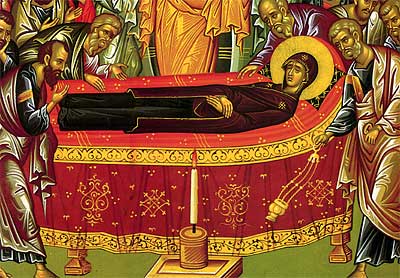
Dormition of the Theotokos (August 15)


Dormition of the Theotokos


Introduction

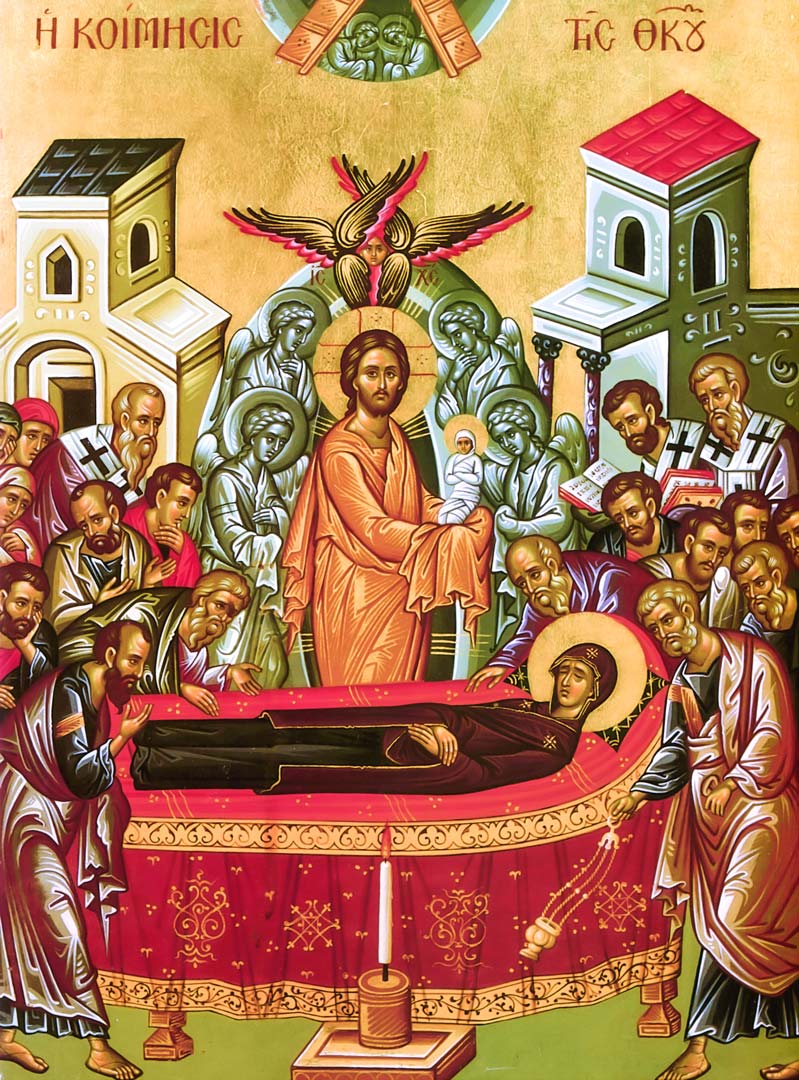
The Feast of the Dormition of Our Most Holy Lady, the Theotokos and Ever-Virgin Mary is celebrated on August 15 each year. The Feast commemorates the repose (dormition and in the Greek kimisis) or "falling-asleep" of the Mother of Jesus Christ, our Lord. The Feast also commemorates the translation or assumption into heaven of the body of the Theotokos.

Biblical Story

The Holy Scriptures tell us that when our Lord was dying on the Cross, He saw His mother and His disciple John and said to the Virgin Mary, "Woman, behold your son!" and to John, "Behold your mother!" (John 19:25-27). From that hour, the Apostle took care of the Theotokos in his own home.
Along with the biblical reference in Acts 1:14 that confirms that the Virgin Mary was with the Holy Apostles on the day of Pentecost, the tradition of the Church holds that she remained in the home of the Apostle John in Jerusalem, continuing a ministry in word and deed.

At the time of her death, the disciples of our Lord who were preaching throughout the world returned to Jerusalem to see the Theotokos. Except for the Apostle Thomas, all of them including the Apostle Paul were gathered together at her bedside. At the moment of her death, Jesus Christ himself descended and carried her soul into heaven.
Following her repose, the body of the Theotokos was taken in procession and laid in a tomb near the Garden of Gethsemane. When the Apostle Thomas arrived three days after her repose and desired to see her body, the tomb was found to be empty. The bodily assumption of the Theotokos was confirmed by the message of an angel and by her appearance to the Apostles.

Icon of the Feast

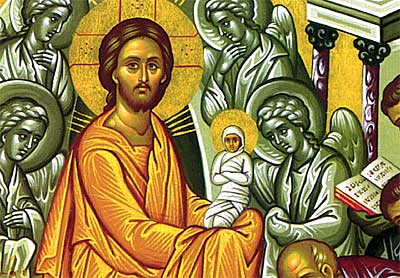
The Icon of the Feast of the Dormition of the Theotokos shows her on her deathbed surrounded by the Apostles. Christ is standing in the center (1.) looking at His mother. He is holding a small child clothed in white representing the soul of the Virgin Mary. With His golden garments, the angels above His head, and the mandorla surrounding Him, Christ is depicted in His divine glory.
1. Christ, appearing in His Glory, stands in the center of the icon cradling the soul of His Mother, the Theotokos and Ever-Virgin Mary.
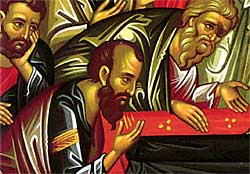
The posture of the Apostles direct attention toward the Theotokos (2.). On the right Saint Peter censes the body of the Theotokos. On the left Saint Paul (3.) bows low in honor of her.
2. The Apostles bow their heads in reverence to the Theotokos as Saint Peter (right) censes her body (detail).
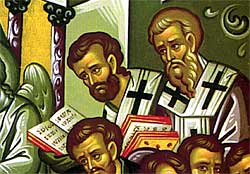
Together with the Apostles are several bishops (4.) and women. The bishops traditionally represented are James, the brother of the Lord, Timothy, Heirotheus, and Dionysius the Areopagite. They are shown wearing episcopal vestments. The women are members of the church in Jerusalem.
3. The Apostle Paul bows in honor of the Theotokos (detail).
4. Also in attendance to pray for the Theotokos were several Bishops (detail).
In front of the bed of the Theotokos is a candle (5.) that helps to form a central axis in the icon. Above the candle is the body of the Theotokos and Ever-Virgin Mary. Standing over His mother is Christ holding her most pure soul. Above Christ the gates of heaven stand open, ready to receive the Mother of God.
5. The Theotokos lies in the center of the icon surrounded by the Apostles and a candle in front of her bed (detail).
This great Feast of the Church and the icon celebrates a fundamental teaching of our faith—the Resurrection of the body. In the case of the Theotokos, this has been accomplished by the divine will of God. Thus, this Feast is a feast of hope, hope in Resurrection and life eternal. Like those who gathered around the body of the Virgin Mary, we gather around our departed loved ones and commend their souls into the hands of Christ. As we remember those who have reposed in the faith before us and have passed on into the communion of the Saints, we prepare ourselves to one day be received into the new life of the age to come.
We also affirm through this Feast as we journey toward our heavenly abode that the Mother of God intercedes for us. Through Christ she has become the mother of all of the children of God, embracing us with divine love.

Orthodox Christian Celebration of the Feast of the Dormition

The commemoration of the Dormition of the Theotokos and the preparation for the Feast begin on August 1 with a period of fasting. A strict fast is followed on most of the days (no meat, dairy, oil, or wine), with the exceptions of fish on the Feast of the Transfiguration (August 6) and the day of the Dormition. Oil and Wine are allowed on Saturdays and Sundays.
On the weekdays before the Feast, Paraklesis services are held in most parishes. These consist of the Great Paraklesis and the Small Paraklesis, both services of supplication and prayer for the intercessions of the Theotokos.
The Feast of the Dormition is celebrated with the Divine Liturgy of Saint John Chrysostom which is conducted on the morning of the Feast and preceded by a Matins (Orthros) service. A Great Vespers is conducted on the evening before the day of the Feast. Scripture readings for the Feast of the Dormition are the following: At Vespers: Genesis 28:10-17; Ezekiel 43:27-44:4; Proverbs 9:1-11. At the Matins: Luke 1:39-49, 56. At the Divine Liturgy: Philippians 2:5-11; Luke 10:38-42; 11:27-28.

Resources

Icon of the Dormition of the Theotokos provided by Theologic and used with permission.
Festival Icons for the Christian Year by John Baggley (Crestwood, NY: St. Vladimir's Seminary Press, 2000), pp. 160-166.
The Festal Menaion. Translated by Mother Mary (South Canaan, PA: St. Tikhon’s Seminary Press, 1969) pp. 63-65.
The Incarnate God: The Feasts of Jesus Christ and the Virgin Mary, Catherine Aslanoff, editor and Paul Meyendorff, translator (Crestwood, NY: St. Vladimir’s Seminary Press, 1995).
On the Dormition of Mary: Early Patristic Homilies. Translation and introduction by Brian E. Daley, S.J. (Crestwood, NY: St. Vladimir's Seminary Press, 1998).


thanks to:


https://www.goarch.org/dormition


Thursday, August 9, 2018

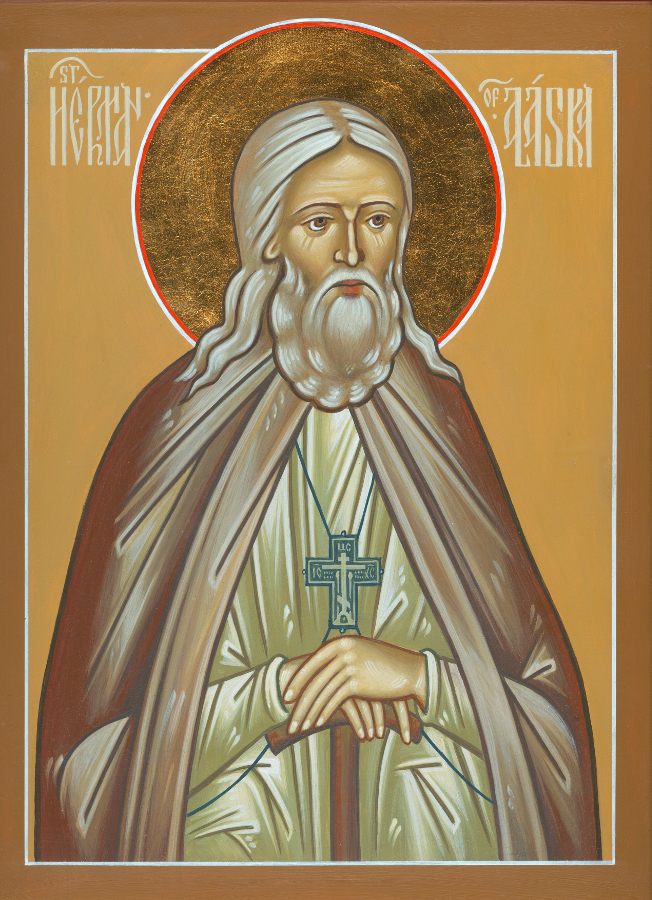
St. Herman of Alaska, Wonderworker of All America commemoration August 9th


Glorification of the Venerable Herman of Alaska, Wonderworker of All America


A spiritual mission was organized in 1793, made up of monks of the Valaam Monastery. They were sent to preach the Word of God to the native inhabitants of northwestern America, who only ten years before had come under the sovereignty of Russia. Saint Herman was among the members of this Mission.Saint Herman came from a family of merchants of Serpukhov, a city of the Moscow Diocese. His name before he was tonsured, and his family name are not known. (The monastic name is given when a monk takes his vows). He had a great zeal for piety from youth, and at sixteen he entered monastic life. (This was in 1772, if we assume that Herman was born in 1756, although sometimes 1760 is given as the date of his birth.) First he entered the Trinity-Sergius Hermitage which was located near the Gulf of Finland on the Peterhof Road, about 15 versts (about 10 miles) from Saint Petersburg. Miraculous HealingAt the Saint Sergius Hermitage there occurred the following incident to Father Herman. On the right side of his throat under his chin there appeared an abscess. The swelling grew rapidly, disfiguring his face. It became difficult for him to swallow, and the odor was unbearable. In this critical condition Father Herman awaited death. He did not appeal to a physician of this world, but locking his cell he fell before an icon of the Mother of God. With fervent tears he prayed, asking of Her that he might be healed. He prayed the whole night. Then he took a wet towel and with it wiped the face of the Most Holy Mother, and with this towel he covered the swelling. He continued to pray with tears until he fell asleep from sheer exhaustion on the floor. In a dream he saw the Virgin Mary healing him.When Herman awoke in the morning, he found to his great surprise that he was fully healed. The swelling had disappeared, even though the abscess had not broken through, leaving behind but a small mark as though a reminder of the miracle. Physicians to whom this healing was described did not believe it, arguing that it was necessary for the abscess to have either broken through of its own accord or to have been cut open. But the words of the physicians were the words of human experience, for where the grace of God operates there the order of nature is overcome. Such occurrences humble human reason under the strong hand of God’s Mercy. Life at ValaamFor five or six years Father Herman continued to live in the Saint Sergius Hermitage, and then he transferred to the Valaam Monastery, which was widely scattered on the large islands in the waters of the great Lake Ladoga. He came to love the Valaam haven with all his soul, as he came to love its unforgettable Superior, the pious Elder Nazarius, and all the brethren. He wrote to Father Nazarius later from America, “Your fatherly goodness to me, humble one, will be erased out of my heart neither by the terrible, unpassable Siberian lands, nor by the dark forests. Nor will it be wiped out by the swift flow of the great rivers; nor will the awful ocean quench these feelings. In my mind I imagine my beloved Valaam, looking to it beyond the great ocean.” He praised the Elder Nazarius in his letters as, “the most reverend, and my beloved father,” and the brethren of Valaam he called, “my beloved and dearest.” The place where he lived in America, deserted Spruce Island, he called “New Valaam.” And as we can see, he always remained in spiritual contact with his spiritual homeland, for as late as 1823, that is after thirty years of his life within the borders of America, he wrote letters to the successor of Father Nazarius, the lgumen Innocent.Father Barlaam, later lgumen of Valaam, and a contemporary of Father Herman, who accepted his tonsure from Father Nazarius, wrote thus of the life of Father Herman.“Father Herman went through the various obediences here, and being ‘well disposed toward every thing’ was in the course of events sent to Serdobol to oversee there the work of quarrying marble. The Brothers loved Father Herman, and awaited impatiently his return to the cloisters from Serdobol. Recognizing the zeal of the young hermit the wise elder, Father Nazarius, released him to take abode in the wilderness. This wilderness was in the deep forest about a mile from the cloister: to this day this place has retained the name ‘Herman’s.’ On holy days, Father Herman returned to the monastery from the wilderness. Then it was that at Little Vespers he would stand in the choir and sing in his pleasant tenor the responses with the brethren from the Canon, ‘O Sweetest Jesus, save us sinners. Most Holy Theotokos, Save us,’ and tears would fall like hail from his eyes.” The First Mission to AmericaIn the second half of the 18th century the borders of Holy Russia expanded to the north. In those years Russian merchants discovered the Aleutian Islands which formed in the Pacific Ocean a chain from the eastern shores of Kamchatka to the western shares of North America. With the opening of these islands there was revealed the sacred necessity to illumine with the light of the Gospel the native inhabitants. With the blessing of the Holy Synod, Metropolitan Gabriel gave to the Elder Nazarius the task of selecting capable persons from the brethern of Valaam for this holy endeavor. Ten men were selected, and among them was Father Herman. The chosen men left Valaam for the place of their great appointment in 1793. (The members of this historical mission were: Archimandrite Joseph (Bolotoff), the Hieromonks, Juvenal, Macarius, Athanasius, Stephan and Nectarius, Hierodeacons, Nectarius and Stephen, and the monks Joasaph, and Herman.)As a result of the holy zeal of the preachers the light of the evangelic sermon quickly poured out among the sons of Russia, and several thousand pagans accepted Christianity. A school for the education of newly-baptized children was organized, and a church was built at the place where the missionaries lived. But by the inscrutable providence of God the general progress of the mission was unsatisfactory. After five years of very productive labor, Archimandrite Joasaph, who had just been elevated to the rank of bishop, was drowned with his party. (This occurred on the Pacific Ocean between Kamchatka and the Aleutian Islands. The ship, Phoenix, one of the first sea-going ships built in Alaska, sailed from Okhotsk carrying the first Bishop for the American Mission and his party. The Phoenix was caught in one of the many storms which periodically sweep the northern Pacific, and the ship and all hands perished together with Bishop Joasaph and his party.) Before this the zealous Hieromonk Juvenal was granted the martyr’s crown. The others died one after another until in the end only Father Herman remained. The Lord permitted him to labor longer than any of his brethren in the apostolic task of enlightening the Aleutians.The New Valaam — Spruce IslandIn America, Father Herman chose as his place of habitation Spruce Island, which he called New Valaam. This island is separated by a strait about a mile and a quarter wide from Kodiak Island on which had been built a wooden monastery for the residence of the members of the mission, and a wooden church dedicated to the Resurrection of the Savior. (New Valaam was named for Valaam on Lake Ladoga, the monastery from which Father Herman came to America. It is interesting to note that Valaam is also located on an island, although, this island is in a fresh water lake, whereas, Spruce Island is on the Pacific Ocean, although near other islands and the Alaskan mainland.)Spruce Island is not large, and is almost completely covered by a forest. Almost through its middle a small brook flows to the sea. Herman selected this picturesque island for the location of his hermitage. He dug a cave out of the ground with his own hands, and in it he lived his first full summer. For winter there was built for him a cell near the cave, in which he lived until his death. The cave was converted by him into a place for his burial. A wooden chapel, and a wooden house to be used as a schoolhouse and a guest house were built not too distant from his cell. A garden was laid out in front of his cell. For more than forty years Father Herman lived here. Father Herman’s Way of LifeFather Herman himself spaded the garden, planted potatoes and cabbage and various vegetables in it. For winter, he preserved mushrooms, salting or drying them. The salt was obtained by him from ocean water. It is said that a wicker basket in which the Elder carried seaweed from the shore, was so large that it was difficult for one person to carry. The seaweed was used for fertilizing the soil. But to the astonishment of all, Father Herman carried a basket filled with seaweed for a long distance without any help at all. By chance his disciple, Gerasim, saw him one winter night carrying a large log which normally would be carried by four men; and he was bare footed. Thus worked the Elder, and everything that he acquired as a result of his immeasurable labors was used for the feeding and clothing of orphans and also for books for his students.His clothes were the same for winter as for summer. He did not wear a shirt; instead he wore a smock of deer skin, which he did not take off for several years at a time, nor did he change it, so that the fur in it was completely worn away, and the leather became glossy. Then there were his boots or shoes, cassock (podrasnik), an ancient and faded out cassock (riasa) full of patchwork, and his headdress (klobuk). He went everywhere in these clothes, and at all times; in the rain, in snowstorms, and during the coldest freezing weather. In this, Father Herman followed the example of many Eastern Ascetic Fathers and Monks who showed the greatest concern for the welfare and needs of others. Yet, they themselves wore the oldest possible clothes to show their great humility before God, and their detachment from worldly things.A small bench covered with a time-worn deerskin served as Father Herman’s bed. He used two bricks for a pillow; these were hidden from visitors by a skin or a shirt. There was no blanket. Instead, he covered himself with a wooden board which lay on the stove. This board Father Herman, himself called his blanket, and he willed that it be used to cover his remains; it was as long as he was tall. “During my stay in the cell of Father Herman,” writes the creole Constantine Larionov, “I, a sinner, sat on his ‘blanket’-and I consider this the acme of my fortune!” (‘creole’ is the name by which the Russians referred to the children of mixed marriages of native Indians of Alaska, Eskimo and Aleuts with Russians.)On the occasions when Father Herman was the guest of administrators of the American Company and in the course of their soul-saving talks he sat up with them until midnight. He never spent the night with them, but regardless of the weather he always returned to his hermitage. If for some extraordinary reason it was necessary for him to spend the night away from his cell, then in the morning the bed which had been prepared for him would be found untouched; the Elder not having slept at all. The same was true in his hermitage where having spent the night in talks, he never rested.The Elder ate very little. As a guest, he scarcely tasted the food, and remained without dinner. In his cell his dinner consisted of a very small portion of a small fish or some vegetables. His body, emaciated as a result of his labors, his vigils, and fasting, was crushed by chains which weighed about sixteen pounds. These chains are kept to this day in the chapel. Telling of these deeds of Father Herman, his disciple, the Aleut Ignaty Aligyaga, added, “Yes, Apa led a very hard life, and no one can imitate his life!” (The Aleutian word “Apa” means Elder or grandfather, and it is a name indicative of the great affection in which he was held).Our writing of the incidents in the life of the Elder deal, so to speak, with the external aspects of his labor. “His most important works,” says the Bishop Peter, “were his exercises in spiritual endeavor in his isolated cell where no one saw him, but outside the cell they heard him singing and celebrating services to God according to the monastic rule.” This witness of the Bishop is supported by the following answers of Father Herman, himself, “How do you manage to live alone in the forest, Father Herman? Don’t you ever become lonesome?” He answered, “No I am not there alone! God is here, as God is everywhere. The Holy Angels are there. With whom is it better to talk, with people, or with Angels? Most certainly with Angels.” Father Herman and the Native AlaskansThe way in which Father Herman looked upon the natives of America, how he understood his own relations with them, and how he was concerned for their needs he expressed himself in one of his letters to the former administrator of the colony, Simeon Yanovsky. He wrote, “Our Creator granted to our beloved homeland this land which like a newly-born babe does not yet have the strength for knowledge or understanding. It requires not only protection, because of its infantile weakness and impotence, but also his sustenance. Even for this it does not yet have the ability to make an appeal on its own behalf. And since the welfare of this nation by the Providence of God, it is not known for how long, is dependent on and has been entrusted into the hands of the Russian government which has now been given into your own power, therefore I, the most humble servant of these people, and their nurse (nyanka) stand before you in their behalf, write this petition with tears of blood. Be our Father and our Protector. Certainly we do not know how to be eloquent, so with an inarticulate infant’s tongue we say: Wipe away the tears of the defenseless orphans, cool the hearts melting away in the fire of sorrow. Help us to know what consolation means.”The Elder acted the way he felt. He always interceded before the governors on behalf of those who had transgressed. He defended those who had been offended. He helped those who were in need with whatever means he had available. The Aleuts, men, women and children, often visited him. Some asked for advice, others complained of oppression, others sought out defense, and still others desired help. Each one received the greatest possible satisfaction from the Elder. He discussed their mutual difficulties, and he tried to settle these peacefully. He was especially concerned about reestablishing understanding in families. If he did not succeed in reconciling a husband and wife, the Elder prevailed upon them to separate temporarily. The need for such a procedure he explained thus, “it is better to let them live apart, or believe me, it can be terrible if they are not separated. There have been incidents when a husband killed his wife, or when a wife destroyed her husband.”Father Herman especially loved children. He made large quantities of biscuits for them, and he baked cookies (krendelki) for them; and the children were fond of the Elder. Father Herman’s love for the Aleuts reached the point of self-denial. An Epidemic StrikesA ship from the United States brought to Sitka Island, and from there to Kodiak Island, a contagious disease, a fatal illness. It began with a fever, a heavy cold, and difficult respiration, and it ended with chills; in three days the victim died. On the island there was neither a doctor nor medicine. The illness spread rapidly through the village, and then throughout the nearby areas. The disease affected all, even infants. The fatalities were so great that for three days there was no one to dig graves, and the bodies remained unburied. An eyewitness said, “I cannot imagine anything more tragic and horrible than the sight which struck me when I visited an Aleutian ‘Kazhim’. This was a large building, or barracks, with dividing sections, in which the Aleuts lived with their families; it contained about 100 people. Here some had died, their cold bodies lay near the living; others were dying; there were groans and weeping which tore at one’s soul.”“I saw mothers over whose bodies cold in death crawled a hungry child, crying and searching in vain for its food...My heart was bursting with compassion! It seemed that if anyone could paint with a worthy brush the full horror of this tragic scene, that he would have successfully aroused fear of death in the most embittered heart.” Father Herman, during this terrible sickness which lasted a whole month, gradually dying out towards the end, visited the sick, never tiring. He admonished them in their fear, prayed, brought them to penance, or prepared them for death. He never spared himself. Father Herman as a Spiritual TeacherThe Elder was concerned in particular for the moral growth of the Aleuts. With this end in mind a school was built for children-the orphans of the Aleuts. He himself taught them the Law of God and church music. For this same purpose he gathered the Aleuts on Sunday and Holy Days for prayer in the chapel near his cell. Here his disciple read the Hours and the various prayers while the Elder himself read the Epistle and Gospel. He also preached to them. His students sang, and they sang very well. The Aleuts loved to hear his sermons, gathering around him in large numbers. The Elder’s talks were captivating, and his listeners were moved by their wonderous power. He himself writes of one example of the beneficial results of his words.“Glory to the holy destinies of the Merciful God! He has shown me now through his unfathomable Providence a new occurrence which I, who have lived here for twenty years had never seen before on Kodiak,” he wrote. “Recently after Easter, a young girl about twenty years of age who knows Russian well, came to me. Having heard of the Incarnation of the Son of God and of Eternal Life, she became so inflamed with love for Jesus Christ that she does not wish to leave me. She pleaded eloquently with me. Contrary to my personal inclination and love for solitude, and despite all the hindrances and difficulties which I put forward before accepting her, she has now been living near the school for a month and is not lonesome. I, looking on this with great wonder, remembered the words of the Savior: ‘that which is hidden from the wise and learned is revealed to babes’” (Matthew 11:25).This woman lived at the school until the death of the Elder. She watched for the good conduct of the children who studied in his school. Father Herman willed that after his death she was to continue to live on Spruce Island. Her name was Sophia Vlasova.Yanovsky writes about the character and the eloquence of the talks of the Elder thus: “When I met Father Herman I was thirty years old. I must say that I was educated in the naval corps school; that I knew many sciences having read extensively. But to my regret, the Science of sciences, that is the Law of God, I barely remembered the externals—and these only theoretically, not applying them to life. I was a Christian in name only, but in my soul and in reality, I was a freethinker. Furthermore, I did not admit the divinity and holiness of our religion, for I had read through many atheistic works. Father Herman recognized this immediately and he desired to reconvert me. To my great surprise he spoke so convincingly, wisely—and he argued with such conviction—that it seemed to me that no learning or worldly wisdom could stand one’s ground before his words. We conversed with him daily until midnight, and even later, of God’s love, of eternity, of the salvation of souls, and of Christian living. From his lips flowed a ceaseless stream of sweet words! By these continual talks and by the prayers of the holy Elder the Lord returned me completely to the way of Truth, and I became a real Christian. I am indebted for all this to Father Herman he is my true benefactor.“Several years ago,” continues Yanovsky, “Father Herman converted a certain naval captain G. to Orthodoxy from the Lutheran Faith. This captain was well educated. Besides many sciences, he was well versed in languages. He knew Russian, English, German, French, Italian and also some Spanish. But for all this he could not resist the convictions and proofs of Father Herman. He changed his faith and was united to the Orthodox Church through Chrismation. When he was leaving America, the Elder said to him while they were parting, “Be on guard, if the Lord should take your wife from you then do not marry a German woman under any circumstance. If you do marry a German woman, undoubtedly she will damage your Orthodoxy.” The Captain gave his word, but he failed to keep it. The warning of the Elder was prophetic. Indeed, after several years the Captain’s wife did die, and he married a German woman. There is no doubt that his faith weakened or that he left it; for he died suddenly without penance.”Further on Yanovsky writes, “Once the Elder was invited aboard a frigate which came from Saint Petersburg. The Captain of the frigate was a highly educated man, who had been sent to America by order of the Emperor to make an inspection of all the colonies. There were more than twenty-five officers with the Captain, and they also were educated men. In the company of this group sat a monk of a hermitage, small in stature and wearing very old clothes. All these educated conversationalists were placed in such a position by his wise talks that they did not know how to answer him. The Captain himself used to say, ‘We were lost for an answer before him.’“Father Herman gave them all one general question: ‘Gentlemen, What do you love above all, and what will each of you wish for your happiness?’ Various answers were offered ... Some desired wealth, others glory, some a beautiful wife, and still others a beautiful ship he would captain; and so forth in the same vein. ‘It is not true,’ Father Herman said to them concerning this, ‘that all your various wishes can bring us to one conclusion—that each of you desires that which in his own understanding he considers the best, and which is most worthy of his love?’ They all answered, ‘Yes, that is so!’ He then continued, ‘Would you not say, Is not that which is best, above all, and surpassing all, and that which by preference is most worthy of love, the Very Lord, our Jesus Christ, who created us, adorned us with such ideals, gave life to all, sustains everything, nurtures and loves all, who is Himself Love and most beautiful of all men? Should we not then love God above every thing, desire Him more than anything, and search Him out?’“All said, ‘Why, yes! That’s self-evident!’ Then the Elder asked, ‘But do you love God?’ They all answered, ‘Certainly, we love God. How can we not love God?’ ‘And I a sinner have been trying for more than forty years to love God, I cannot say that I love Him completely,’ Father Herman protested to them. He then began to demonstrate to them the way in which we should love God. ‘If we love someone,’ he said, ‘we always remember them; we try to please them. Day and night our heart is concerned with the subject. Is that the way you gentlemen love God? Do you turn to Him often? Do you always remember Him? Do you always pray to Him and fulfill His holy commandments?’ They had to admit that they had not! ‘For our own good, and for our own fortune,’ concluded the Elder, ‘let us at least promise ourselves that from this very minute we will try to love God more than anything and to fulfill His Holy Will!’ Without any doubt this conversation was imprinted in the hearts of the listeners for the rest of their lives.’“In general, Father Herman liked to talk of eternity, of salvation of the future life, of our destinies under God. He often talked on the lives of the Saints, on the Prologue, but he never spoke about anything frivolous. It was so pleasant to hear him that those who conversed with him, the Aleuts and their wives, were so captivated by his talks that often they did not leave him until dawn, and then they left him with reluctance;” thus witnesses the Creole, Constantine Larionov. A Description of Father HermanYanovsky writes a detailed description of Father Herman. “I have a vivid memory,” he said, “Of all the features of the Elder’s face reflecting goodness; his pleasant smile, his meek and attractive mien, his humble and quiet behavior, and his gracious word. He was short of stature. His face was pale and covered with wrinkles. His eyes were greyish-blue, full of sparkle, and on his head there were a few gray hairs. His voice was not powerful, but it was very pleasant.” Yanovsky relates two incidents from his conversations with the Elder. “Once,” he writes, “I read to Father Herman the ode, ‘God,’ by Derzhavin. The Elder was surprised, and entranced. He asked me to read it again. I read it once more, “Is it possible that a simple, educated man wrote this?” he asked. “Yes, a learned poet,” I answered. “This has been written under God’s inspiration,” said the Elder. The Martyrdom of Peter“On another occasion I was relating to him how the Spanish in California had imprisoned fourteen Aleuts, and how the Jesuits were forcing all of them to accept the Catholic Faith. But this Aleut would not agree under any circumstances, saying, ‘We are Christians.’ The Jesuits protested, ‘That’s not true; you are heretics and schismatics. If you do not agree to accept our faith then we will torture all of you.’ Then the Aleuts were placed in cells until evening; two to a cell. At night the Jesuits came to the prison with lanterns and lighted candles. They began to persuade the Aleuts in the cell once again to accept the Catholic Faith. ‘We are Christians,’ was the answer of the Aleuts, ‘and we will not change our Faith.’ Then the Jesuits began to torture them, at first the one while his companion was the witness. They cut the toes off his feet, first one joint and then the other joint. And then they cut the first joint on the fingers of the hands, and then the other joint. Afterwards they cut off his feet, and his hands; the blood flowed. The martyr endured all and steadfastly insisted on one thing: ’I am a Christian.’ In such suffering, he bled to death. The Jesuit promised to torture to death his comrades also on the next day.... But that night an order was received from Monterey stating that the imprisoned Aleuts were to be released immediately, and sent there under escort. Therefore, in the morning all were dispatched to Monterey with the exception of the martyred Aleut. This was related to me by a witness, the same Aleut who was the comrade of the tortured Aleut. Afterwards he escaped from imprisonment, and I reported this incident to the supreme authorities in Saint Petersburg. When I finished my story, Father Herman asked, ‘And how did they call the martyred Aleut?’ I answered, ‘Peter; I do not remember his family name.’ The Elder stood up before an icon reverently, made the sign of the Cross and pronounced, ’Holy newly-martyred Peter, pray to God for us!’” The Spirit of Father Herman’s TeachingIn order to express the spirit of Father Herman’s teaching, we present here a quotation from a letter that was written by his own hand.“The empty years of these desires separate us from our heavenly homeland, and our Love for these desires and our habits clothe us, as it were, in an odious dress; it is called by the Apostle ‘the external (earthy) man’ (1 Corinthians 15:47). We who are wanderers in the journey of this life call to God for aid. We must divest ourselves of this repulsiveness, and put on new desires, and a new love for the coming age. Thus, through this we will know either an attraction or a repulsion for the heavenly homeland. It is possible to do this quickly, but we must follow the example of the sick, who wishing for desired health, do not stop searching for means of curing themselves. But I am not speaking clearly.”Not desiring anything for himself in life, when he first came to America, he refused in his humility the dignity of hieromonk and archimandrite, deciding to remain forever a common monk, Father Herman, without the least fear before the powerful, strove with all sincerity for God. With gentle love, and disregarding the person, he criticized many for intemperate living, for unworthy behavior, and for oppressing the Aleuts. Evil armed itself against him and gave him all sorts of trouble and sorrow. But God protected the Elder. The Administrator of the Colony, Yanovsky, not having yet seen Father Herman, after receiving one of those complaints, had already written to Saint Petersburg of the necessity of his removal. He explained that it seemed that he was arousing the Aleuts against the administration. But this accusation turned out to be unjust, and in the end Yanovsky was numbered among the admirers of Father Herman.Once an inspector came to Spruce Island with the Administrator of the Colony and with company employees to search through Father Herman’s cell. This party expected to find property of great value in Father Herman’s cell. But when they found nothing of value, an employee of the American Company, Ponomarkhov, began to tear up the floor with an axe, undoubtedly with the consent of his seniors. Then Father Herman said to him, “My friend, you have lifted the axe in vain; this weapon shall deprive you of your life.” Some time later people were needed at Fort Nicholas, and for that reason several Russian employees were sent there from Kodiak; among them was Ponomarkhov; there the natives of Kenai cut off his head while he slept. The Temptations of Father HermanMany great sorrows were borne by Father Herman from evil spirits. He himself revealed this to his disciple, Gerasim. Once when he entered Father Herman’s cell without the usual prayer he received no answer from Father Herman to any of his questions. The next day Gerasim asked him the reason for his silence. On that occasion Father Herman said to him, “When I came to this island and settled in this hermitage the evil spirits approached me ostensibly to be helpful. They came in the form of a man, and in the form of animals. I suffered much from them; from various afflictions and temptations. And that is why I do not speak now to anyone who enters into my presence without prayer.” (It is customary among devout laymen, as well as clergy, to say out loud a prayer, and upon hearing a response ending with Amen, to enter and go to the icon in the room to reverence it, and to say a prayer before greeting the host). Supernatural Gifts from GodHerman dedicated himself fully for the Lord’s service; he strove with zeal solely for the glorification of His Most Holy Name. Far from his homeland in the midst of a variety of afflictions and privations Father Herman spent several decades performing the noblest deeds of self-sacrifice. He was privileged to receive many supernatural gifts from God.In the midst of Spruce Island down the hill flows a little stream into the sea. The mouth of this stream was always swept by surf. In the spring when the brook fish appeared the Elder raked away some of the sand at its mouth so that the fish could enter, and at their first appearance they rushed up the stream. His disciple, lgnaty, said, “it was so that if ‘Apa’ would tell me, I would go and get fish in the stream!” Father Herman fed the birds with dried fish, and they would gather in great numbers around his cell. Underneath his cell there lived an ermine. This little animal can not be approached when it has had its young, but the Elder fed it from his own hand. “Was not this a miracle that we had seen?” said his disciple, Ignaty. They also saw Father Herman feeding bears. But when Father Herman died the birds and animals left; even the garden would not give any sort of crops even though someone had willingly taken care of it, Ignaty insisted.On Spruce Island there once occurred a flood. The inhabitants came to the Elder in great fear. Father Herman then took an icon of the Mother of God from the home where his students lived, and placed it on a “laida” (a sandy bank) and began to pray. After his prayer he turned to those present and said,“Have no fear, the water will not go any higher than the place where this holy icon stands.” The words of the Elder were fulfilled. After this he promised the same aid from this holy icon in the future, through the intercessions of the Mother of God. He entrusted the icon to his disciple Sophia; in case of future floods the icon was to be placed on the “laida.” This icon is preserved on the island to this day. At the request of the Elder, Baron F. P. Wrangel wrote a letter to a Metropolitan (his name is not known) which was dictated by Father Herman. When the letter was completed and read, the Elder congratulated the Baron upon his attaining the rank of admiral. The Baron was taken aback. This was news to him. It was confirmed, but only after an elapse of some time, and just before he departed for Saint Petersburg.Father Herman said to the administrator Kashevarov, from whom he accepted his son from the font (during the Sacrament of Baptism), “I am sorry for you, my dear ‘kum.’ It’s a shame; the change will be unpleasant for you.” In two years, during a change of administration, Kashevarov was sent to Sitka in chains.Once, the forest on Spruce Island caught fire. The Elder, with his disciple Ignaty, in a thicket of the forest made a belt about a yard wide in which they turned over the moss. They extended it to the foot of the hill. The Elder said, “Rest assured, the fire will not pass this line.” On the next day, according to the testimony of Ignaty, there was no hope of salvation (from the fire) and the fire, pushed by a strong wind, reached the place where the moss had been turned over by the Elder. The fire ran over the moss and halted, leaving untouched the thick forest which was beyond the line.The Elder often said that there would be a Bishop for America; this at a time when no one even thought of it, and there was no hope that there would be a Bishop for America. This was related by Bishop Peter, and his prophecy was fulfilled in time.“After my death,” said Father Herman, “there will be an epidemic, many people shall die during it, and the Russians shall unite the Aleuts.” And so it happened. It seems that about a half a year after his passing, there was a smallpox epidemic; the death rate in America during the epidemic was tremendous. In some villages, only a few inhabitants remained alive. This led the administration of the colony to unite the Aleuts; the twelve settlements were consolidated into seven.“Although a long time shall elapse after my death, I will not be forgotten” said Father Herman to his disciples. “My place of habitation will not remain empty. A monk like me, who will be escaping from the glory of men, will come and he will live on Spruce Island, and Spruce Island will not be without people.” (This prophecy has now been fulfilled in its entirety. Just such a monk as Father Herman described lived on Spruce Island for many years; his name was Archimandrite Gerasim, who died on October 13, 1969. This monk took on himself the responsibility of taking care of the Chapel under which the Elder Herman was first buried. Metropolitan Leonty, soon after his elevation to the primacy of the Russian Orthodox Church in America, made a pilgrimage to Spruce Island, and the grave of Herman. Prophecies for the FutureThe Creole Constantine, when he was not more than twelve years old, was asked by Father Herman, “My beloved one, what do you think; this chapel which they are building now, will it ever stand empty?” The youngster answered, “I do not know, Apa.” “Indeed,” said Constantine, “I did not understand his question at that time, even though the whole conversation with the Elder remains vivid in my memory.” The Elder remained silent for some time, and then said, “My child, remember, in time there will be a monastery in this place.”Father Herman said to his disciple the Aleut Ignaty Aligyaga, “Thirty years shall pass after my death, and all those living on Spruce Island will have died, but you alone will remain alive. You will be old and poor when I will be remembered.” And indeed after the death of Father Herman thirty years passed when they were reminded of him, and they began to gather information and facts about him, on the basis of which his Life was written. “It is amazing,” exclaims Ignaty, “how a man like us could know all this so long before it happened! However, no, he was no ordinary man! He knew our thoughts, and involuntarily he led us to the point where we revealed them to him, and we received counsel from him.”“When I die,” the Elder said to his disciple, “you will bury me alongside Father Joasaph. You will bury me by yourself, for you will not wait for the priest. Do not wash my body. Lay it on a board. Clasp my hands over my chest, wrap me in my mantia (the monk’s outer cloak), and with its wings cover my face and place the klobuk (monastic head covering) on my head. If anyone wishes to bid farewell to me, let them kiss the Cross. Do not show my face to anyone....” The Repose of Father HermanThe time of the Elder’s passing had come. One day he ordered his disciple Gerasim to light a candle before the Icons, and to read the Acts of the Holy Apostles. After some time his face glowed brightly and he said in a loud voice, “Glory to Thee, O Lord!” He then ordered the reading to be halted, and he announced that the Lord had willed that his life would now be spared for another week. A week later, again by his orders, candles were lit, and the Acts of the Holy Apostles were read. Quietly, the Elder bowed his head on Gerasim’s chest; the cell was filled with a sweet-smelling odor; and his face glowed, and Father Herman was no more! Thus he died in blessedness, he passed away in the sleep of a righteous man in the eighty-first year of his life of great labor the 25th day of December 1837. (It was the 13th of December according to the Julian Calendar, although there are some records which state that he died on November 28th and was buried on December 26th).Those sent with the sad news to the harbor returned to announce that the administrator of the colony Kashevarov had forbidden the burial of the Elder until his own arrival. He also ordered that a finer coffin be made for Father Herman, and that he would come as soon as possible and would bring a priest with him. But then a great wind came up, a rain fell, and a terrible storm broke. The distance from the harbor to Spruce Island is not great—about a two hour journey—but no one would agree to go to sea in such weather. Thus it continued for a full month, and although the body lay in state for a full month in the warm house of his students, his face did not undergo any change at all, and not the slightest odor emanated from his body. Finally, through the efforts of Kuzma Uchilischev, a coffin was obtained. No one arrived from the harbor, and the inhabitants of Spruce Island alone buried the remains of the Elder in the ground. Thus the words which Father Herman uttered before his death were fulfilled. After this the wind quieted down, and the surface of the sea became as smooth as a mirror.One evening, above the village Katani (on Afognak) an unusual pillar of light which reached up to heaven was seen above Spruce Island. Astonished by the miraculous appearance, experienced elders and the Creole Gerasim Vologdin and his wife Anna said, “It seems that Father Herman has left us,” and they began to pray. After a time, they were informed that the Elder had indeed passed away that very night. This same pillar was seen in various places by others. On the night of his death a vision was seen in another of the settlements on Afognak; it seemed as though a man was rising from Spruce Island into the clouds.The disciples buried their father, and placed a wooden memorial marker above his grave. Father Peter Kashevarov, the priest on Kodiak, says, “I saw it myself, and I can say that today it seems as though it had never been touched by time; as though it had been cut this day.”Having witnessed the life of Father Herman glorified by his zealous labors, having seen his miracles, and the fulfillment of his predictions, finally having observed his blessed falling asleep, “in general, all the local inhabitants,” Bishop Peter witnesses, “have the highest esteem for him, as though he was a holy ascetic, and they are fully convinced that he has found favor in the presence of God.”In 1842, five years after the passing away of the Elder, Archbishop Innocent of Kamchatka and the Aleutians, was near Kodiak on a sailing vessel which was in great distress. He looked to Spruce Island, and said to himself, “If you have found favor in God’s presence, Father Herman then may the wind change.” It seems as though not more than fifteen minutes had passed, said the bishop, when the wind became favorable, and he successfully reached the shore. In thanksgiving for being saved, Archbishop Innocent himself conducted a Memorial Service (Panikhida) over the grave of the blessed Father Herman.
O Holy Father Herman of Alaska, pray unto God for us!


thanks to:

https://oca.org/saints/lives/2016/08/09/102241-glorification-of-the-venerable-herman-of-alaska-wonderworker-of