Thursday, October 17, 2019
sayings C.S. Lewis ~ my argument against God was...
My argument against God was that the universe seemed so cruel and unjust. But how had I got this idea of just and unjust? A man does not call a line crooked unless he has some idea of a straight line. What was I comparing this universe with when I called it unjust?
~ C.S. Lewis


Wednesday, October 9, 2019
St. Innocent Orthodox Church Iconography
 St. Innocent Orthodox
Church Iconography
St. Innocent Orthodox
Church Iconography
Title of this Icon: Anastasis, Resurrection
or Descent into Hades
Overall
Explanation of this Icon:
Christ descends into Hades and pulls Adam and
Eve out of the tombs. Abel stands close
to his mother Eve, and in some icons is depicted with his foot in her tomb.
Ezekiel is
there because of the prophecy of the dry bones.
Moses is there with the tablets of the law and Noah is there with the
Ark, a symbol of the Church. On the
bottom right are some of the righteous women, on the left, John the Forerunner
leads the way. Jonah is at the far left
because his coming out of the whale is a symbol of the resurrection and
Christ’s Descent into Hades. Daniel was
in the pit, but was uneaten by the lions.
Everyone in
this icon -- prophets, righteous kinds, righteous women -- all were waiting in
Hades having died before Christ was crucified on the cross.

A: Risen Christ
-- Christ surrounded by the light of the mandorla, descend into Hades and pulls
Adam and Eve out of the tombs. His pose
is reminiscent of ancient images of the Emperor. Trampling the enemy underfoot and pully up
images of the provinces that he is freeing by his victory in battle.
B & C: Adam
and Eve, who are a symbol for all mankind.
Christ is holding Adam and Eve firmly by the wrists so that they cannot
slip away.
D (Doors,
locks, etc): Through the wood of the cross (which you see under Christ’s feet),
Christ destroys death and everything that binds us, as symbolized by the locks
that are broken. The dark area under
Christ’s feet represents Hades.

A: St. John
the Baptist
B: Prophet
Isaiah
C: Prophet
Hosea
D: Prophet
Habbakuk
E: Prophet Jeremiah
F: Isaac
G: Prophet
Daniel
H: King David
(behind him is Hezekiah)
I: Manassah
(behind him is Josiah)
J:Solomon
K: Jonah

A: Abel
B: Moses with
the tablets of the law
C: Zechariah
D: Ezekiel
E: Elisha
F: St Simeon
G: Noah with
the ark
H: Sarah (behind
her is Ruth)
I: Hannah
(behind her is Miriam)
J: Naomi
K: Anna the
Prophetess
L: Rebecca

Title of this Icon: Our Lady of the Sign
Explanation: The Virgin is standing with her arms
outstretched in prayer (in the ORANS position) interceding for the whole
world. In her womb represented by the
circle (her womb is more spacious that the heavens), stands the Christ child,
painted like an adult, to show wisdom.
His arms are outstretched in the form of a cross and he is blessing with
both hands in the same way the Bishop does.
Christ is dressed in golden robes rather than the
blue and red to show that he existed before time with the Father. From Him come rays of light showing a
Theophany and pointing also to the Transfiguration. When Mary’s arms are outstretched in the
Orans position, her body assumes the shape of a cross as does her son. The icon represents the church at prayer and
also internal prayer of the heart -- the Jesus Prayer. It also represents the Incarnation.

Title of this
Icon: Communion of the Apostles
Overall
Explanation: Christ is standing behind an altar, making the sign of the
blessing on the gifts of bread and wine. It is called the Communion of the
Apostles but is not strictly speaking the twelve apostles. On either side of Christ, stand Peter and
Paul, who are considered the two pillars of the church.
On the side
walls of the altar, the icon continues with the four evangelists, Matthew,
Mark, Luke, John, and representatives of the twelve apostles -- Thomas,
Phillip, Bartholomew, Andrew, James and Simon.
These are the same twelve that appear in the festal icons. They represent the fullness of the church.
A: Christ
B: Peter
C: Paul
D: Altar
painted in inverse perspective
E: Michael
Archangel dressed liked a Deacon, to his left, Andrew, John, Luke, Simon,
Thomas
F: Gabriel
Archangel dressed liked a Deacon, to his right Matthew, Mark, James, Philip and
Barthalomew

Explanation of this Icon: Before going into
battle, Constantine saw this cross in the heavens and was told “In this sign,
you will conquer.”

Title of this Icon: The Last Judgement
Overall Explanation:
A: Christ
coming again in Glory -- Deisis -- Angels rolling up the Heaven and the Earth.
B & C: The
Twelve sitting in judgement accompanied by archangels
D: The
Righteous coming in a cloud
E: Adam and
Eve, prostrating before the Prepared Throne -- Hetoimasia, and the weighing of
souls
F: The Lake of
Fire
G: The Elect
entering Paradise, Lazarus in Abraham’s bosom
H: An image of
the Theotokos in Paradise with the wise thief
I: The Torments
of the Damned and the Rich man in Hell

Explanation:
The Deisis
A: Christ as He
comes again in glory, seated on the arc of the heavens. His right hand points up to show the fate of
the righteous, His left hand down to show the fate of the unrighteous as He
sits in Judgment flanked by the Virgin Mary on His right and John the Baptist
on His left, surrounded by archangels.
B: His feet are
resting on Angels called Thrones -- also known as wheels or many eyed. Out of
His foot comes the river of fire. For
the righteous, this is Paradise. For those who reject Christ, it is a burning
fiery furnace.
C: Theotokos
D: John the
Baptist
E: Angel
rolling up the scroll of heaven and earth.
This angel is red to represent the sun and the day.
F: The Host of
Archangels
G: Angel
rolling up the scroll of heaven and earth.
This angel is green indicating night and the moon.

A: Peter
B: John
C: Luke
D: Bartholomew
E: James
F: Philip

A: Paul
B: Matthew
C: Mark
D: Andrew
E: Simon
F: Thomas

Explanation of this Icon: In this cloud are the
righteous who are mentioned in the anaphora prayers of the Divine Liturgy :
“Moreover, we offer you this spiritual sacrifice for those departed in faith:
the forefathers, patriarchs, prophets, apostles, martyrs, preachers,
evangelists, confessors, ascetics and every righteous spirit made perfect in
faith”

Explanation: The Prepared Throne (Hetoimasia)
A & B: Adam and Eve making prostrations
before the prepared throne, now with halos to show the restoration of mankind
C: Seraphim
D: Cross with the crown of thorns, and spear and
sponge and nails, and ICXC NIKA
E: The
red cushion on the altar is reserved for royalty, Christ’s robe which
represents His humanity, and the Gospel
Explanation: The Weighing of Souls -- as a soul is being weighed,
the demons (our accusers) stack scrolls of sins on one side and even try
unfairly to pull the scale down by hanging onto the chain. The archangels, however, completely weight
the scale in the souls favor by only two scrolls. Their two scrolls outweigh the demons many
scrolls
A: Archangels
B: The weighing of a soul
C: The demons lead those chained by their
rejection of God to the lake of fire. When we die, we will be surrounded by the
love of God, whether we like it or not.
If we love it, it is Paradise for us.
If we hate it, it is a burning fiery furnace.
Explanation of Icon: The Lake of Fire
A: Archangel driving them forward
B: Demon
C: The River of Fire is the love of God. But for those who reject that love, it is
torment. There are many monastics and
clergy in the lake of fire, a warning to us all that going to church can be to
our condemnation and judgment. It is not
a guarantee that we will be saved.
D: (Unknown at this time)

Explanation of Icon: The Entry of the Elect into
Paradise
A: Basil the Great
B: Solomon
C: Prophet Isaiah
D: Andrew
E: John the Evangelist
F: John Chrysostom
G: David
H: Moses
I: Paul
J: Peter with the keys to the kingdom (the keys being repentance)
K: The Seraphim with the flaming sword blocking the door to
Paradise
L: Abraham
M: Lazarus (the poor man) in Abraham’s bosom
N: The souls of the righteous in the new Eden

Explanation of icon: An Image of Paradise
A: The Theotokos Enthroned
B: Archangel Michael
C: Archangel Gabriel
D: The Wise Thief

Explanation: The Torments of the Damned
A: The Rich Man in Hell with the now useless
money bags under his feet. He is asking
Lazarus for some water to cool his tongue but between he and Lazarus, there is
a great chasm.
B: The Gnashing of Teeth
C: The Outer Darkness
D: “The Worm that Sleepeth Not”
E: The Unquenchable Fire
Saturday, September 28, 2019
Sayings Charles J. Chaput & John Stuart Mills ~ The quest of nihilism, relativism and evil
Evil teaches tolerance until it is dominant, then it tries to silence good.
~ Charles J. Chaput
Bad men need nothing more to compass their ends, than that good men should look on and do nothing
~ John Stuart Mills
Thursday, September 19, 2019
Sayings Plato & Orwell ~ Drifting from truth and goodness
Sayings Plato ~ Shadows and lies of ones culture
Those who are able to see beyond the shadows and lies of
their culture will never be understood, let alone believed, by the masses.
~ Plato
Tuesday, September 17, 2019
Sayings C.S. Lewis ~ To love is to be vulnerable
To love at all is to be vulnerable. Love anything and your heart will be wrung and possibly broken. If you want to make sure of keeping it intact you must give it to no one, not even an animal. Wrap it carefully round with hobbies and little luxuries; avoid all entanglements. Lock it up safe in the casket or coffin of your selfishness. But in that casket, safe, dark, motionless, airless, it will change. It will not be broken; it will become unbreakable, impenetrable, irredeemable. To love is to be vulnerable.
~ The Four Loves
thanks to source:
https://www.goodreads.com/quotes/3058-to-love-at-all-is-to-be-vulnerable-love-anything
Martyr Sophia and her three daughters at Rome ~ Commemorated on September 17
Martyr Sophia and her three daughters at Rome
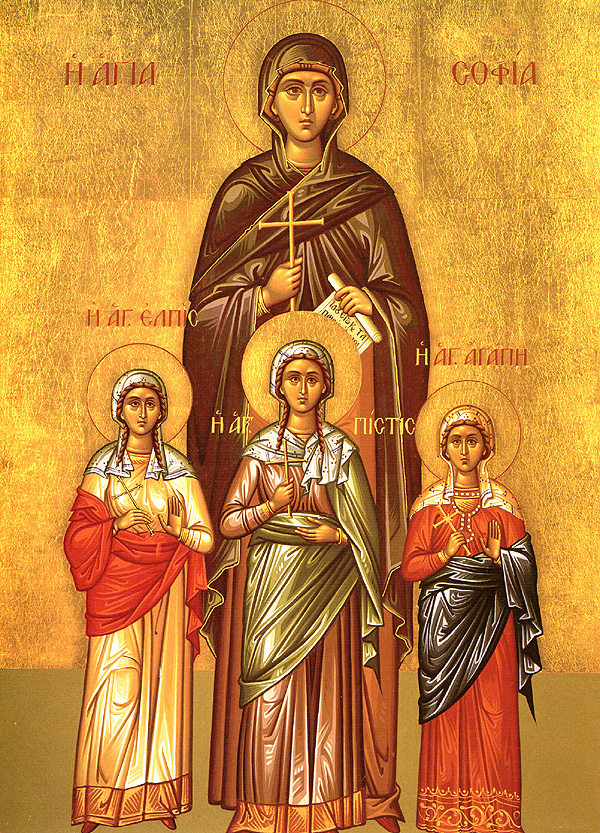
The Holy Martyrs Saint Sophia and her Daughters Faith, Hope and Love were born in Italy. Their mother was a pious Christian widow who named her daughters for the three Christian virtues. Faith was twelve, Hope was ten, and Love was nine. Saint Sophia raised them in the love of the Lord Jesus Christ. Saint Sophia and her daughters did not hide their faith in Christ, but openly confessed it before everyone.
An official named Antiochus denounced them to the emperor Hadrian (117-138), who ordered that they be brought to Rome. Realizing that they would be taken before the emperor, the holy virgins prayed fervently to the Lord Jesus Christ, asking that He give them the strength not to fear torture and death. When the holy virgins and their mother came before the emperor, everyone present was amazed at their composure. They looked as though they had been brought to some happy festival, rather than to torture. Summoning each of the sisters in turn, Hadrian urged them to offer sacrifice to the goddess Artemis. The young girls remained unyielding.
Then the emperor ordered them to be tortured. They burned the holy virgins over an iron grating, then threw them into a red-hot oven, and finally into a cauldron with boiling tar, but the Lord preserved them.
The youngest child, Love, was tied to a wheel and they beat her with rods until her body was covered all over with bloody welts. After undergoing unspeakable torments, the holy virgins glorified their Heavenly Bridegroom and remained steadfast in the Faith.
They subjected Saint Sophia to another grievous torture: the mother was forced to watch the suffering of her daughters. She displayed adamant courage, and urged her daughters to endure their torments for the sake of the Heavenly Bridegroom. All three maidens were beheaded, and joyfully bent their necks beneath the sword.
In order to intensify Saint Sophia’s inner suffering, the emperor permitted her to take the bodies of her daughters. She placed their remains in coffins and loaded them on a wagon. She drove beyond the city limits and reverently buried them on a high hill. Saint Sophia sat there by the graves of her daughters for three days, and finally she gave up her soul to the Lord. Even though she did not suffer for Christ in the flesh, she was not deprived of a martyr’s crown. Instead, she suffered in her heart. Believers buried her body there beside her daughters.
The relics of the holy martyrs have rested at El’zasa, in the church of Esho since the year 777.
source:
https://www.oca.org/saints/lives/1999/09/17/102638-martyr-sophia-and-her-three-daughters-at-rome
source:
https://www.oca.org/saints/lives/1999/09/17/102638-martyr-sophia-and-her-three-daughters-at-rome
Subscribe to:
Posts (Atom)