Sunday, January 10, 2016
Quote by St. Mark The Ascetic on correcting others
If someone does not obey you when you have told him once, do not argue and try to compel him; but take for yourself the profit which he has thrown away. For forbearance will benefit you more than correcting him.
St. Mark The Ascetic
Philokalia


Saturday, December 12, 2015
St. Basil Quote on judging
“If you see your neighbor in sin, don’t look only at this, but also think about what he has done or does that is good, and infrequently trying this in general, while not partially judging, you will find that he is better than you.”
— St. Basil the Great, Conversations, 20
Online Quote
http://www.orthodoxchurchquotes.com/category/sayings-from-saints-elders-and-fathers/st-basil-the-great/page/2/
Venerable Simeon the New Theologian
Venerable Simeon the New Theologian
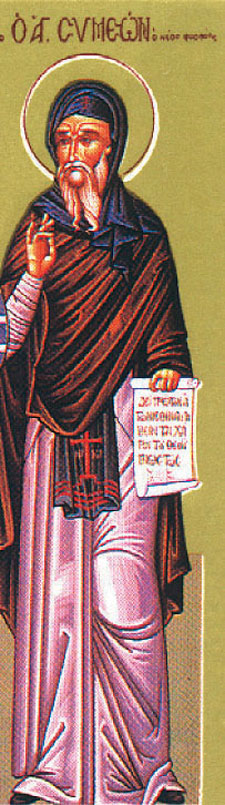

online Source:
http://oca.org/saints/lives/2015/03/12/100790-venerable-simeon-the-new-theologian
St. Symeon the New Theologian quotes
"When a man walks in the fear of God he knows no fear, even if he were to be surrounded by wicked men. He has the fear of God within him and wears the invincible armor of faith. This makes him strong and able to take on anything, even things which seem difficult or impossible to most people. Such a man is like a giant surrounded by monkeys, or a roaring lion among dogs and foxes. He goes forward trusting in the Lord and the constancy of his will to strike and paralyze his foes. He wields the blazing club of the Word in wisdom." -- The Practical and Theological Chapters
"The roof of any house stands upon the foundations and the rest of the structure. The foundations themselves are laid in order to carry the roof. This is both useful and necessary, for the roof cannot stand without the foundations and the foundations are absolutely useless without the roof—no help to any living creature. In the same way the grace of God is preserved by the practice of the commandments, and the observance of these commandments is laid down like foundations through the gift of God. The grace of the Spirit cannot remain with us without the practice of the commandments, but the practice of the commandments is of no help or advantage to us without the grace of God."
"Our holy fathers have renounced all other spiritual work and concentrated wholly on this one doing, that is, on guarding the heart, convinced that, through this practice, they would easily attain every other virtue, whereas without it not a single virtue can be firmly established."
"For those who believe in Him, Christ will become all this and even more, beyond enumeration, not only in the age to come but first in this life, and then in the world to come. Thou in an obscure way here below and in a perfect manner in the Kingdom, those who believe see clearly nonetheless and receive as of now the first-fruits of everything they will have in the future life. Indeed, if they do not receive on earth everything that was promised to them, they do not have any part of foretaste of the blessings to come, their higher hope being set on the hereafter. However, it is through death and the resurrection that God in His foresight has given us the Kingdom, incorruptibility, the totality of life eternal. Given these conditions, we unquestionably become partakers of the good things to come, that is, incorruptible, immortal, sons of God, sons of the light and of the day, inheritors of the Kingdom of Heaven, since we carry the Kingdom within."
online source:
http://orthodoxwiki.org/Symeon_the_New_Theologian
Thursday, November 12, 2015
Saint Maximus' four degrees of dispassion
"St. Maximus sets out four degrees of dispassion.
The first type of dispassion is observed in beginners and is “complete abstention from the actual committing of sin.” In this stage the man does not commit the acts outwardly.
The second dispassion, which occurs in the virtuous, is the complete rejection in the mind of all assent to evil thoughts.
The third dispassion, which is complete quiescence of passionate desire, is found in the deified, and
...the fourth is the complete purging even of passion-free images, in those who are perfect. It seems from this passage that according to the degree of a man's purity, the corresponding dispassion is manifested." (1994, pp. 299-300)
posted on this blog:
https://www.blogger.com/blogger.g?blogID=7389188445839022522#editor/target=post;postID=5390527568632566986;onPublishedMenu=posts;onClosedMenu=posts;postNum=20;src=link
Thursday, November 5, 2015
Church grows under persecution?
Quote by C.S. Lewis
(from the Problem of Pain)
the Church grows under the harshest persecution and grows lethargic
Quote by Lao Tzu
the Church grows under the harshest persecution and grows lethargic
and dies when apart from it
C.S. Lewis
1898-1963
Quote by Lao Tzu
“So it is that some things are increased by being diminished, and others are diminished by being increased.”
State / Church ~ Death Penalty/Mercy...
So we are still left with, what are the boundaries and inter-relationships of the Church and State when it comes to capital punishment?
The historic concensus of the great theologians of the Church, both East and West uniformly affirm the existence of the State as a God ordained power separate from the Church, and its authority to exact capital punishment as an option for the good of society.
One of the quotes from St. John Chrysostom that is usually put forth by anti war and death penalty advocates is, “in our case (as Christians) the wrong-doer must be made better, not by force, but by persuasion”. However, the full quote is from “On the Priesthood”:
"Christians above all men are not permitted forcibly to correct the failings of those who sin. Secular judges indeed, when they have captured malefactors under the law, show their authority to be great, and prevent them even against their will from following their own devices: but in our case the wrong-doer must be made better, not by force, but by persuasion”
St. John is not denying the authority of the State, nor its responsibility to punish and restrain the evildoer. What he is saying is the Church does not use force to convert souls.
In the Christian West, St. Thomas Aquinas sums up the consensus of the Western Fathers in his commentary on I Corinthians 5: “if a man be dangerous and infectious to the community, on account of some sin, it is praiseworthy and advantageous that he be killed in order to safeguard the common good, since ‘a little leaven corrupteth the whole lump’ (1 Corinthians 5:6)” (ST II-II q. 64, art. 2).
On the Orthodox side of things, in the “Bases of the Social Concept of the Russian Orthodox Church” the Russian bishops underscore St. John and Bill Gould, and essentially concur with the Catholic and Lutheran statements. It says,
“The Church should not assume the prerogatives of the state, such as resistance to sin by force, use of temporal authoritative powers and assumption of the governmental functions which presuppose coercion or restriction. At the same time, the Church may request or urge the government to exercise power in particular cases, yet the decision (to do so) rests with the state…. There are no indications to the need to abolish (the death penalty) in the New Testament or in the Tradition, or in the historical legacy of the Orthodox Church either…. Keeping in mind that mercy toward a fallen man is always more preferable than revenge, the Church welcomes these steps by state authorities. At the same time, she believes that the decision to abolish or not to apply death penalty should be made by society freely, considering the rate of crime and the state of law-enforcement and judiciary, and even more so, the need to protect the life of its well-intentioned members.”
...
“The state does not bear the sword for naught”, St. Paul says. St. John Chrysostom comments on this passage in Romans 13 and says: For he bears not the sword in vain. You see how (God) has furnished him with arms, and set him on guard like a soldier for a terror to those that commit sin. For he is the minister of God to execute wrath, a revenger upon him that does evil.”
Source of Quote:
http://www.ancientfaith.com/podcasts/stevethebuilder/capital_punishment_part_4
Subscribe to:
Posts (Atom)