A place to discuss Orthodox Christianity, faith, tradition, philosophy, and other things... to the One Holy, Catholic and Apostolic Church--- Kýrie Isoú Christé eléi̱son i̱más
--- En archí̱ i̱n o Lógos kai o
Lógos í̱tan me to Theó , kai
Lógos í̱tan o Theós...
... kai o Lógos égine sárka kai katoíki̱se anámesá mas. Glory to God!!!
What is morally wrong can never be advantageous, even when it enables you to make some gain that you believe to be to your advantage. The mere act of believing that some wrongful course of action constitutes an advantage is pernicious.
The Great Martyr Theodore Stratelates came from the city of Euchaita in Asia Minor. He was endowed with many talents, and was handsome in appearance. For his charity God enlightened him with the knowledge of Christian truth. The bravery of the saintly soldier was revealed after he, with the help of God, killed a giant serpent living on a precipice in the outskirts of Euchaita. The serpent had devoured many people and animals, terrorizing the countryside. Saint Theodore armed himself with a sword and vanquished it, glorifying the name of Christ among the people.
For his bravery Saint Theodore was appointed military commander [stratelatos] in the city of Heraclea, where he combined his military service with preaching the Gospel among the pagans subject to him. His gift of persuasion, reinforced by his personal example of Christian life, turned many from their false gods. Soon, nearly all of Heraclea had accepted Christianity.
During this time the emperor Licinius (311-324) began a fierce persecution against Christians. In an effort to stamp out the new faith, he persecuted the enlightened adherents of Christianity, who were perceived as a threat to paganism. Among these was Saint Theodore. Licinius tried to force Saint Theodore to offer sacrifice to the pagan gods. The saint invited Licinius to come to him with his idols so both of them could offer sacrifice before the people.
Blinded by his hatred for Christianity, Licinius trusted the words of the saint, but he was disappointed. Saint Theodore smashed the gold and silver statues into pieces, which he then distributed to the poor. Thus he demonstrated the vain faith in soulless idols, and also displayed Christian charity.
Saint Theodore was arrested and subjected to fierce and refined torture. He was dragged on the ground, beaten with iron rods, had his body pierced with sharp spikes, was burned with fire, and his eyes were plucked out. Finally, he was crucified. Varus, the servant of Saint Theodore, barely had the strength to write down the incredible torments of his master.
God, however, in His great mercy, willed that the death of Saint Theodore should be as fruitful for those near him as his life was. An angel healed the saint’s wounded body and took him down from the cross. In the morning, the imperial soldiers found him alive and unharmed. Seeing with their own eyes the infinite might of the Christian God, they were baptized not far from the place of the unsuccessful execution.
Thus Saint Theodore became “like a day of splendor” for those pagans dwelling in the darkness of idolatary, and he enlightened their souls “with the bright rays of his suffering.” Unwilling to escape martyrdom for Christ, Saint Theodore voluntarily surrendered himself to Licinius, and discouraged the Christians from rising up against the torturer, saying, “Beloved, halt! My Lord Jesus Christ, hanging upon the Cross, restrained the angels and did not permit them to take revenge on the race of man.”
Going to execution, the holy martyr opened up the prison doors with just a word and freed the prisoners from their bonds. People who touched his robe were healed instantly from sicknesses, and freed from demonic possession. By order of the emperor, Saint Theodore was beheaded by the sword. Before his death he told Varus, “ Do not fail to record the day of my death, and bury my body in Euchaita.” He also asked to be remembered each year on this date. Then he bent his neck beneath the sword, and received the crown of martyrdom which he had sought. This occurred on February 8, 319, on a Saturday, at the third hour of the day.
Saint Theodore is regarded as the patron saint of soldiers. He is also commemorated on June 8.
There is the case of a man minding his own business, sitting at peace and quiet; and when a brother comes up and says an annoying word to him, he is put out by it. And from the circumstances he thinks that he is justifiably angered, and he speaks against the one who troubled him, saying, "If he had not come and spoken to me and annoyed me I should not have been at fault." This is a delusion: this is false reasoning! It was not the one who spoke that put him in a bad mood. He only showed that it already existed in him; so that he could, if he chose, make reparation for his fault. But the man referred to above is like clean-looking winter wheat, externally good and ready to use; but when someone crushes it, its corruption is revealed. He was sitting at peace but he had this anger inside him and he did not know it. One word to him from the other and the corruption hidden inside him leapt out.
From St. Dorotheos of Gaza (Discourses and Sayings; Cistercian Publications pg. 142):
Thus I will, thus I command, my pleasure stands for a reason.
The Abolition of Man (page 65)
~ C.S. Lewis
This reminds me of a saying by the Satanic manifesto:
Do as thou wilt, that shall be the whole of the law
In Matthew our Lord says
Matthew 22:37-40 NKJV
37 Jesus said to him, “‘You shall love the Lord your God with all your heart, with all your soul, and with all your mind.’38 This is the first and great commandment.39 And the second is like it:‘You shall love your neighbor as yourself.’40 On these two commandments hang all the Law and the Prophets.”
Satan would say it in the opposite:
You shall hate the Lord your God with all your heart, with all your soul, and with all your mind.
You shall hate your neighbor as yourself.
C.S. Lewis' book, point by point, explains that when we remove the Commandments, the virtues, the absolutes or The Tao(Lewis calls it the Tao), we remove any value system professing good and evil and step into a void where we have no values. We can't even call anyone in this void good or evil, because such distinctions do not exist within it. Good and evil are distinctions within the Tao only; outside of this Tao there is only feeling, emotion and passions, and the degree or level that those impose on us. Lewis is warning the generations then and now about stepping into this void. What a thought! He called the deciders of what is and should be as 'conditioners' that will replace the Tao. These conditioners within this void will naturally arise to fill the space. These conditioners will instruct to us what is "good" or "proper".
How have The Supreme Court, and Secular or Progressive thinkers moved us closer to the void? Which political party do these proponents of the void side with? Are we currently in the void in some ways? Is the religion of Scientism a conditioner? Or Technocratism, Progressiveism, Humanism, LGBTQ+ism?
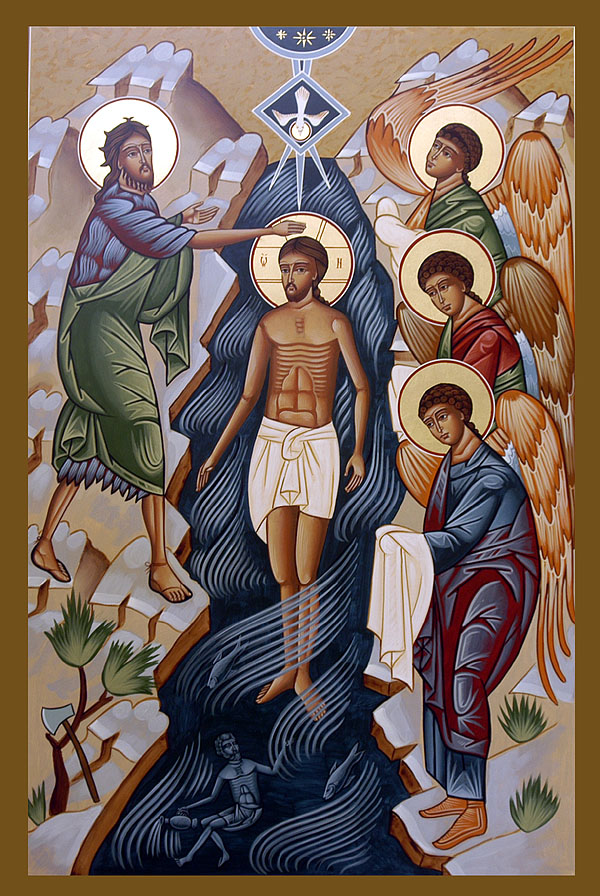
The second day of the Afterfeast of Theophany falls on January 8. At Vespers we repeat a hymn which has already been sung at Compline for Theophany. In the hymn Saint John wonders in whose name he should baptize Christ. Should he baptize Him in the name of the Father? The Lord Jesus Christ already bears Him in Himself. Of the Son? He Himself is the incarnate Son of God. Of the Holy Spirit? Christ Himself sends the Spirit.
"One day, while St. Antony was sitting with a certain Abba, a virgin came up and said to the Elder: 'Abba, I fast six days of the week and I repeat by heart portions of the Old and New Testament daily.' To which the Elder replied: 'Does poverty mean the same to you as abundance?' 'No', she answered. 'Or dishonour the same as praise?' 'No, Abba.' 'Are your enemies the same for you as your friends?' 'No', she replied. At that the wise Elder said to her: 'Go, get to work, you have accomplished nothing.' "