A place to discuss Orthodox Christianity, faith, tradition, philosophy, and other things... to the One Holy, Catholic and Apostolic Church--- Kýrie Isoú Christé eléi̱son i̱más
--- En archí̱ i̱n o Lógos kai o
Lógos í̱tan me to Theó , kai
Lógos í̱tan o Theós...
... kai o Lógos égine sárka kai katoíki̱se anámesá mas. Glory to God!!!
Saint Porphyrius, Archbishop of Gaza, was born about the year 346 at Thessalonica. His parents were people of substance, and this allowed Saint Porphyrius to receive a fine education. Having the inclination for monastic life, he left his native region at twenty-five years of age and set off for Egypt, where he lived in the Nitrian desert under the guidance of Saint Macarius the Great (January 19). There he also met Saint Jerome (June 15), who was then visiting the Egyptian monasteries. He went to Jerusalem on pilgrimage to the holy places, and to venerate the Life-Creating Cross of the Lord (September 14), then he moved into a cave in the Jordanian wilderness for prayer and ascetic deeds.
After five years, Saint Porphyrius was afflicted with a serious malady of the legs. He decided to go to the holy places of Jerusalem to pray for healing. As he lay half-conscious at the foot of Golgotha, Saint Porphyrius fell into a sort of trance. He beheld Jesus Christ descending from the Cross and saying to him, “Take this Wood and preserve it.”
Coming out of his trance, he found himself healthy and free from pain. Then he gave away all his money to the poor and for the adornment of the churches of God. For a time he supported himself by working as a shoemaker. The words of the Savior were fulfilled when the saint was forty-five years old. The Patriarch of Jerusalem ordained Saint Porphyrius to the holy priesthood and appointed him custodian of the Venerable Wood of the Cross of the Lord.
In 395 the bishop of the city of Gaza (in Palestine) died. The local Christians went to Caesarea to ask Metropolitan John to send them a new bishop who would be able to contend against the pagans, which were predominant in their city and were harassing the Christians there. The Lord inspired the Metropolitan to summon the priest Porphyrius. With fear and trembling the ascetic accepted the office of bishop, and with tears he prostrated himself before the Life-Creating Wood and went to fulfill his new obedience.
In Gaza there were only three Christian churches, but there were a great many pagan temples and idols. During this time there had been a long spell without rain, causing a severe drought. The pagan priests brought offerings to their idols, but the woes did not cease. Saint Porphyrius imposed a fast for all the Christians; he then served an all-night Vigil, followed by a church procession around the city. Immediately the sky covered over with storm clouds, thunder boomed, and abundant rains poured down. Seeing this miracle, many pagans cried out, “Christ is indeed the only true God!” As a result of this, 127 men, thirty-five women and fourteen children were united to the Church through Holy Baptism, and another 110 men soon after this.
The pagans continued to harass the Christians. They passed them over for public office, and burdened them with taxes. Saint Porphyrius and Metropolitan John of Caesarea journeyed to Constantinople to seek redress from the emperor. Saint John Chrysostom (September 14, January 27 and 30) received them and assisted them.
Ss. John and Porphyrius were presented to the empress Eudoxia who was expecting a child at that time. “Intercede for us,” said the bishops to the empress, “and the Lord will send you a son, who shall reign during your lifetime”. Eudoxia very much wanted a son, since she had given birth only to daughters. Through the prayer of the saints an heir was born to the imperial family. As a result of this, the emperor issued an edict in 401 ordering the destruction of pagan temples in Gaza and the restoration of privileges to Christians. Moreover, the emperor gave the saints money for the construction of a new church, which was to be built in Gaza on the site of the chief pagan temple.
Saint Porphyrius upheld Christianity in Gaza to the very end of his life, and guarded his flock from the vexatious pagans. Through the prayers of the saint numerous miracles and healings occurred. The holy archpastor guided his flock for twenty-five years, and reposed in 420 at an advanced age.
St Symeon the New Theologian:'Let each one of us keep in mind the benefit of fasting... For this healer of our souls is effective, in the case of one to quieten the fevers and impulses of the flesh, in another to assuage bad temper, in yet another to drive away sleep, in another to stir up zeal, and in yet another to restore purity of mind and to set him free from evil thoughts. In one it will control his unbridled tongue and, as it were by a bit, restrain it by the fear of God and prevent it from uttering idle and corrupt words. In another it will invisibly guard his eyes and fix them on high instead of allowing them to roam hither and thither, and thus cause him to look on himself and teach him to be mindful of his own faults and shortcomings. Fasting gradually disperses and drives away spiritual darkness and the veil of sin that lies on the soul, just as the sun dispels the mist. Fasting enables us spiritually to see that spiritual air in which Christ, the Sun who knows no setting, does not rise, but shines without ceasing. Fasting, aided by vigil, penetrates and softens hardness of heart. where once were the vapors of drunkenness it causes fountains of compunction to spring forth. I beseech you, brethren, let each of us strive that this may happen in us! Once this happens we shall readily, with God's help, cleave through the whole sea of passions and pass through the waves of the temptations inflicted by the cruel tyrant, and so come to anchor in the port of impassibility.
'My brethren, it is not possible for these things to come about in one day or one week! They will take much time, labor, and pain, in accordance with each man's attitude and willingness, according to the measure of faith and one's contempt for the objects of sight and thought. In addition, it is also in accordance with the fervor of his ceaseless penitence and its constant working in the secret chamber of his heart that this is accomplished more quickly or more slowly by the gift and grace of God. But without fasting no one was ever able to achieve any of these virtues or any others, for fasting is the beginning and foundation of every spiritual activity'.
— Symeon the New Theologian: the Discourses, pub. Paulist Press. pp. 168-169.
Mother Gavrilia of blessed memory spent much time traveling in the service of Christ to places that separated her from the daily liturgical life of the Church. Especially during these times, the advice of her spiritual father Archimandrite Lazarus Moore stood her in good stead:
'Fasting is one of our greatest weapons against the Evil One. I will repeat what Father Lazarus told me once. In 1962, I went to the USA. I stayed there a long time and travelled to many states. The letters of Father Lazarus were a great help... He used to say: "Go anywhere you like, do whatever you like, as long as you observe Fasting"... Because not a single arrow of the Evil One can reach you when you fast. Never.'
— Ascetic of Love, the biography of Mother Gavrilia, pub. Series Talanto. pg. 200.
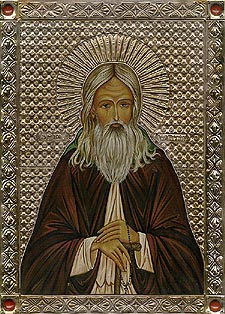
St Seraphim of Sarov on Fasting: 'Once there came to him a mother who was concerned about how she might arrange the best possible marriage for her young daughter. When she came to Saint Seraphim for advice, he said to her: "Before all else, ensure that he, whom your daughter chooses as her companion for life, keeps the fasts. If he does not, then he is not a Christian, whatever he may consider himself to be."'
— From a sermon of Metropolitan Philaret, quoted in The Ladder of Divine Ascent, pub. Holy Trinity Monastery, pg.xxxiii.
Abba Daniel of Sketis: 'In proportion as the body grows fat, so does the soul wither away.'
notes:
The rules given here are of course only one part, the most external part, of a true fast, which will include increased prayer and other spiritual disciplines, and may include resolutions to set aside other aspects of our day-to-day life (such as caffeine or television), or to take up practices such as visiting the sick.
Obviously, many Orthodox do not keep the traditional rule. If you adopt it, beware of pride, and pay no attention to anyone's fast but your own. As one monastic put it, we must "keep our eyes on our own plates."
Do not substitute the notion of "deciding what to give up for Lent" for the rule that the Church has given us. First, keep the Church's fasting rule as well as you are able, then decide on additional disciplines, in consultation with your priest.
We are always advised to fast according to our strength, and you may find from experience that you need to modify the fasting rule to fit your own strength and situation. But do not assume beforehand that the rule is too difficult for you. The Lord is our strength, and can uphold us in marvelous and unforseen ways.
Those who attempt to keep the Church's traditional fast will find that, though the temptations to pride and legalism are real, the spiritual benefits are great. A return to more diligent fasting could play a large part in the spiritual renewal of our Orthodox churches.
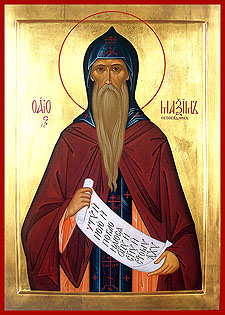
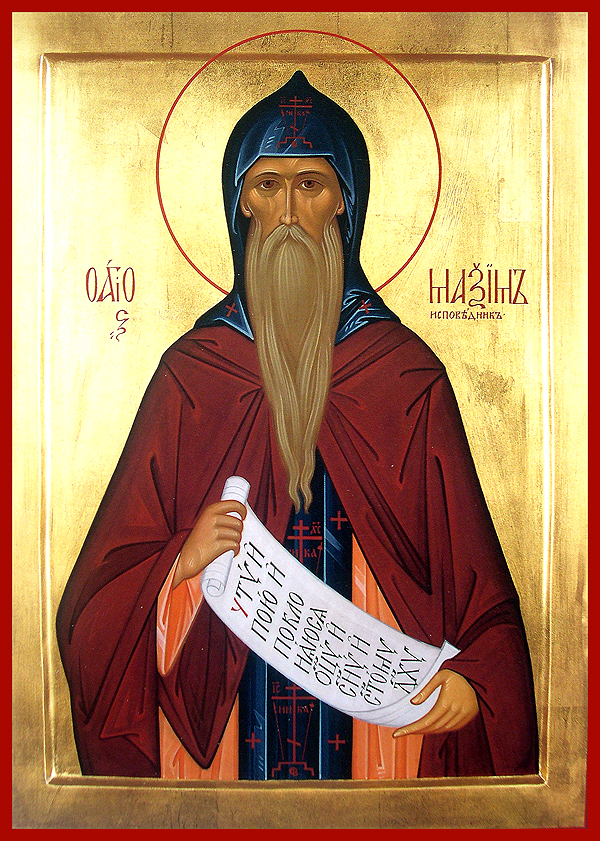
Saint Maximus the Confessor was born in Constantinople around 580 and raised in a pious Christian family. He received an excellent education, studying philosophy, grammar, and rhetoric. He was well-read in the authors of antiquity and he also mastered philosophy and theology. When Saint Maximus entered into government service, he became first secretary (asekretis) and chief counselor to the emperor Heraclius (611-641), who was impressed by his knowledge and virtuous life.
Saint Maximus soon realized that the emperor and many others had been corrupted by the Monothelite heresy, which was spreading rapidly through the East. He resigned from his duties at court, and went to the Chrysopolis monastery (at Skutari on the opposite shore of the Bosphorus), where he received monastic tonsure. Because of his humility and wisdom, he soon won the love of the brethren and was chosen igumen of the monastery after a few years. Even in this position, he remained a simple monk.
In 638, the emperor Heraclius and Patriarch Sergius tried to minimize the importance of differences in belief, and they issued an edict, the “Ekthesis” (“Ekthesis tes pisteos” or “Exposition of Faith),” which decreed that everyone must accept the teaching of one will in the two natures of the Savior. In defending Orthodoxy against the “Ekthesis,” Saint Maximus spoke to people in various occupations and positions, and these conversations were successful. Not only the clergy and the bishops, but also the people and the secular officials felt some sort of invisible attraction to him, as we read in his Life.
When Saint Maximus saw what turmoil this heresy caused in Constantinople and in the East, he decided to leave his monstery and seek refuge in the West, where Monothelitism had been completely rejected. On the way, he visited the bishops of Africa, strengthening them in Orthodoxy, and encouraging them not to be deceived by the cunning arguments of the heretics.
The Fourth Ecumenical Council had condemned the Monophysite heresy, which falsely taught that in the Lord Jesus Christ there was only one nature (the divine). Influenced by this erroneous opinion, the Monothelite heretics said that in Christ there was only one divine will (“thelema”) and only one divine energy (“energia”). Adherents of Monothelitism sought to return by another path to the repudiated Monophysite heresy. Monothelitism found numerous adherents in Armenia, Syria, Egypt. The heresy, fanned also by nationalistic animosities, became a serious threat to Church unity in the East. The struggle of Orthodoxy with heresy was particularly difficult because in the year 630, three of the patriarchal thrones in the Orthodox East were occupied by Monothelites: Constantinople by Sergius, Antioch by Athanasius, and Alexandria by Cyrus.
Saint Maximus traveled from Alexandria to Crete, where he began his preaching activity. He clashed there with a bishop, who adhered to the heretical opinions of Severus and Nestorius. The saint spent six years in Alexandria and the surrounding area.
Patriarch Sergius died at the end of 638, and the emperor Heraclius also died in 641. The imperial throne was eventually occupied by his grandson Constans II (642-668), an open adherent of the Monothelite heresy. The assaults of the heretics against Orthodoxy intensified. Saint Maximus went to Carthage and he preached there for about five years. When the Monothelite Pyrrhus, the successor of Patriarch Sergius, arrived there after fleeing from Constantinople because of court intrigues, he and Saint Maximus spent many hours in debate. As a result, Pyrrhus publicly acknowledged his error, and was permitted to retain the title of “Patriarch.” He even wrote a book confessing the Orthodox Faith. Saint Maximus and Pyrrhus traveled to Rome to visit Pope Theodore, who received Pyrrhus as the Patriarch of Constantinople.
In the year 647 Saint Maximus returned to Africa. There, at a council of bishops Monotheletism was condemned as a heresy. In 648, a new edict was issued, commissioned by Constans and compiled by Patriarch Paul of Constantinople: the “Typos” (“Typos tes pisteos” or “Pattern of the Faith”), which forbade any further disputes about one will or two wills in the Lord Jesus Christ. Saint Maximus then asked Saint Martin the Confessor (April 14), the successor of Pope Theodore, to examine the question of Monothelitism at a Church Council. The Lateran Council was convened in October of 649. One hundred and fifty Western bishops and thirty-seven representatives from the Orthodox East were present, among them Saint Maximus the Confessor. The Council condemned Monothelitism, and the Typos. The false teachings of Patriarchs Sergius, Paul and Pyrrhus of Constantinople, were also anathematized.
When Constans II received the decisions of the Council, he gave orders to arrest both Pope Martin and Saint Maximus. The emperor’s order was fulfilled only in the year 654. Saint Maximus was accused of treason and locked up in prison. In 656 he was sent to Thrace, and was later brought back to a Constantinople prison.
The saint and two of his disciples were subjected to the cruelest torments. Each one’s tongue was cut out, and his right hand was cut off. Then they were exiled to Skemarum in Scythia, enduring many sufferings and difficulties on the journey.
After three years, the Lord revaled to Saint Maximus the time of his death (August 13, 662). Three candles appeared over the grave of Saint Maximus and burned miraculously. This was a sign that Saint Maximus was a beacon of Orthodoxy during his lifetime, and continues to shine forth as an example of virtue for all. Many healings occurred at his tomb.
In the Greek Prologue, August 13 commemorates the Transfer of the Relics of Saint Maximus to Constantinople, but it could also be the date of the saint’s death. It may be that his memory is celebrated on January 21 because August 13 is the Leavetaking of the Feast of the Transfiguration of the Lord.
Saint Maximus has left to the Church a great theological legacy. His exegetical works contain explanations of difficult passages of Holy Scripture, and include a Commentary on the Lord’s Prayer and on Psalm 59, various “scholia” or “marginalia” (commentaries written in the margin of manuscripts), on treatises of the Hieromartyr Dionysius the Areopagite (October 3) and Saint Gregory the Theologian (January 25). Among the exegetical works of Saint Maximus are his explanation of divine services, entitled “Mystagogia” (“Introduction Concerning the Mystery”).
The dogmatic works of Saint Maximus include the Exposition of his dispute with Pyrrhus, and several tracts and letters to various people. In them are contained explanations of the Orthodox teaching on the Divine Essence and the Persons of the Holy Trinity, on the Incarnation of the Word of God, and on “theosis” (“deification”) of human nature.
“Nothing in theosis is the product of human nature,” Saint Maximus writes in a letter to his friend Thalassius, “for nature cannot comprehend God. It is only the mercy of God that has the capacity to endow theosis unto the existing... In theosis man (the image of God) becomes likened to God, he rejoices in all the plenitude that does not belong to him by nature, because the grace of the Spirit triumphs within him, and because God acts in him” (Letter 22).
Saint Maximus also wrote anthropological works (i.e. concerning man). He deliberates on the nature of the soul and its conscious existence after death. Among his moral compositions, especially important is his “Chapters on Love.” Saint Maximus the Confessor also wrote three hymns in the finest traditions of church hymnography, following the example of Saint Gregory the Theologian.
The theology of Saint Maximus the Confessor, based on the spiritual experience of the knowledge of the great Desert Fathers, and utilizing the skilled art of dialectics worked out by pre-Christian philosophy, was continued and developed in the works of Saint Simeon the New Theologian (March 12), and Saint Gregory Palamas (November 14).
Saint Gregory, Bishop of Nyssa, was a younger brother of Saint Basil the Great (January 1). His birth and upbringing came at a time when the Arian disputes were at their height. Having received an excellent education, he was at one time a teacher of rhetoric. In the year 372, he was consecrated by Saint Basil the Great as bishop of the city of Nyssa in Cappadocia.
Saint Gregory was an ardent advocate for Orthodoxy, and he fought against the Arian heresy with his brother Saint Basil. Gregory was persecuted by the Arians, by whom he was falsely accused of improper use of church property, and thereby deprived of his See and sent to Ancyra.
In the following year Saint Gregory was again deposed in absentia by a council of Arian bishops, but he continued to encourage his flock in Orthodoxy, wandering about from place to place. After the death of the emperor Valens (378), Saint Gregory was restored to his cathedra and was joyously received by his flock. His brother Saint Basil the Great died in 379.
Only with difficulty did Saint Gregory survive the loss of his brother and guide. He delivered a funeral oration for him, and completed Saint Basil’s study of the six days of Creation, the Hexaemeron. That same year Saint Gregory participated in the Council of Antioch against heretics who refused to recognize the perpetual virginity of the Mother of God. Others at the opposite extreme, who worshipped the Mother of God as being God Herself, were also denounced by the Council. He visited the churches of Arabia and Palestine, which were infected with the Arian heresy, to assert the Orthodox teaching about the Most Holy Theotokos. On his return journey Saint Gregory visited Jerusalem and the Holy Places.
In the year 381 Saint Gregory was one of the chief figures of the Second Ecumenical Council, convened at Constantinople against the heresy of Macedonius, who incorrectly taught about the Holy Spirit. At this Council, on the initiative of Saint Gregory, the Nicean Symbol of Faith (the Creed) was completed.
Together with the other bishops Saint Gregory affirmed Saint Gregory the Theologian as Archpastor of Constantinople.
In the year 383, Saint Gregory of Nyssa participated in a Council at Constantinople, where he preached a sermon on the divinity of the Son and the Holy Spirit. In 386, he was again at Constantinople, and he was asked to speak the funeral oration in memory of the empress Placilla. Again in 394 Saint Gregory was present in Constantinople at a local Council, convened to resolve church matters in Arabia.
Saint Gregory of Nyssa was a fiery defender of Orthodox dogmas and a zealous teacher of his flock, a kind and compassionate father to his spiritual children, and their intercessor before the courts. He was distinguished by his magnanimity, patience and love of peace.
Having reached old age, Saint Gregory of Nyssa died soon after the Council of Constantinople. Together with his great contemporaries, Saints Basil the Great and Gregory the Theologian, Saint Gregory of Nyssa had a significant influence on the Church life of his time. His sister, Saint Macrina, wrote to him: “You are renowned both in the cities, and gatherings of people, and throughout entire districts. Churches ask you for help.” Saint Gregory is known in history as one of the most profound Christian thinkers of the fourth century. Endowed with philosophical talent, he saw philosophy as a means for a deeper penetration into the authentic meaning of divine revelation.
Saint Gregory left behind many remarkable works of dogmatic character, as well as sermons and discourses. He has been called “the Father of Fathers.”
Venerable Herman of Alaska, Wonderworker of All America. A spiritual mission was organized in 1793 with volunteers from the monks of the Valaam Monastery. They were sent to preach the Word of God to the native inhabitants of northwestern America, who had come under the sovereignty of Russia only ten years before. Saint Herman was one of the members of this mission.
Saint Herman came from a family of merchants of Serpukhov, a city of the Moscow diocese. His name before he was tonsured, and his family name are not known. There is a possibility, however, that his baptismal name was Gerasimus. He had a great zeal for piety from his youth, and he entered monastic life at sixteen. (This was in 1772, if we assume that Herman was born in 1756, although sometimes 1760 is given as the date of his birth.) First he entered the Trinity-Sergius Hermitage which was located near the Gulf of Finland on the Peterhof Road, about 15 versts (about 10 miles) from Saint Petersburg. He also spent time at at Sarov, where he first met Father Nazarius, who became his Elder at Valaam. Later, Saint Herman followed him to Sanaxar where Saint Theodore (February 19) was their igumen.
Miraculous Healing
At the Saint Sergius Hermitage there occurred the following incident to Father Herman. On the right side of his throat under his chin there appeared an abscess. The swelling grew rapidly, disfiguring his face. It became difficult for him to swallow, and the odor was unbearable. In this critical condition Father Herman awaited death. He did not appeal to a physician of this world, but locking his cell he fell before an icon of the Mother of God. With fervent tears he prayed, asking of Her that he might be healed. He prayed the whole night. Then he took a wet towel and with it wiped the face of the Most Holy Mother, and with this towel he covered the swelling. He continued to pray with tears until he fell asleep from sheer exhaustion on the floor. In a dream he saw the Virgin Mary healing him.
When Herman awoke in the morning, he found to his great surprise that he was fully healed. The swelling had disappeared, even though the abscess had not broken through, leaving behind but a small mark as though a reminder of the miracle. Physicians to whom this healing was described did not believe it, arguing that it was necessary for the abscess to have either broken through of its own accord or to have been cut open. But the words of the physicians were the words of human experience, for where the grace of God operates there the order of nature is overcome. Such occurrences humble human reason under the strong hand of God’s Mercy.
Life at Valaam
For five or six years Father Herman continued to live in the Saint Sergius Hermitage, and then he transferred to the Valaam Monastery, which was widely scattered on the large islands in the waters of the great Lake Ladoga. He came to love the Valaam haven with all his soul, as he came to love its unforgettable Superior, the pious Elder Nazarius, and all the brethren. He wrote to Father Nazarius later from America, “Your fatherly goodness to me, humble one, will be erased out of my heart neither by the terrible, unpassable Siberian lands, nor by the dark forests. Nor will it be wiped out by the swift flow of the great rivers; nor will the awful ocean quench these feelings. In my mind I imagine my beloved Valaam, looking to it beyond the great ocean.” He praised the Elder Nazarius in his letters as, “the most reverend, and my beloved father,” and the brethren of Valaam he called, “my beloved and dearest.” The place where he lived in America, deserted Spruce Island, he called “New Valaam.” And as we can see, he always remained in spiritual contact with his spiritual homeland, for as late as 1823, that is after thirty years of his life within the borders of America, he wrote letters to the successor of Father Nazarius, the lgumen Innocent.
Father Barlaam, later lgumen of Valaam, and a contemporary of Father Herman, who accepted his tonsure from Father Nazarius, wrote thus of the life of Father Herman.
“Father Herman went through the various obediences here, and being ‘well disposed toward everything’ was in the course of events sent to Serdobol to oversee there the work of quarrying marble. The Brothers loved Father Herman, and awaited impatiently his return to the cloisters from Serdobol. Recognizing the zeal of the young hermit the wise elder, Father Nazarius, released him to take abode in the wilderness. This wilderness was in the deep forest about a mile from the cloister: to this day this place has retained the name ‘Herman’s.’ On holy days, Father Herman returned to the monastery from the wilderness. Then it was that at Little Vespers he would stand in the choir and sing in his pleasant tenor the responses with the brethren from the Canon, ‘O Sweetest Jesus, save us sinners. Most Holy Theotokos, Save us,’ and tears would fall like hail from his eyes.”
The First Mission to America
In the second half of the 18th century the borders of Holy Russia expanded to the north. In those years Russian merchants discovered the Aleutian Islands which formed in the Pacific Ocean a chain from the eastern shores of Kamchatka to the western shores of North America. With the opening of these islands there was revealed the sacred necessity to illumine with the light of the Gospel the native inhabitants. With the blessing of the Holy Synod, Metropolitan Gabriel gave to the Elder Nazarius the task of selecting capable persons from the brethern of Valaam for this holy endeavor. Ten men were selected, and among them was Father Herman. The chosen men left Valaam for the place of their great appointment in 1793. (The members of this historical mission were: Archimandrite Joseph (Bolotoff), the Hieromonks, Juvenal, Macarius, Athanasius, Stephan and Nectarius, Hierodeacons, Nectarius and Stephen, and the monks Joasaph, and Herman.)
As a result of the holy zeal of the preachers the light of the evangelic sermon quickly poured out among the sons of Russia, and several thousand pagans accepted Christianity. A school for the education of newly-baptized children was organized, and a church was built at the place where the missionaries lived. But by the inscrutable providence of God the general progress of the mission was unsatisfactory. After five years of very productive labor, Archimandrite Joasaph, who had just been elevated to the rank of bishop, was drowned with his party. (This occurred on the Pacific Ocean between Kamchatka and the Aleutian Islands. The ship, Phoenix, one of the first sea-going ships built in Alaska, sailed from Okhotsk carrying the first Bishop for the American Mission and his party. The Phoenix was caught in one of the many storms which periodically sweep the northern Pacific, and the ship and all hands perished together with Bishop Joasaph and his party.) Before this the zealous Hieromonk Juvenal was granted the martyr’s crown. The others died one after another until in the end only Father Herman remained. The Lord permitted him to labor longer than any of his brethren in the apostolic task of enlightening the Aleutians.
The New Valaam — Spruce Island
In America, Father Herman chose as his place of habitation Spruce Island, which he called New Valaam. This island is separated by a strait about a mile and a quarter wide from Kodiak Island on which had been built a wooden monastery for the residence of the members of the mission, and a wooden church dedicated to the Resurrection of the Savior. (New Valaam was named for Valaam on Lake Ladoga, the monastery from which Father Herman came to America. It is interesting to note that Valaam is also located on an island, although, this island is in a fresh water lake, whereas, Spruce Island is on the Pacific Ocean, although near other islands and the Alaskan mainland.)
Spruce Island is not large, and is almost completely covered by a forest. Almost through its middle a small brook flows to the sea. Herman selected this picturesque island for the location of his hermitage. He dug a cave out of the ground with his own hands, and in it he lived his first full summer. For winter there was built for him a cell near the cave, in which he lived until his death. The cave was converted by him into a place for his burial. A wooden chapel, and a wooden house to be used as a schoolhouse and a guest house were built not too distant from his cell. A garden was laid out in front of his cell. For more than forty years Father Herman lived here.
Father Herman’s Way of Life
Father Herman himself spaded the garden, planted potatoes and cabbage and various vegetables in it. For winter, he preserved mushrooms, salting or drying them. The salt was obtained by him from ocean water. It is said that a wicker basket in which the Elder carried seaweed from the shore, was so large that it was difficult for one person to carry. The seaweed was used for fertilizing the soil. But to the astonishment of all, Father Herman carried a basket filled with seaweed for a long distance without any help at all. By chance his disciple, Gerasim, saw him one winter night carrying a large log which normally would be carried by four men; and he was bare footed. Thus worked the Elder, and everything that he acquired as a result of his immeasurable labors was used for the feeding and clothing of orphans and also for books for his students.
His clothes were the same for winter as for summer. He did not wear a shirt; instead he wore a smock of deer skin, which he did not take off for several years at a time, nor did he change it, so that the fur in it was completely worn away, and the leather became glossy. Then there were his boots or shoes, cassock (podrasnik), an ancient and faded out cassock (riasa) full of patchwork, and his headdress (klobuk). He went everywhere in these clothes, and at all times; in the rain, in snowstorms, and during the coldest freezing weather. In this, Father Herman followed the example of many Eastern Ascetic Fathers and Monks who showed the greatest concern for the welfare and needs of others. Yet, they themselves wore the oldest possible clothes to show their great humility before God, and their detachment from worldly things.
A small bench covered with a time-worn deerskin served as Father Herman’s bed. He used two bricks for a pillow; these were hidden from visitors by a skin or a shirt. There was no blanket. Instead, he covered himself with a wooden board which lay on the stove. This board Father Herman, himself called his blanket, and he willed that it be used to cover his remains; it was as long as he was tall. “During my stay in the cell of Father Herman,” writes the creole Constantine Larionov, “I, a sinner, sat on his ‘blanket’-and I consider this the acme of my fortune!” (‘creole’ is the name by which the Russians referred to the children of mixed marriages of native Indians of Alaska, Eskimo and Aleuts with Russians.)
On the occasions when Father Herman was the guest of administrators of the American Company and in the course of their soul-saving talks he sat up with them until midnight. He never spent the night with them, but regardless of the weather he always returned to his hermitage. If for some extraordinary reason it was necessary for him to spend the night away from his cell, then in the morning the bed which had been prepared for him would be found untouched; the Elder not having slept at all. The same was true in his hermitage where having spent the night in talks, he never rested.
The Elder ate very little. As a guest, he scarcely tasted the food, and remained without dinner. In his cell his dinner consisted of a very small portion of a small fish or some vegetables. His body, emaciated as a result of his labors, his vigils, and fasting, was crushed by chains which weighed about sixteen pounds. These chains are kept to this day in the chapel. Telling of these deeds of Father Herman, his disciple, the Aleut Ignaty Aligyaga, added, “Yes, Apa led a very hard life, and no one can imitate his life!” (The Aleutian word “Apa” means Elder or grandfather, and it is a name indicative of the great affection in which he was held).
Our writing of the incidents in the life of the Elder deal, so to speak, with the external aspects of his labor. “His most important works,” says the Bishop Peter, “were his exercises in spiritual endeavor in his isolated cell where no one saw him, but outside the cell they heard him singing and celebrating services to God according to the monastic rule.” This witness of the Bishop is supported by the following answers of Father Herman, himself, “How do you manage to live alone in the forest, Father Herman? Don’t you ever become lonesome?” He answered, “No I am not there alone! God is here, as God is everywhere. The Holy Angels are there. With whom is it better to talk, with people, or with Angels? Most certainly with Angels.”
Father Herman and the Native Alaskans
The way in which Father Herman looked upon the natives of America, how he understood his own relations with them, and how he was concerned for their needs he expressed himself in one of his letters to the former administrator of the colony, Simeon Yanovsky. He wrote, “Our Creator granted to our beloved homeland this land which like a newly-born babe does not yet have the strength for knowledge or understanding. It requires not only protection, because of its infantile weakness and impotence, but also his sustenance. Even for this it does not yet have the ability to make an appeal on its own behalf. And since the welfare of this nation by the Providence of God, it is not known for how long, is dependent on and has been entrusted into the hands of the Russian government which has now been given into your own power, therefore I, the most humble servant of these people, and their nurse (nyanka) stand before you in their behalf, write this petition with tears of blood. Be our Father and our Protector. Certainly we do not know how to be eloquent, so with an inarticulate infant’s tongue we say: Wipe away the tears of the defenseless orphans, cool the hearts melting away in the fire of sorrow. Help us to know what consolation means.”
The Elder acted the way he felt. He always interceded before the governors in behalf of those who had transgressed. He defended those who had been offended. He helped those who were in need with whatever means he had available. The Aleuts, men, women and children, often visited him. Some asked for advice, others complained of oppression, others sought out defense, and still others desired help. Each one received the greatest possible satisfaction from the Elder. He discussed their mutual difficulties, and he tried to settle these peacefully. He was especially concerned about reestablishing understanding in families. If he did not succeed in reconciling a husband and wife, the Elder prevailed upon them to separate temporarily. The need for such a procedure he explained thus, “it is better to let them live apart, or believe me, it can be terrible if they are not separated. There have been incidents when a husband killed his wife, or when a wife destroyed her husband.”
Father Herman especially loved children. He made large quantities of biscuits for them, and he baked cookies (krendelki) for them; and the children were fond of the Elder. Father Herman’s love for the Aleuts reached the point of self-denial.
An Epidemic Strikes
A ship from the United States brought to Sitka Island, and from there to Kodiak Island, a contagious disease, a fatal illness. It began with a fever, a heavy cold, and difficult respiration, and it ended with chills; in three days the victim died. On the island there was neither a doctor nor medicine. The illness spread rapidly through the village, and then throughout the nearby areas. The disease affected all, even infants. The fatalities were so great that for three days there was no one to dig graves, and the bodies remained unburied. An eyewitness said, “I cannot imagine anything more tragic and horrible than the sight which struck me when I visited an Aleutian ‘Kazhim’. This was a large building, or barracks, with dividing sections, in which the Aleuts lived with their families; it contained about 100 people. Here some had died, their cold bodies lay near the living; others were dying; there were groans and weeping which tore at one’s soul.”
“I saw mothers over whose bodies cold in death crawled a hungry child, crying and searching in vain for its food...My heart was bursting with compassion! It seemed that if anyone could paint with a worthy brush the full horror of this tragic scene, that he would have successfully aroused fear of death in the most embittered heart.” Father Herman, during this terrible sickness which lasted a whole month, gradually dying out towards the end, visited the sick, never tiring. He admonished them in their fear, prayed, brought them to penance, or prepared them for death. He never spared himself.
Father Herman as a Spiritual Teacher
The Elder was concerned in particular for the moral growth of the Aleuts. With this end in mind a school was built for children-the orphans of the Aleuts. He himself taught them the Law of God and church music. For this same purpose he gathered the Aleuts on Sunday and Holy Days for prayer in the chapel near his cell. Here his disciple read the Hours and the various prayers while the Elder himself read the Epistle and Gospel. He also preached to them. His students sang, and they sang very well. The Aleuts loved to hear his sermons, gathering around him in large numbers. The Elder’s talks were captivating, and his listeners were moved by their wonderous power. He himself writes of one example of the beneficial results of his words.
“Glory to the holy destinies of the Merciful God! He has shown me now through his unfathomable Providence a new occurrence which I, who have lived here for twenty years had never seen before on Kodiak,” he wrote. “Recently after Easter, a young girl about twenty years of age who knows Russian well, came to me. Having heard of the Incarnation of the Son of God and of Eternal Life, she became so inflamed with love for Jesus Christ that she does not wish to leave me. She pleaded eloquently with me. Contrary to my personal inclination and love for solitude, and despite all the hindrances and difficulties which I put forward before accepting her, she has now been living near the school for a month and is not lonesome. I, looking on this with great wonder, remembered the words of the Savior: ‘that which is hidden from the wise and learned is revealed to babes’” (Matthew 11:25).
This woman lived at the school until the death of the Elder. She watched for the good conduct of the children who studied in his school. Father Herman willed that after his death she was to continue to live on Spruce Island. Her name was Sophia Vlasova.
Yanovsky writes about the character and the eloquence of the talks of the Elder thus: “When I met Father Herman I was thirty years old. I must say that I was educated in the naval corps school; that I knew many sciences having read extensively. But to my regret, the Science of sciences, that is the Law of God, I barely remembered the externals—and these only theoretically, not applying them to life. I was a Christian in name only, but in my soul and in reality, I was a freethinker. Furthermore, I did not admit the divinity and holiness of our religion, for I had read through many atheistic works. Father Herman recognized this immediately and he desired to reconvert me. To my great surprise he spoke so convincingly, wisely—and he argued with such conviction—that it seemed to me that no learning or worldly wisdom could stand one’s ground before his words. We conversed with him daily until midnight, and even later, of God’s love, of eternity, of the salvation of souls, and of Christian living. From his lips flowed a ceaseless stream of sweet words! By these continual talks and by the prayers of the holy Elder the Lord returned me completely to the way of Truth, and I became a real Christian. I am indebted for all this to Father Herman he is my true benefactor.
“Several years ago,” continues Yanovsky, “Father Herman converted a certain naval captain G. to Orthodoxy from the Lutheran Faith. This captain was well educated. Besides many sciences, he was well versed in languages. He knew Russian, English, German, French, Italian and also some Spanish. But for all this he could not resist the convictions and proofs of Father Herman. He changed his faith and was united to the Orthodox Church through Chrismation. When he was leaving America, the Elder said to him while they were parting, “Be on guard, if the Lord should take your wife from you then do not marry a German woman under any circumstance. If you do marry a German woman, undoubtedly she will damage your Orthodoxy.” The Captain gave his word, but he failed to keep it. The warning of the Elder was prophetic. Indeed, after several years the Captain’s wife did die, and he married a German woman. There is no doubt that his faith weakened or that he left it; for he died suddenly without penance.”
Further on Yanovsky writes, “Once the Elder was invited aboard a frigate which came from Saint Petersburg. The Captain of the frigate was a highly educated man, who had been sent to America by order of the Emperor to make an inspection of all the colonies. There were more than twenty-five officers with the Captain, and they also were educated men. In the company of this group sat a monk of a hermitage, small in stature and wearing very old clothes. All these educated conversationalists were placed in such a position by his wise talks that they did not know how to answer him. The Captain himself used to say, ‘We were lost for an answer before him.’
“Father Herman gave them all one general question: ‘Gentlemen, What do you love above all, and what will each of you wish for your happiness?’ Various answers were offered ... Some desired wealth, others glory, some a beautiful wife, and still others a beautiful ship he would captain; and so forth in the same vein. ‘It is not true,’ Father Herman said to them concerning this, ‘that all your various wishes can bring us to one conclusion—that each of you desires that which in his own understanding he considers the best, and which is most worthy of his love?’ They all answered, ‘Yes, that is so!’ He then continued, ‘Would you not say, Is not that which is best, above all, and surpassing all, and that which by preference is most worthy of love, the Very Lord, our Jesus Christ, who created us, adorned us with such ideals, gave life to all, sustains everything, nurtures and loves all, who is Himself Love and most beautiful of all men? Should we not then love God above every thing, desire Him more than anything, and search Him out?’
“All said, ‘Why, yes! That’s self-evident!’ Then the Elder asked, ‘But do you love God?’ They all answered, ‘Certainly, we love God. How can we not love God?’ ‘And I a sinner have been trying for more than forty years to love God, I cannot say that I love Him completely,’ Father Herman protested to them. He then began to demonstrate to them the way in which we should love God. ‘If we love someone,’ he said, ‘we always remember them; we try to please them. Day and night our heart is concerned with the subject. Is that the way you gentlemen love God? Do you turn to Him often? Do you always remember Him? Do you always pray to Him and fulfill His holy commandments?’ They had to admit that they had not! ‘For our own good, and for our own fortune,’ concluded the Elder, ‘let us at least promise ourselves that from this very minute we will try to love God more than anything and to fulfill His Holy Will!’ Without any doubt this conversation was imprinted in the hearts of the listeners for the rest of their lives.’
“In general, Father Herman liked to talk of eternity, of salvation of the future life, of our destinies under God. He often talked on the lives of the Saints, on the Prologue, but he never spoke about anything frivolous. It was so pleasant to hear him that those who conversed with him, the Aleuts and their wives, were so captivated by his talks that often they did not leave him until dawn, and then they left him with reluctance;” thus witnesses the Creole, Constantine Larionov.
A Description of Father Herman
Yanovsky writes a detailed description of Father Herman. “I have a vivid memory,” he said, “Of all the features of the Elder’s face reflecting goodness; his pleasant smile, his meek and attractive mien, his humble and quiet behavior, and his gracious word. He was short of stature. His face was pale and covered with wrinkles. His eyes were greyish-blue, full of sparkle, and on his head there were a few gray hairs. His voice was not powerful, but it was very pleasant.” Yanovsky relates two incidents from his conversations with the Elder. “Once,” he writes, “I read to Father Herman the ode, ‘God,’ by Derzhavin. The Elder was surprised, and entranced. He asked me to read it again. I read it once more, “Is it possible that a simple, educated man wrote this?” he asked. “Yes, a learned poet,” I answered. “This has been written under God’s inspiration,” said the Elder.
The Martyrdom of Peter
“On another occasion I was relating to him how the Spanish in California had imprisoned fourteen Aleuts, and how the Jesuits were forcing all of them to accept the Catholic Faith. But this Aleut would not agree under any circumstances, saying, ‘We are Christians.’ The Jesuits protested, ‘That’s not true; you are heretics and schismatics. If you do not agree to accept our faith then we will torture all of you.’ Then the Aleuts were placed in cells until evening; two to a cell. At night the Jesuits came to the prison with lanterns and lighted candles. They began to persuade the Aleuts in the cell once again to accept the Catholic Faith. ‘We are Christians,’ was the answer of the Aleuts, ‘and we will not change our Faith.’ Then the Jesuits began to torture them, at first the one while his companion was the witness. They cut the toes off his feet, first one joint and then the other joint. And then they cut the first joint on the fingers of the hands, and then the other joint. Afterwards they cut off his feet, and his hands; the blood flowed. The martyr endured all and steadfastly insisted on one thing: ’I am a Christian.’ In such suffering, he bled to death. The Jesuit promised to torture to death his comrades also on the next day.... But that night an order was received from Monterey stating that the imprisoned Aleuts were to be released immediately, and sent there under escort. Therefore, in the morning all were dispatched to Monterey with the exception of the martyred Aleut. This was related to me by a witness, the same Aleut who was the comrade of the tortured Aleut. Afterwards he escaped from imprisonment, and I reported this incident to the supreme authorities in Saint Petersburg. When I finished my story, Father Herman asked, ‘And how did they call the martyred Aleut?’ I answered, ‘Peter; I do not remember his family name.’ The Elder stood up before an icon reverently, made the sign of the Cross and pronounced, ’Holy newly-martyred Peter, pray to God for us!’”
The Spirit of Father Herman’s Teaching
In order to express the spirit of Father Herman’s teaching, we present here a quotation from a letter that was written by his own hand.
“The empty years of these desires separate us from our heavenly homeland, and our Love for these desires and our habits clothe us, as it were, in an odious dress; it is called by the Apostle ‘the external (earthy) man’ (1 Corinthians 15:47). We who are wanderers in the journey of this life call to God for aid. We must divest ourselves of this repulsiveness, and put on new desires, and a new love for the coming age. Thus, through this we will know either an attraction or a repulsion for the heavenly homeland. It is possible to do this quickly, but we must follow the example of the sick, who wishing for desired health, do not stop searching for means of curing themselves. But I am not speaking clearly.”
Not desiring anything for himself in life, when he first came to America, he refused in his humility the dignity of hieromonk and archimandrite, deciding to remain forever a common monk, Father Herman, without the least fear before the powerful, strove with all sincerity for God. With gentle love, and disregarding the person, he criticized many for intemperate living, for unworthy behavior, and for oppressing the Aleuts. Evil armed itself against him and gave him all sorts of trouble and sorrow. But God protected the Elder. The Administrator of the Colony, Yanovsky, not having yet seen Father Herman, after receiving one of those complaints, had already written to Saint Petersburg of the necessity of his removal. He explained that it seemed that he was arousing the Aleuts against the administration. But this accusation turned out to be unjust, and in the end Yanovsky was numbered among the admirers of Father Herman.
Once an inspector came to Spruce Island with the Administrator of the Colony and with company employees to search through Father Herman’s cell. This party expected to find property of great value in Father Herman’s cell. But when they found nothing of value, an employee of the American Company, Ponomarkhov, began to tear up the floor with an axe, undoubtedly with the consent of his seniors. Then Father Herman said to him, “My friend, you have lifted the axe in vain; this weapon shall deprive you of your life.” Some time later people were needed at Fort Nicholas, and for that reason several Russian employees were sent there from Kodiak; among them was Ponomarkhov; there the natives of Kenai cut off his head while he slept.
The Temptations of Father Herman
Many great sorrows were borne by Father Herman from evil spirits. He himself revealed this to his disciple, Gerasim. Once when he entered Father Herman’s cell without the usual prayer he received no answer from Father Herman to any of his questions. The next day Gerasim asked him the reason for his silence. On that occasion Father Herman said to him, “When I came to this island and settled in this hermitage the evil spirits approached me ostensibly to be helpful. They came in the form of a man, and in the form of animals. I suffered much from them; from various afflictions and temptations. And that is why I do not speak now to anyone who enters into my presence without prayer.” (It is customary among devout laymen, as well as clergy, to say out loud a prayer, and upon hearing a response ending with Amen, to enter and go to the icon in the room to reverence it, and to say a prayer before greeting the host).
Supernatural Gifts from God
Herman dedicated himself fully for the Lord’s service; he strove with zeal solely for the glorification of His Most Holy Name. Far from his homeland in the midst of a variety of afflictions and privations Father Herman spent several decades performing the noblest deeds of self-sacrifice. He was privileged to receive many supernatural gifts from God.
In the midst of Spruce Island down the hill flows a little stream into the sea. The mouth of this stream was always swept by surf. In the spring when the brook fish appeared the Elder raked away some of the sand at its mouth so that the fish could enter, and at their first appearance they rushed up the stream. His disciple, lgnaty, said, “it was so that if ‘Apa’ would tell me, I would go and get fish in the stream!” Father Herman fed the birds with dried fish, and they would gather in great numbers around his cell. Underneath his cell there lived an ermine. This little animal can not be approached when it has had its young, but the Elder fed it from his own hand. “Was not this a miracle that we had seen?” said his disciple, Ignaty. They also saw Father Herman feeding bears. But when Father Herman died the birds and animals left; even the garden would not give any sort of crops even though someone had willingly taken care of it, Ignaty insisted.
On Spruce Island there once occurred a flood. The inhabitants came to the Elder in great fear. Father Herman then took an icon of the Mother of God from the home where his students lived, and placed it on a “laida” (a sandy bank) and began to pray. After his prayer he turned to those present and said,“Have no fear, the water will not go any higher than the place where this holy icon stands.” The words of the Elder were fulfilled. After this he promised the same aid from this holy icon in the future, through the intercessions of the Mother of God. He entrusted the icon to his disciple Sophia; in case of future floods the icon was to be placed on the “laida.” This icon is preserved on the island to this day.
At the request of the Elder, Baron F. P. Wrangel wrote a letter to a Metropolitan (his name is not known) which was dictated by Father Herman. When the letter was completed and read, the Elder congratulated the Baron upon his attaining the rank of admiral. The Baron was taken aback. This was news to him. It was confirmed, but only after an elapse of some time, and just before he departed for Saint Petersburg.
Father Herman said to the administrator Kashevarov, from whom he accepted his son from the font (during the Sacrament of Baptism), “I am sorry for you, my dear ‘kum.’ It’s a shame; the change will be unpleasant for you.” In two years, during a change of administration, Kashevarov was sent to Sitka in chains.
Once, the forest on Spruce Island caught fire. The Elder, with his disciple Ignaty, in a thicket of the forest made a belt about a yard wide in which they turned over the moss. They extended it to the foot of the hill. The Elder said, “Rest assured, the fire will not pass this line.” On the next day, according to the testimony of Ignaty, there was no hope of salvation (from the fire) and the fire, pushed by a strong wind, reached the place where the moss had been turned over by the Elder. The fire ran over the moss and halted, leaving untouched the thick forest which was beyond the line.
The Elder often said that there would be a Bishop for America; this at a time when no one even thought of it, and there was no hope that there would be a Bishop for America. This was related by Bishop Peter, and his prophecy was fulfilled in time.
“After my death,” said Father Herman, “there will be an epidemic, many people shall die during it, and the Russians shall unite the Aleuts.” And so it happened. It seems that about a half a year after his passing, there was a smallpox epidemic; the death rate in America during the epidemic was tremendous. In some villages, only a few inhabitants remained alive. This led the administration of the colony to unite the Aleuts; the twelve settlements were consolidated into seven.
“Although a long time shall elapse after my death, I will not be forgotten” said Father Herman to his disciples. “My place of habitation will not remain empty. A monk like me, who will be escaping from the glory of men, will come and he will live on Spruce Island, and Spruce Island will not be without people.” (This prophecy has now been fulfilled in its entirety. Just such a monk as Father Herman described lived on Spruce Island for many years; his name was Archimandrite Gerasim, who died on October 13, 1969. This monk took on himself the responsibility of taking care of the Chapel under which the Elder Herman was first buried. Metropolitan Leonty, soon after his elevation to the primacy of the Russian Orthodox Church in America, made a pilgrimage to Spruce Island, and the grave of Herman.
Prophecies for the Future
The Creole Constantine, when he was not more than twelve years old, was asked by Father Herman, “My beloved one, what do you think; this chapel which they are building now, will it ever stand empty?” The youngster answered, “I do not know, Apa.” “Indeed,” said Constantine, “I did not understand his question at that time, even though the whole conversation with the Elder remains vivid in my memory.” The Elder remained silent for some time, and then said, “My child, remember, in time there will be a monastery in this place.”
Father Herman said to his disciple the Aleut Ignaty Aligyaga, “Thirty years shall pass after my death, and all those living on Spruce Island will have died, but you alone will remain alive. You will be old and poor when I will be remembered.” And indeed after the death of Father Herman thirty years passed when they were reminded of him, and they began to gather information and facts about him, on the basis of which his Life was written. “It is amazing,” exclaims Ignaty, “how a man like us could know all this so long before it happened! However, no, he was no ordinary man! He knew our thoughts, and involuntarily he led us to the point where we revealed them to him, and we received counsel from him.”
“When I die,” the Elder said to his disciple, “you will bury me alongside Father Joasaph. You will bury me by yourself, for you will not wait for the priest. Do not wash my body. Lay it on a board. Clasp my hands over my chest, wrap me in my mantia (the monk’s outer cloak), and with its wings cover my face and place the klobuk (monastic head covering) on my head. If anyone wishes to bid farewell to me, let them kiss the Cross. Do not show my face to anyone....”
The Repose of Father Herman
The time of the Elder’s passing had come. One day he ordered his disciple Gerasim to light a candle before the Icons, and to read the Acts of the Holy Apostles. After some time his face glowed brightly and he said in a loud voice, “Glory to Thee, O Lord!” He then ordered the reading to be halted, and he announced that the Lord had willed that his life would now be spared for another week. A week later, again by his orders, candles were lit, and the Acts of the Holy Apostles were read. Quietly, the Elder bowed his head on Gerasim’s chest; the cell was filled with a sweet-smelling odor; and his face glowed, and Father Herman was no more! Thus he died in blessedness, he passed away in the sleep of a righteous man in the eighty-first year of his life of great labor the 25th day of December 1837. (It was the 13th of December according to the Julian Calendar, although there are some records which state that he died on November 28th and was buried on December 26th).
Those sent with the sad news to the harbor returned to announce that the administrator of the colony Kashevarov had forbidden the burial of the Elder until his own arrival. He also ordered that a finer coffin be made for Father Herman, and that he would come as soon as possible and would bring a priest with him. But then a great wind came up, a rain fell, and a terrible storm broke. The distance from the harbor to Spruce Island is not great—about a two hour journey—but no one would agree to go to sea in such weather. Thus it continued for a full month, and although the body lay in state for a full month in the warm house of his students, his face did not undergo any change at all, and not the slightest odor emanated from his body. Finally, through the efforts of Kuzma Uchilischev, a coffin was obtained. No one arrived from the harbor, and the inhabitants of Spruce Island alone buried the remains of the Elder in the ground. Thus the words which Father Herman uttered before his death were fulfilled. After this the wind quieted down, and the surface of the sea became as smooth as a mirror.
One evening, above the village Katani (on Afognak) an unusual pillar of light which reached up to heaven was seen above Spruce Island. Astonished by the miraculous appearance, experienced elders and the Creole Gerasim Vologdin and his wife Anna said, “It seems that Father Herman has left us,” and they began to pray. After a time, they were informed that the Elder had indeed passed away that very night. This same pillar was seen in various places by others. On the night of his death a vision was seen in another of the settlements on Afognak; it seemed as though a man was rising from Spruce Island into the clouds.
The disciples buried their father, and placed a wooden memorial marker above his grave. Father Peter Kashevarov, the priest on Kodiak, says, “I saw it myself, and I can say that today it seems as though it had never been touched by time; as though it had been cut this day.”
Having witnessed the life of Father Herman glorified by his zealous labors, having seen his miracles, and the fulfillment of his predictions, finally having observed his blessed falling asleep, “in general, all the local inhabitants,” Bishop Peter witnesses, “have the highest esteem for him, as though he was a holy ascetic, and they are fully convinced that he has found favor in the presence of God.”
In 1842, five years after the passing away of the Elder, Archbishop Innocent of Kamchatka and the Aleutians, was near Kodiak on a sailing vessel which was in great distress. He looked to Spruce Island, and said to himself, “If you have found favor in God’s presence, Father Herman then may the wind change.” It seems as though not more than fifteen minutes had passed, said the bishop, when the wind became favorable, and he successfully reached the shore. In thanksgiving for being saved, Archbishop Innocent himself conducted a Memorial Service (Panikhida) over the grave of the blessed Father Herman.
O Holy Father Herman of Alaska, pray unto God for us!