Total Pageviews

Search This Blog

Friday, January 25, 2019

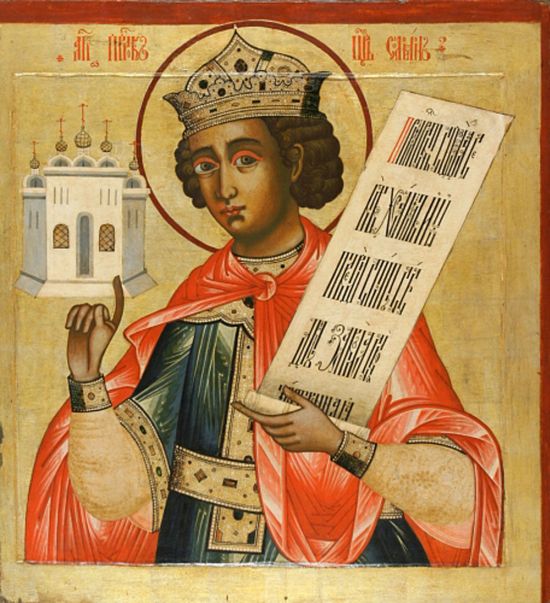
Prophet Solomon Commemorated December 17th


Prophet Solomon

No information available at this time.


Thanks to:

https://oca.org/saints/lives/2006/12/17/613-prophet-solomon


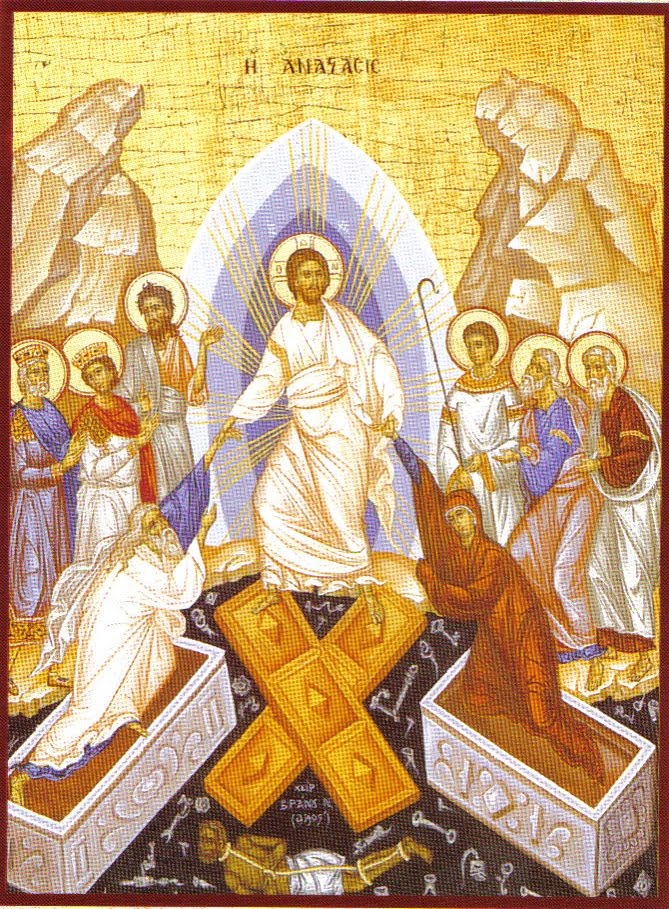
This icon shows King Solomon on the left in red (right of King David) with his father King David (far left) and in green (bottom) St. John the Forerunner. They are all recognizing Christ in hades lifting Adam and Eve from the grave:


Related image


Image result for descent into hades icon


Image result for descent into hades icon

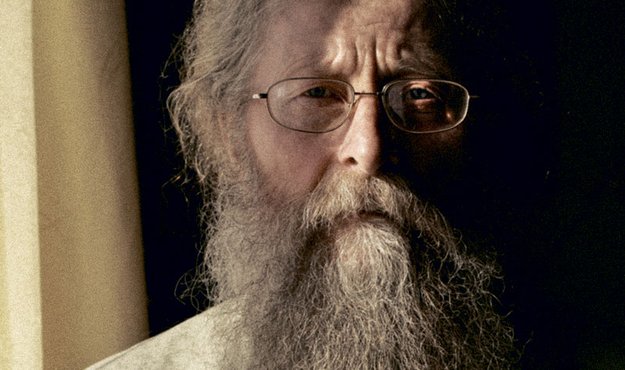
Thoughts on King Solomon by Archpriest Father Gennady


Ecclesiastes Asks the Question, the Gospel Gives the Answer

ARCHPRIEST GENNADY FAST | 24 NOVEMBER 2012
Who among us has not heard or repeated such phrases as: “vanity of vanities, all is vanity,” “the wind returneth again according to his circuits,” or “there is no new thing under the sun”? Many people know that these are from the Book of Ecclesiastes (or, The Preacher) in the Bible. In most cases, those who have read this book enjoy its melancholy poetry with its vivid, surprising imagery. Others wonder what is Christian about this book and why the Church has accepted it as one of its sacred texts.
Quite brief compared to other Old Testament texts, Ecclesiastes (Qoheleth in Hebrew) was studied and commented on by the Holy Fathers of the Church; many volumes of modern studies have likewise been dedicated to it. We will discuss it here with Archpriest Gennady Fast, rector of the Church of Sts. Constantine and Helen in Abakan (capital of the Republic of Khakassia, Russia), biblical scholar, and author of many books about the Old Testament, including the recently published Commentary on the Book of Ecclesiastes [in Russian, 2009].
Archpriest Gennady Fast was born in 1954 in the Novosibirsk Oblast (in Siberia) into a deeply religious Lutheran family of exiled Russian Germans and was named Heinrich. After being expelled from Karaganda State University for his religious convictions, he studied physics at Tomsk University and later worked on the faculty of theoretical physics. Before graduating from university he converted to Orthodoxy and was baptized with the name Gennady. After being expelled from Tomsk University, he became a priest. He served in Tuva, in the Kemerovo Oblast, and in the Krasnoyarsk Krai. For many years he was rector of the ancient Dormition Church in Yeniseisk. He has trained scores of Siberian priests. He was, and remains, one of today’s most outstanding and well-known Orthodox missionaries. He is a biblical scholar and author of a number of books that have received wide distribution. At present he is rector of the Church of Sts. Constantine and Helen in Abakan.
Fr. Gennady Fast
Fr. Gennady, let us begin with authorship. Many of our readers will be surprised by the claim that the author of Ecclesiastes is the wise King Solomon, son of King David and builder of the Jerusalem Temple; in other words, that the unnamed Preacher and Solomon are one and the same person. One learns from your commentary that in his old age Solomon left his royal palace and his riches, dressed in rags, took up his staff, and went wandering along the roads, contemplating the vanity of all earthly things. Yet this is not in the Bible, just as there is no indication of Solomonic authorship. 
In 3 [1] Kings 11, it says that Solomon died and was buried in Jerusalem. Moreover, he died under unfortunate circumstances: under the influence of his wives, he fell into idolatry and provoked God’s wrath. It was only for the sake of David, Solomon’s father, that the Lord spared Israel and Jerusalem in those days. Nowhere is it written that Asmodeus cast Solomon from the Holy City and that he set out wandering along the roads… 
Indeed, there is a theory that Ecclesiastes came into being after the Babylonian captivity and was written by a later Hellenized Jew. This is due in part to the author’s philosophical inclination, which is much more characteristic of the culture of Greek antiquity than of Jewish culture. Likewise, philological analysis of the text forces one to consider a later origin. But this hypothesis can neither be proven nor disproven. Personally, I hold to the traditional, patristic point of view that the author of Ecclesiastes is Solomon. In patristic literature, Ecclesiastes was always viewed as being King Solomon’s repentance, the book he wrote after committing idolatry.
As far as the wandering along the roads with a staff is concerned, this is an ancient Judaic tradition contained in the Haggadah. The Holy Fathers accepted ancient Judaic traditions, many of which passed into patristic literature. I made use of this image – that of the stranger-king, of the king who rejects his kingdom for a pauper’s bundle – as a backdrop for reflecting on Ecclesiastes-Qoheleth. I think that this book could have arisen in just this way.
Yet there are no penitential motives in the text of Ecclesiastes, such as David’s Psalm 50… 
Yes, this is not David’s repentance! This is more likely a philosopher’s repentance, a reexamination of his entire life. The word “repentance” is here best used in the Greek sense: metanoia, turnabout, change. There were several turnabouts in Solomon’s life: his ardent love for God and Divine Wisdom in his youth; his active life in adulthood; and later, towards the end of his life, a surfeit of wealth and pleasure leading to questionable actions. We do not entirely know how deeply he fell into idolatry, but it is clear that he became bogged down by his polygamy and flirted with paganism. He was later overtaken not by the heartfelt contrition of his father David, but by a certain philosophical reevaluation of his existence.
So I was great, and increased more than all that were before me in Jerusalem: also my wisdom remained with me. And whatsoever my eyes desired I kept not from them; I withheld not my heart from any joy: for my heart rejoiced in all my labour; and this was my portion of all my labour. Then I looked on all the works that my hands had wrought, and on the labour that I had laboured to do: and behold, all was vanity and vexation of spirit, and there was no profit under the sun (Ecclesiastes 2:9-11).
Why did the question of the meaning of life arise in him, who was fully a man of the Old Testament? Why did it not arise among Abraham, Isaac, and Jacob, or among Moses, Joshua, Samuel, and David, among others? 
This is like asking why it was specifically Einstein who came up with the theory of relativity. Or why was it was specifically Pushkin who wrote Eugene Onegin. People are different; each has his own path and calling on this earth. The righteous of the Old Testament you list were deeply religious, but none of them chose wisdom as their main principle of life; they did not ask God for an understanding heart, as did Solomon at Gibeon (cf. 3 [1] Kings 3:9). Having received wisdom from God, Solomon served it all his life – and it is precisely this that never changed! He served wisdom when judging people, when he composed the Song of Songs, when he wrote Proverbs – the entire body of Solomonic books might be called books of wisdom. Therefore, it is not surprising that the philosophical problem of the overall meaning of life would arise specifically for Solomon.
Then said I in my heart, As it happeneth to the fool, so it happeneth even to me, and why was I then more wise? Then I said in my heart, that this also is vanity. For there is no remembrance of the wise more than of the fool for ever; seeing that which now is, in the days to come shall be forgotten. And how dieth the wise man? as the fool (Ecclesiastes 2:15-16).
The Righteous Prophet and King Solomon
But this might also be put differently. Solomon’s precursors in sacred history, the righteous of the Old Testament, were devoid of painful reflection. They knew how to live. They loved life. They were neither oppressed by its finitude nor frightened by death: they died with remarkable calm and had very little interest in what would happen to them after their deaths, or whether there would be anything at all. They were joyful when children were born to them, and it never entered their heads to ask: why was this child born, given that it will die anyway? When all is said and done, they were healthy! Compared to them, Solomon seems like a tortured intellectual, almost Chekhovian… 
Indeed, Solomon’s predecessors did not resemble him. They lived by faith and love for live, with which they were perfectly satisfied. They were not philosophers. The philosophical view of life is generally uncharacteristic of ancient Israel. The books of the Old Testament are not philosophical; they are historical and prophetic. The Ecclesiast is something of an exception. He really does seem to belong to another culture. This has provided the grounds for biblical criticism to doubt the identification of the Ecclesiast with Solomon. The Ecclesiast or Qoheleth – or, as we believe, Solomon – is someone who may not have had a deep religiosity. The Song of Songs makes no mention of the Creator. The Wisdom of Solomon could, with light editing, be used by atheists. God is mentioned there, but He is not central, and it is not He who governs all things. In this sense, Solomon is consistent: this is who he is, and he could be no other way. It is no accident that you draw a parallel between him and the Russian intelligentsia of the nineteenth century. That century we had St. Philaret of Moscow, the Optina Elders, Theophan the Recluse and, finally, Gogol and Dostoevsky, who led their readers – if not always evenly and smoothly – along the path of the Orthodox faith. We also had Leo Tolstoy, however. It is very hard to answer the question of what, for the Count, was lacking in Orthodoxy, or why he had so much dislike for it. In the case of the Qoheleth, we can say that God made us of him – and, by the way, God also made use of Tolstoy. I know many people who read Tolstoy during the Soviet era, because his work was easily accessible, and through him began to reflect on deeper spiritual problems. And this served as the impetus, in the long run, for them to come to Orthodoxy. On the contrary, I do not know of a single Orthodox person who, after having read Tolstoy, left Orthodoxy for Tolstoyanism. If Tolstoy had only known!
I said in my heart concerning the estate of the sons of men, that God might manifest them, and that they might see that they themselves are beasts. For that which befalleth the sons of men befalleth beasts; even one thing befalleth them: as the one dieth, so dieth the other; yea, they have all one breath, so that a man hath no pre-eminence above a beast: for all is vanity(Ecclesiastes 3:18-19).
Why, and on what religious basis, did Ecclesiastes become what it is? 
It became what it is because, in essence, it is asking a question. Ecclesiastes asks the question, the Gospel gives the answer. Neither Moses nor David asks questions; they are satisfied with what they receive directly from God. The Prophet Elias says: The Lord God of Israel liveth, before whom I stand (3 [1] Kings 17:1). What questions can he possibly have? But with Solomon… He was not an atheist, of course; he was a believing person, but he came close to the very edge of the abyss in which there is no God. At certain moments for him it is as if God vanishes. But God needs just such a person so that the question might be asked. Solomon is ruthlessly candid, and cannot find comfort in such customary phrases as “God will provide…” or “It’s all God’s will…”
He is, by the way, not entirely alone. The long-suffering Job likewise asks questions and likewise finds no comfort in such phrases. Nor does the Prophet Habakkuk find comfort in them: he climbs the tower and offers his complaint to God. But Solomon, unlike Job and Habakkuk, has no complaint for God. Perhaps they had these complaints because they felt God so closely. In comparison with them, Solomon is in some sense a wordly person; his complaint is not directed to God, but to a life that is completely meaningless. He had everything that this life can offer: immeasurable wealth, power, glory, honor – but now he sees no meaning in any of it. Ecclesiastes is not even about the meaning of life; it is about life’s meaninglessness. The author has an honest view, he is free of all self-delusion, he sees this meaninglessness without embellishment. Where is divine revelation in Ecclesiastes? Here is the paradox: it is in the fact that it leaves one without God. It allows one to see clearly what life without God is like. That is why this text is so dramatic, why there is the strain, intensity, and drama of a human soul that has lost all meaning.
I was struck by a phrase from your book: “Only in the desert of Ecclesiastes can one find the oasis of the Gospel.” However, this too is perplexing. Is it really only possible to approach God through the condition of the Ecclesiast, through the experience of meaninglessness and emptiness? Are there no other ways? 
You are not the only one who is perplexed. One journalist, who was outraged by my statement, said: neither Sergius of Radonezh, nor Seraphim of Sarov, nor John of Kronstadt needed any such desert in order to score the source of living water. But these words, which I have nonetheless left in the book, do not necessarily imply a chronological order: first the experience of desertedness, emptiness, meaninglessness – and then the Gospel. It happens in this order with some, but not with all. The saints mentioned here experienced the Ecclesiast’s desert in this sense: they experienced deeply the vanity and futility of this world and therefore renounced it. Otherwise they would not have had the revelations that were given to them. Whoever is perfectly satisfied with this world will never become a Sergius or a Seraphim, even if he knows the entire Psalter by heart. The emptiness of this world without God needs to be experienced inwardly so that it can later be filled by God.
Ecclesiastes is very current, very relevant to our times. It defines someone who participates in the consumer race, in the pursuit of pleasure, success, and empty amusements. Today I know people who have come to Christianity specifically through the Preacher’s book. By reading it one sees the godlessness of the world and sets off in search of God, finding Him in the Gospel. It is a great pity, of course, that people (the faithful included, alas!) today read so little and prefer lighter reading. But Ecclesiastes remains very much in demand and is still read, even if it is not wholly understood.
For God giveth to a man that is good in his sight, wisdom, and knowledge, and joy: but to the sinner he giveth travail, to gather and to heap up, that he may give to him that is good before God. This also is vanity and vexation of spirit (Ecclesiastes 2:26).
What is necessary in order to understand Ecclesiastes? 
A key of sorts to Ecclesiastes is the Hebrew word yitron, which appears nowhere else in the Bible. It means “remainder” or “profit.” It is what we sometimes call the bottom line. It answers the question: “With all this, what do we really have left?” The Ecclesiast needs an answer to this question and so puts everything to the test: wealth, poverty, women, wine, creative work, power, even piety. But the bottom line is that there is nothing left: everything is “vanity of vanities” and vexation of spirit.
For what hath man of all his labour, and of the vexation of his heart, wherein he hath laboured under the sun? For all his days are sorrows, and his travail grief; yea, his heart taketh not rest in the night. This is also vanity. There is nothing better for a man, than that he should eat and drink, and that he should make his soul enjoy good in his labour. This also I saw, that it was from the hand of God (Ecclesiastes 2:22-24).
But how is there nothing left? Solomon built the Temple, after all! In the Temple a miracle was manifest on the very first day and Solomon prayed for his people for generations to come (cf. 3 [1] Kings 8) – these pages cannot be forgotten! The Temple was still standing at that moment in history. It had not yet been destroyed! 
The Temple was standing. But this did not change anything. This is often the case in life. When we read Solomon’s prayer at the dedication of the Temple, we see that the Temple was filled with the divine presence – truly the Shekhinah. But then nothing was left. Solomon-Ecclesiast does not even mention the Temple a single time! (This, incidentally, causes biblical critics to doubt King Solomon’s authorship. But, in some sense, this is of no importance to us.) The Apostle Paul warns us that it is quite possible to preach to others and remain a castaway oneself (cf. 1 Corinthians 9:27). Such tragedies happen to people, even to priests – there is such a thing as burnout. I have seen burned-out priests, among whom were men who were talented, intelligent, and by no means devoid of moral qualities. They had all been quite zealous in their time. But then some inner disillusionment came along and the mundane crept into their lives. The same thing happened with the Ecclesiast. He built the Temple, but he did not gain the higher good – the yitron.
But a burned-out priest most likely has himself to blame, and so too with the Ecclesiast… 
Perhaps. If Solomon had always maintained the temperament he had on the day the Temple was dedicated, would idols have appeared in Jerusalem? But they did appear. Yes, the Ecclesiast’s story is that of a fall or emptying. He was full and became empty. For nothing under the sun has this yitron. For in fact, yitron is what is above the sun.
But besides the word yitron, there is another key word needed for understanding Ecclesiastes: tov. Unlike the first word, it is common in both ancient Hebrew and in Holy Scripture, beginning with the first chapters of Genesis. It means “good” or “fine.” That which is good is tov. Everything, as we have already said, that Solomon tested – riches, glory, women, wine, labor, piety – was in fact good, tov. Reading the text of Ecclesiastes, we see how he repeatedly tries to climb to the summit in order to reach the desired yitron, but for some reason is unable. Not wanting to fall all the way to the bottom, where there is sin and perdition, he settles into a kind of average human happiness, into this tov. But for some reason, the philosopher cannot stay for long in this common human happiness. Again clambering to the summit, he again falls down and looks for comfort in the common tov, which he does not find. It is this hovering between the ordinary good and the loftier, imperishable good that defines the state of soul of the Qoheleth, the philosopher.
Behold that which I have seen: it is good and comely for one to eat and to drink, and to enjoy the good of all his labor that he taketh under the sun all the days of his life, which God giveth him: for it is his portion (Ecclesiastes 5:18).
Was it not this drama that attracted Christian ascetics to Ecclesiastes?
It served as a sort of justification for what they were doing. After all, Ecclesiastes is a book about the meaninglessness of life in its more positive aspects. Note that the author does not reflect on suffering, illness, crime, war, and so on. He reflects on the normal, positive condition of man – what is normally considered happiness. Happiness is that same tov in which there is no yitron. In the Gospel there is no concept of happiness whatsoever; rather, there is a different concept: blessedness. Blessedness is yitron, a loftier attainment. Remember the rich youth who went away from Christ sorrowful (cf. Matthew 19:16-22; Mark 10:17-22; Luke 18:18-23)? He was offered tov – average wellbeing and piety (“keep the commandments”). But this did not satisfy him. But to part with his wellbeing and wealth for the sake of blessedness and treasure in heaven – this he could not do (cf. Matthew 19:21).
Christian ascetics consciously gave up the world in its vain manifestations, denying themselves seemingly blameless and God-created pleasures – but this was not a rejection of sin. This was a rejection of tov, of the good, because in this good, there is no yitron, the highest good.
You dedicate an entire chapter of your book to the Ecclesiast’s antimonies, the most famous of which is: A time to cast away stones, and a time to gather stones together (Ecclesiastes 3:5). What is their moral and spiritual meaning? 
To everything there is a season, and a time to every purpose under the heaven (Ecclesiastes 3:1). People often do not know which season it now is, or they think that an entire season is for one thing alone. But life is dialectical; the laws of dialectics have never been repealed. Someone who is a Christian, who lives in the Holy Spirit, should be able to feel the season with particular sensitivity. His actions might be contradictory: he might punish or forgive, strike out or give healing. There is a well-known incident from the life of St. Luke (Voyno-Yasenetsky) of Crimea: he saw some members of the Komsomol [Young Communist League] placing a ladder against the wall of a church in order to climb onto the roof and remove the cross. The saint wrathfully shook the ladder and they fell down and were hurt. Then he took them to the hospital and treated them: to everything there is a season. Or take Admiral Ushakov, about whom many people still ask why he was glorified among the saints and where his holiness lies. His cannons destroyed the Turkish squadron and the Turks started drowning – so he sent his sailors out on lifeboats to saves them and pull them out of the water: it was the season to show mercy. Divine Sophia, Wisdom, is manifest in a person when he knows the season.
Ecclesiastes has a very powerful moral charge. Its author is a very moral person – in other words, a man of righteousness. For him a wise life is a righteous life. But there is also the assertion that righteousness is meaningless. How do these things go together? 
This is the Ecclesiast’s tragedy! He is unable to live immorally, he encourages piety, but all the while he sees the futility of piety without God. Here we can call to mind our Communists, among whom were people of high morals, people who gave their life in the war… But those whom I was able to encounter could no longer believe in any sort of communism. They urged people to work, to live honorably and according to the laws of communist morality, and they did not feel any discomfort in this – so long as they did not look inward, so long as they were not inclined to Russian soul-searching. They were like the Preacher, which again confirms that every time and generation can see itself in the Ecclesiast.
God does not lose people who have lost Him. Someone might not have God and has emptiness instead, but God does not leave him because he lives morally; he neither can nor wants to fall below a certain moral level. In principle, this is characteristic of any person; even criminals create their own moral code, which they call “living by the rules.”
I returned, and saw under the sun, that the race is not to the swift, nor the battle to the strong, neither yet bread to the wise, nor yet riches to men of understanding, nor yet favour to men of skill; but time and chance happenteth to them all. For man also knoweth not his time: as the fishes that are taken in an evil net, and as the birds that are caught in the snare; so are the sons of men snared in an evil time, when it falleth suddenly upon them (Ecclesiastes 9:11-12).
Solomon was a wise man and a philosopher, but not a prophet… Yet you write that there is testimony concerning the coming Messiah in his book… 
There is a text that allows for messianic interpretation, in chapter 4, beginning with verse 13, about the child who is born poor into his kingdom: There is no end of all the people, even of all that have been before them: they also that come after shalt not rejoice in him. Surely this also is vanity and vexation of spirit (4:16).
But how is this messianic, if it is all vanity? 
Many walk with this Child, with Christ – this is the mass conversion of the nations to Christianity. They that come after that will not rejoice – this is apostasy, growing cool, falling away. For how many nations today is faith in Christ only a vestige, only the remains of a tradition? Christmas, the beloved winter holiday for families, no longer has anything to do with Christ. We live in an epoch that is called post-Christian… The text of Ecclesiastes shows that Christianity itself is no exception, that its historical path follows the same cycle: rise is followed by decline, ardor by frigidity. Although ultimately the gates of hell shall not prevail against the Church (cf. Matthew 16:18) and the Bridegroom will come for His bride. Everything done for the Lord’s sake is good; Orthodox empires with magnificent churches are good. But then enemies come, or rebellion breaks out, and the churches are emptied and destroyed. The way out of this cycle is only the Eighth Day, when the cycle will be completed with the appearance of the Lord in glory. But for us, living today, the way out is holiness, it is the Kingdom of God that we await as coming, but which we have already now. When in the Liturgy we exclaim “Blessed is the Kingdom,” we are blessing the Kingdom that is here and now, in which we are. This is the way out of the vicious circle, including the cycle of Christian history, that Solomon did not see. Ultimately, yitron is the Lord Himself – the Lord, Who is everywhere and in everything. An ancient Paterikon tells the story of a monk who could attend the Paschal services because every year he was assigned to the kitchen. This was a serious deprivation for him, and he dreamed of at least hearing how they sang “Christ is Risen.” But the Lord consoled him with apples from Paradise, with which he was able to treat the brethren returning from the service in the morning.
Interview conducted by Marina Biriukova.
Translated from the Russian.
thanks to: 
http://www.pravmir.com/ecclesiastes-asks-the-question-the-gospel-gives-the-answer/


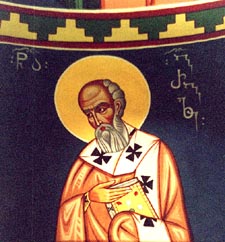
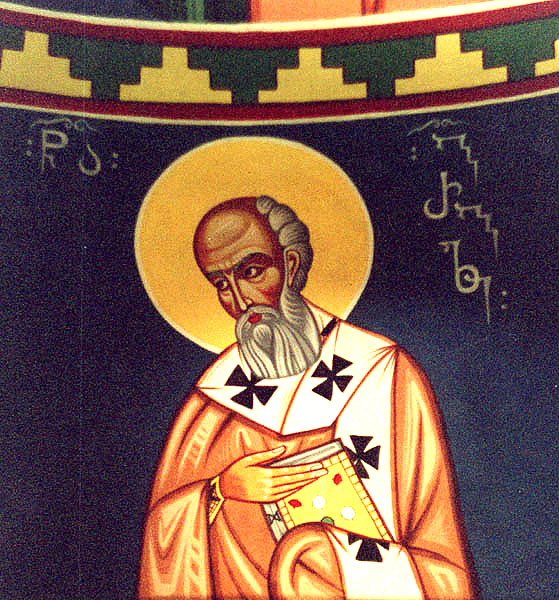
St. Gregory the Theologian Commemorated January 25th


St. Gregory the Theologian the Archbishop of Constantinople

Saint Gregory the Theologian, Archbishop of Constantinople, a great Father and teacher of the Church, was born into a Christian family of eminent lineage in the year 329, at Arianzos (not far from the city of Cappadocian Nazianzos). His father, also named Gregory (January 1), was Bishop of Nazianzus. The son is the Saint Gregory Nazianzus encountered in Patristic theology. His pious mother, Saint Nonna (August 5), prayed to God for a son, vowing to dedicate him to the Lord. Her prayer was answered, and she named her child Gregory.
When the child learned to read, his mother presented him with the Holy Scripture. Saint Gregory received a complete and extensive education: after working at home with his uncle Saint Amphilochius (November 23), an experienced teacher of rhetoric, he then studied in the schools of Nazianzos, Caesarea in Cappadocia, and Alexandria. Then the saint decided to go to Athens to complete his education.
On the way from Alexandria to Greece, a terrible storm raged for many days. Saint Gregory, who was just a catechumen at that time, feared that he would perish in the sea before being cleansed in the waters of Baptism. Saint Gregory lay in the ship’s stern for twenty days, beseeching the merciful God for salvation. He vowed to dedicate himself to God, and was saved when he invoked the name of the Lord.
Saint Gregory spent six years in Athens studying rhetoric, poetry, geometry, and astronomy. His teachers were the renowned pagan rhetoricians Gymorias and Proeresias. Saint Basil, the future Archbishop of Caesarea (January 1) also studied in Athens with Saint Gregory. They were such close friends that they seemed to be one soul in two bodies. Julian, the future emperor (361-363) and apostate from the Christian Faith, was studying philosophy in Athens at the same time.
Upon completing his education, Saint Gregory remained for a certain while at Athens as a teacher of rhetoric. He was also familiar with pagan philosophy and literature.
In 358 Saint Gregory quietly left Athens and returned to his parents at Nazianzus. At thirty-three years of age, he received Baptism from his father, who had been appointed Bishop of Nazianzus. Against his will, Saint Gregory was ordained to the holy priesthood by his father. However, when the elder Gregory wished to make him a bishop, he fled to join his friend Basil in Pontus. Saint Basil had organized a monastery in Pontus and had written to Gregory inviting him to come.
Saint Gregory remained with Saint Basil for several years. When his brother Saint Caesarius (March 9) died, he returned home to help his father administer his diocese. The local church was also in turmoil because of the Arian heresy. Saint Gregory had the difficult task of reconciling the bishop with his flock, who condemned their pastor for signing an ambiguous interpretation of the dogmas of the faith.
Saint Gregory convinced his father of the pernicious nature of Arianism, and strengthened him in Orthodoxy. At this time, Bishop Anthimus, who pretended to be Orthodox but was really a heretic, became Metropolitan of Tyana. Saint Basil had been consecrated as the Archbishop of Caesarea, Cappadocia. Anthimus wished to separate from Saint Basil and to divide the province of Cappadocia.
Saint Basil the Great made Saint Gregory bishop of the city of Sasima, a small town between Caesarea and Tyana. However, Saint Gregory remained at Nazianzos in order to assist his dying father, and he guided the flock of this city for a while after the death of his father in 374.
Upon the death of Patriarch Valentus of Constantinople in the year 378, a council of bishops invited Saint Gregory to help the Church of Constantinople, which at this time was ravaged by heretics. Obtaining the consent of Saint Basil the Great, Saint Gregory came to Constantinople to combat heresy. In the year 379 he began to serve and preach in a small church called “Anastasis” (“Resurrection”). Like David fighting the Philistines with a sling, Saint Gregory battled against impossible odds to defeat false doctrine.
Heretics were in the majority in the capital: Arians, Macedonians, and Appolinarians. The more he preached, the more did the number of heretics decrease, and the number of the Orthodox increased. On the night of Pascha (April 21, 379) when Saint Gregory was baptizing catechumens, a mob of armed heretics burst into the church and cast stones at the Orthodox, killing one bishop and wounding Saint Gregory. But the fortitude and mildness of the saint were his armor, and his words converted many to the Orthodox Church.
Saint Gregory’s literary works (orations, letters, poems) show him as a worthy preacher of the truth of Christ. He had a literary gift, and the saint sought to offer his talent to God the Word: “I offer this gift to my God, I dedicate this gift to Him. Only this remains to me as my treasure. I gave up everything else at the command of the Spirit. I gave all that I had to obtain the pearl of great price. Only in words do I master it, as a servant of the Word. I would never intentionally wish to disdain this wealth. I esteem it, I set value by it, I am comforted by it more than others are comforted by all the treasures of the world. It is the companion of all my life, a good counselor and converser; a guide on the way to Heaven and a fervent co-ascetic.” In order to preach the Word of God properly, the saint carefully prepared and revised his works.
In five sermons, or “Theological Orations,” Saint Gregory first of all defines the characteristics of a theologian, and who may theologize. Only those who are experienced can properly reason about God, those who are successful at contemplation and, most importantly, who are pure in soul and body, and utterly selfless. To reason about God properly is possible only for one who enters into it with fervor and reverence.
Explaining that God has concealed His Essence from mankind, Saint Gregory demonstrates that it is impossible for those in the flesh to view mental objects without a mixture of the corporeal. Talking about God in a positive sense is possible only when we become free from the external impressions of things and from their effects, when our guide, the mind, does not adhere to impure transitory images. Answering the Eunomians, who would presume to grasp God’s Essence through logical speculation, the saint declared that man perceives God when the mind and reason become godlike and divine, i.e. when the image ascends to its Archetype. (Or. 28:17). Furthermore, the example of the Old Testament patriarchs and prophets and also the Apostles has demonstrated, that the Essence of God is incomprehensible for mortal man. Saint Gregory cited the futile sophistry of Eunomios: “God begat the Son either through His will, or contrary to will. If He begat contrary to will, then He underwent constraint. If by His will, then the Son is the Son of His intent.”
Confuting such reasoning, Saint Gregory points out the harm it does to man: “You yourself, who speak so thoughtlessly, were you begotten voluntarily or involuntarily by your father? If involuntarily, then your father was under the sway of some tyrant. Who? You can hardly say it was nature, for nature is tolerant of chastity. If it was voluntarily, then by a few syllables you deprive yourself of your father, for thus you are shown to be the son of Will, and not of your father” (Or. 29:6).
Saint Gregory then turns to Holy Scripture, with particular attention examining a place where it points out the Divine Nature of the Son of God. Saint Gregory’s interpretations of Holy Scripture are devoted to revealing that the divine power of the Savior was actualized even when He assumed an impaired human nature for the salvation of mankind.
The first of Saint Gregory’s Five Theological Orations is devoted to arguments against the Eunomians for their blasphemy of the Holy Spirit. Closely examining everything that is said in the Gospel about the Third Person of the Most Holy Trinity, the saint refutes the heresy of Eunomios, which rejected the divinity of the Holy Spirit. He comes to two fundamental conclusions. First, in reading Holy Scripture, it is necessary to reject blind literalism and to try and understand its spiritual sense. Second, in the Old Testament the Holy Spirit operated in a hidden way. “Now the Spirit Himself dwells among us and makes the manifestation of Himself more certain. It was not safe, as long as they did not acknowledge the divinity of the Father, to proclaim openly that of the Son; and as long as the divinity of the Son was not accepted, they could not, to express it somewhat boldly, impose on us the burden of the Holy Spirit” (Or. 31:26).
The divinity of the Holy Spirit is a sublime subject. “Look at these facts: Christ is born, the Holy Spirit is His Forerunner. Christ is baptized, the Spirit bears witness to this... Christ works miracles, the Spirit accompanies them. Christ ascends, the Spirit takes His place. What great things are there in the idea of God which are not in His power? What titles appertaining to God do not apply also to Him, except for Unbegotten and Begotten? I tremble when I think of such an abundance of titles, and how many Names they blaspheme, those who revolt against the Spirit!” (Or. 31:29).
The Orations of Saint Gregory are not limited only to this topic. He also wrote Panegyrics on Saints, Festal Orations, two invectives against Julian the Apostate, “two pillars, on which the impiety of Julian is indelibly written for posterity,” and various orations on other topics. In all, forty-five of Saint Gregory’s orations have been preserved.
The letters of the saint compare favorably with his best theological works. All of them are clear, yet concise. In his poems as in all things, Saint Gregory focused on Christ. “If the lengthy tracts of the heretics are new Psalters at variance with David, and the pretty verses they honor are like a third testament, then we also shall sing Psalms, and begin to write much and compose poetic meters,” said the saint. Of his poetic gift the saint wrote: “I am an organ of the Lord, and sweetly... do I glorify the King, all atremble before Him.”
The fame of the Orthodox preacher spread through East and West. But the saint lived in the capital as though he still lived in the wilderness: “his food was food of the wilderness; his clothing was whatever necessary. He made visitations without pretense, and though in proximity of the court, he sought nothing from the court.”
The saint received a shock when he was ill. One whom he considered as his friend, the philosopher Maximus, was consecrated at Constantinople in Saint Gregory’s place. Struck by the ingratitude of Maximus, the saint decided to resign the cathedra, but his faithful flock restrained him from it. The people threw the usurper out of the city. On November 24, 380 the holy emperor Theodosius arrived in the capital and, in enforcing his decree against the heretics, the main church was returned to the Orthodox, with Saint Gregory making a solemn entrance. An attempt on the life of Saint Gregory was planned, but instead the assassin appeared before the saint with tears of repentance.
At the Second Ecumenical Council in 381, Saint Gregory was chosen as Patriarch of Constantinople. After the death of Patriarch Meletius of Antioch, Saint Gregory presided at the Council. Hoping to reconcile the West with the East, he offered to recognize Paulinus as Patriarch of Antioch.
Those who had acted against Saint Gregory on behalf of Maximus, particularly Egyptian and Macedonian bishops, arrived late for the Council. They did not want to acknowledge the saint as Patriarch of Constantinople, since he was elected in their absence.
Saint Gregory decided to resign his office for the sake of peace in the Church: “Let me be as the Prophet Jonah! I was responsible for the storm, but I would sacrifice myself for the salvation of the ship. Seize me and throw me... I was not happy when I ascended the throne, and gladly would I descend it.”
After telling the emperor of his desire to quit the capital, Saint Gregory appeared again at the Council to deliver a farewell address (Or. 42) asking to be allowed to depart in peace.
Upon his return to his native region, Saint Gregory turned his attention to the incursion of Appolinarian heretics into the flock of Nazianzus, and he established the pious Eulalius there as bishop, while he himself withdrew into the solitude of Arianzos so dear to his heart. The saint, zealous for the truth of Christ, continued to affirm Orthodoxy through his letters and poems, while remaining in the wilderness. He died on January 25, 389, and is honored with the title “Theologian,” also given to the holy Apostle and Evangelist John.
In his works Saint Gregory, like that other Theologian Saint John, directs everything toward the Pre-eternal Word. Saint John of Damascus (December 4), in the first part of his book AN EXACT EXPOSITION OF THE ORTHODOX FAITH, followed the lead of Saint Gregory the Theologian.
Saint Gregory was buried at Nazianzos. In the year 950, his holy relics were transferred to Constantinople into the church of the Holy Apostles. Later on, a portion of his relics was transferred to Rome.
In appearance, the saint was of medium height and somewhat pale. He had thick eyebrows, and a short beard. His contemporaries already called the archpastor a saint. The Orthodox Church, honors Saint Gregory as a second Theologian and insightful writer on the Holy Trinity.
“O glorious Father Gregory, Your knowledge has overcome the pride of false wisdom. The church is clothed with your teaching as a robe of righteousness. We your children celebrate your memory crying out: Rejoice, O father of unsurpassable wisdom!” [Kontakion].

thanks to:
https://oca.org/saints/lives/2014/01/25/100298-st-gregory-the-theologian-the-archbishop-of-constantinople


Friday, December 14, 2018

Why Morality is Not Christian ~ Fr. Stephen Freeman


Why Morality is Not Christian


   I recall my first classes in Moral Theology some 35 or so years ago. The subject is an essential part of Western thought (particularly in the Catholic and Anglican traditions). In many ways the topic was like a journey into Law School. We learned various methods and principles on whose basis moral questions – questions of right and wrong – could be discussed and decided. These classes were also the introduction of certain strains of doubt for me.

The great problem with most moral thinking – is found in its fundamental questions:
  •  What does it mean to act morally?
  • Why is moral better than immoral?
  • Why is right better than wrong?
Such questions have classically had some form of law to undergird them:
  • To act morally is to act in obedience to the law or to God’s commandments.
  • Moral is better than immoral because moral is a description of obedience to the good God. Or, moral is the description of doing the good, or even the greatest good for the greatest number (depending on your school of thought).
  • Right is better than wrong for the same reasons as moral being better than immoral.
   Of course, all of these questions (right and wrong, moral and immoral) require not only a standard of conduct, but someone to enforce the conduct. Right is thus better than wrong, because God will punish the wrong and reward the right – otherwise (in this understanding) everything would be merely academic.
I will grant at the outset that many Christians are completely comfortable with the understanding that God rewards and punishes. I will grant as well that there is ample Scriptural evidence to which persons can point to support such a contention. However, this approach is far from a unanimous interpretation within the Tradition of the faith – and has little support within historic Eastern Orthodoxy.
That Scripture says such things (God is the punisher and rewarder) is undeniable – but there is also another strain of witness:
When James and John approached Christ after He had been turned away by a village of Samaritans, they said, “Lord, do You want us to command fire to come down from heaven and consume them, just as Elijah did?” But He turned and rebuked them, and said, “You do not know what manner of spirit you are of. “For the Son of Man did not come to destroy men’s lives but to save them.” And they went to another village. (Luk 9:54-56)
   If James and John were working out of a “reward and punishment” model (which they clearly were) Christ’s rebuke must have caught them by surprise. The same is true of many other encounters in Christ’s ministry. The interpretation brought by the fathers in all of this, is that God’s role as “punisher” is only an aspect of His role as “healer.” What we endure is not for our destruction and punishment but for our salvation and healing.
This takes everything into a different direction. It is, doubtless, an interpretation brought to the Old Testament from the revelation of Christ in the New. In Christ we see clearly what was only made known in “shadow” under the Old Covenant. Through Him, we now see more clearly.
God as Christ brings an entirely different set of questions to the moral equation:
  • What does the Incarnation of God mean for human morality?
  • What is at stake in our decisions about right and wrong?
  • What does it mean to be moral?
   St. Athanasius (ca. 296 – d. 2 May 373), the great father of the Nicene Council and defender of the faith against the assaults of Arianism offered profound insights into the nature of the human predicament (sin and redemption). His approach, as given in De Incarnatione, begins with the creation of the world from nothing (ex nihilo). Our very existence is a good thing, given to us and sustained by the mercy and grace of the good God. The rupture in communion that occurs at the Fall (and in every sin), is a rejection of the true existence given to us by God. Thus the problem of sin is not a legal issue, but an ontological issue (a matter of being and true existence). The goal of the Christian life is union with God, to be partakers of His Divine Life. Sin rejects that true existence and moves us away from God and towards a spiral of non-being.
Thus, our issues are not moral in nature (obeying things because they are right, etc.) but ontological in nature. The great choice of humanity is between union with God and His Life, or a movement towards non-being and emptiness. Our salvation is not a juridical matter – it is utterly ontological. The great promises in Christ point consistently in that direction.
I beseech you therefore, brethren, by the mercies of God, that you present your bodies a living sacrifice, holy, acceptable to God, which is your reasonable service. And do not be conformed to this world, but be transformed by the renewing of your mind, that you may prove what is that good and acceptable and perfect will of God. (Rom 12:1-2)
But we all, with unveiled face, beholding as in a mirror the glory of the Lord, are being transformed into the same image from glory to glory, just as by the Spirit of the Lord. (2Co 3:18-1)
For it is the God who commanded light to shine out of darkness, who has shone in our hearts to give the light of the knowledge of the glory of God in the face of Jesus Christ. But we have this treasure in earthen vessels, that the excellence of the power may be of God and not of us. We are hard pressed on every side, yet not crushed; we are perplexed, but not in despair; persecuted, but not forsaken; struck down, but not destroyed–always carrying about in the body the dying of the Lord Jesus, that the life of Jesus also may be manifested in our body. For we who live are always delivered to death for Jesus’ sake, that the life of Jesus also may be manifested in our mortal flesh. So then death is working in us, but life in you. (2Co 4:6-12)
   Such verses, which could be multiplied many times, point towards our salvation as a change that occurs within us, rather than a shift in our juridical status – having settled all our justice issues, etc. Rather, we are told that “God is working in us to will and to do of His good pleasure” (Phil. 2:13). Our salvation is nothing less than conformity with the image of God, a true communion of life and participation in the Divine Nature.
Juridical approaches obscure all of this. Concerns for justice quickly denigrate the faith into a cosmic law court (or penal system). Most problematically, the issues tend to be objectified and stand outside the life of believers. To be free of all legal issues that stand between ourselves and God is still far short of paradise. Our goal is to be transformed into union with Christ – to be healed of sin and to be made new. This requires a change within our inmost being – the establishment of the “true self” which is “hid with Christ in God.”
As for justice – it remains a mystery. Christ speaks of God rewarding one group of workers who labored only at the end of the day in a manner that was equal to those who had labored the entire day. The principle at work seems to be something other than a concern for justice (this is an example used by St. Isaac the Syrian).
Morality, as a systematic form of study, is a degeneration of true Christian teaching. Like secularism (and the two-storey universe) it can presume to discuss questions as though there were no God. Morality (and its ethical cousins) becomes a “science,” an abstract exercise of reason based (often) on principles that are merely assumed.  The Scriptures tell us that there is “none good but God,” neither can there be anything good that does not proceed from God. The “good” actions that we make are actions that lead us deeper into union with Christ. Such actions begin in God, are empowered by God, and lead to God. “Morality” is fiction, at least as it has come to be treated in modern thought.
The sin that infects our lives and produces evil actions is a mortal illness (death). Only union with the true life in Christ can heal this, transform us and birth us into the true life which is ours in Christ.
 
   As I have stated on numerous occasions: Christ did not die in order to make bad men good – he died in order to make dead men live.
If my treatment of the word morality is disturbing – I ask your forgiveness. I hope this small piece is of use in considering the true nature of our life in Christ. One of my favorite stories from the Desert Fathers illustrates (obliquely) the difference between mere morality and a true ontological change.
 +++
Abba Lot went to see Abba Joseph and said to him, “Abba as far as I can, I say my little office, I fast a little, I pray and meditate, I live in peace and as far as I can, I purify my thoughts. What else can I do?” then the old man stood up and stretched his hands towards heaven. His fingers became like ten lamps of fire and he said to him, “If you will, you can become all flame.”
 
 
Thanks to:


Holy Hatred?


Holy Hatred

   Lately I came across an interesting bit of theologizing.  The author (who shall remain nameless) spoke of his love for Psalm 139 (“one of my absolute favorite psalms”).  In it he said that “right smack dab in the middle of this Psalm, King David calls for God to slay his enemies and declares that he has nothing but hatred for them.”  He refers, of course, to verse 21:  “Do I not hate them who hate You, O Lord?  And do I not loathe them that rise up against You?  I hate them with perfect hatred; I count them my enemies.”  The author contrasts this attitude with Christ’s words about loving one’s enemies, and characterizes the voice of David in this verse as “the sinful voice of a human.”  Though he says we ought not to “throw the Old Testament out, nor read it flatly without any discernment,” and though he asserts that while “Psalm 139 is full of inspiration,” he still says, “David’s own paradigm comes through.  It’s all [David] knows in his time.  He can’t yet apply the awareness of his divine belovedness [sic] to his enemies.”  The upshot is that we must “pick and choose in the Bible.  Always pick and choose Jesus.”  That is, for him some bits in the Scriptures are devoid of inspiration or authority, and ought to be jettisoned since they are merely the voices of sinful humans, men incapable of rising to a divine standard.  If something in the Old Testament mirrors the Gospel counsel in the New Testament, it may be allowed to stand.  If not, out it goes.  It is not the sinful Old Testament author’s fault however; “it’s all he knows in his time.”  It is an extraordinary bit of exegesis, worthy of the heretic Marcion himself—or perhaps of the Biblical sceptics that made German theological liberalism so famous in the last century.

   It is difficult to deal with the author’s exegesis in any depth, since his thought is not clear.  Since he may or may not be capitalizing pronouns referring to God (e.g. “David calls for God to slay his enemies”), it is hard to be sure of his meaning:  does he assert that smack dab in the middle of the Psalm King David calls for God to slay David’s enemies, or God’s enemies?  The immediate contrast with Christ’s counsel to love one’s own personal enemies would suggest the former, in which case his exegesis is simply wrong.  King David declares his hatred not for his own foes, but for God’s foes—that is the point of saying that he regards them as if they were his own enemies.  If he was talking about his own personal enemies, the verse would make no sense—of course one regards one’s own foes as foes.  The point was David’s zeal for God, which impelled him to make God’s cause his own.  Though those men were not David’s personal enemies, he regarded them as if they were in his zeal for God.

   This bit of confused theologizing is significant because many people fall into the same trap of regarding bits of the Old Testament as unworthy, unspiritual, immoral, and (frankly) as rather embarrassing.  No less a thinker than C. S. Lewis looked at the cursings in the Psalter as something unfortunate, embarrassing, and to be explained away (in his otherwise wonderful book Reflections on the Psalms).  But a view of Old Testament Scripture which declares that “whoever relaxes one of the least these commandments and teaches men so shall be called least in the Kingdom of heaven,” and that “it is easier for heaven and earth to pass away than for one dot of the Law to become void” [Matthew 5:19, Luke 16:17] will not so easily jettison chunks of those Scriptures.  Neither ancient Marcionism nor modern Biblical liberalism are live options for the Orthodox.
  
And make no mistake:  the offending bits are indeed large chunks.  Our unnamed author spoke of his favorite Psalm 139, but similar citations could easily be multiplied.  Many other parts of the Psalter extol holy hatred of unrighteousness and disgust at those who promote it.  Take for example Psalm 119, so valued by the Orthodox that it is constantly used in Matins.  Look at verse 53:  “Hot indignation seizes me because of the wicked who forsake Your Law.”  Or look at verse 113:  “I hate double-minded men, but I love Your Law.”  Or verse 136:  “My eyes shed streams of tears because men do not keep Your Law.”  Or verse 139:  “My zeal consumes me, because my foes forget Your words.”  Or verse 158:  “I look at the faithless with disgust because they do not keep Your commands.”  Such an abundance of antipathy in a psalm which has won such a place in the liturgical tradition of the Church cannot be so easily dismissed by simply suggesting that “it’s all the Psalmist knows in his time,” as if the Holy Spirit found the task of inspiring a sinful Psalmist too daunting.  We cannot jettison it as unworthy.  The solution to our perceived dilemma must lie elsewhere.
One thing the unnamed author never did was to inquire what the word “hate” meant in the offending verse.  He apparently assumed that it meant “to plan to hurt, to retaliate, to strive to inflict pain and misery, to slay.”  Christ indeed forbids such a lust for revenge and for gleeful infliction of pain upon one’s personal foes.  We must not try to hurt our personal foes—bashing them over the head or keying their car—but simply pray for them and commend them to God.  But there is no evidence that the Psalmist in Psalms 139 or 119 was talking about that kind vengeful action.
  
We may begin by asking what the word “hate” actually means in its Biblical context.  Briefly, it means to categorically and emphatically reject.  Thus Christ tells us to “hate” our father and mother and wife and children and even our own life if we would truly be His disciples [Luke 14:26].  Obviously He does not mean one should entertain personal loathing for our family or try to hurt them.  He means that if it comes down to a choice between family and Christ, we must categorically and emphatically reject all the members of our family and their appeals to family loyalty, and choose Christ instead.  To hate means to reject.  That is also the meaning of God’s declaration in Malachi 1:2-3 (quoted in Romans 9:13):  “I loved Jacob but I have hated Esau.”  God did not loathe Esau personally.  He “hated” him in that He rejected him as bearer of Abraham’s covenant, and confirmed that covenant to his brother Jacob instead.

   Understanding this allows us to return to the Psalter with fresh eyes.  David (and the author of Psalm 119) were not declaring that they personally loathed wicked and evil men and wanted to hurt them so much as they decisively rejected their evil ways.  David was declaring his decision to shun their wicked ways however attractive they might have been and to choose righteousness instead.  That is why immediately after saying that he hated God’s foes with perfect hatred, he went on to say, “Search me, O God, and know my heart!  Try me and know my thoughts and see if there be any wicked way in me and lead me in the everlasting way.”  He hated wickedness when he found it in wicked men, and also when he found it in himself, which is why he asked for God’s help to root it out from his heart.
The odd exegesis with which this article began provides a cautionary tale.  We do not have the liberty to “pick and choose in the Bible.”  It is all God’s Word and must be accepted as “inspired by God and profitable for teaching, for reproof, for correction, and for training in righteousness” [2 Timothy 3:16].  If something seems to be unfortunate and embarrassing, that is almost certainly a sign that we are missing something and not understanding what it is really saying.  The Psalter contains many examples of holy hatred (as do the letters of Saint Paul—see for example 2 Corinthians 11:13f, Galatians 5:12, Philippians 3:2, 18f).  Let us imitate this holy hatred and reject decisively the wickedness that abounds in our world.  Such a wicked way may also lurk in our own thoughts and hearts.  Let us pray that God may search us and root it out.


Thanks to:

https://oca.org/reflections/fr.-lawrence-farley/holy-hatred