Total Pageviews

Search This Blog

Tuesday, November 13, 2018

St. John Chrysostom ~ November 13th


Lives of all saints commemorated on November 13


St. John Chrysostom the Archbishop of Constantinople

   Saint John Chrysostom, Archbishop of Constantinople, one of the Three Hierarchs [January 30], was born at Antioch in about the year 347 into the family of a military commander. His father, Secundus, died soon after the birth of his son. His mother, Anthusa, widowed at twenty years of age, did not seek to remarry but rather devoted all her efforts to the raising of her son in Christian piety. The youth studied under the finest philosophers and rhetoricians. But, scorning the vain disciplines of pagan knowledge, the future hierarch turned himself to the profound study of Holy Scripture and prayerful contemplation. Saint Meletius, Bishop of Antioch (February 12), loved John like a son, guided him in the Faith, and in the year 367 baptized him.     After three years John was tonsured as a Reader. When Saint Meletius had been sent into exile by the emperor Valens in the year 372, John and Theodore (afterwards Bishop of Mopsuestia) studied under the experienced instructors of ascetic life, the presbyters Flavian and Diodorus of Tarsus. The highly refined Diodorus had particular influence upon the youth. When John’s mother died, he embraced monasticism, which he called the “true philosophy.” Soon John and his friend Basil were being considered as candidates for the episcopal office, and they decided to withdraw into the wilderness to avoid this. While Saint John avoided the episcopal rank out of humility, he secretly assisted in Basil’s consecration.    During this period Saint John wrote his “Six Discourses on the Priesthood,” a great work of Orthodox pastoral theology. The saint spent four years struggling in the wilderness, living the ascetic life under the guidance of an experienced spiritual guide. And here he wrote three books entitled, “Against the Opponents of Those Attracted to the Monastic Life”, and a collection entitled, “A Comparison of the Monk with the Emperor” (also known as “Comparison of Imperial Power, Wealth and Eminence, with the True and Christian Wisdom-Loving Monastic Life”), both works which are marked by a profound reflection of the worthiness of the monastic vocation.    For two years, the saint lived in a cave in complete silence, but was obliged to return to Antioch to recover his health. Saint Meletius, the Bishop of Antioch, ordained him deacon in the year 381. The following years were devoted to work on new theological writings: “Concerning Providence” (“To the Ascetic Stagirios”), “Book Concerning Virginity,” “To a Young Widow” (2 discourses), and the “Book of Saint Babylos, and Against Julian and the Pagans.”    In the year 386 Saint John was ordained presbyter by Bishop Flavian of Antioch. Saint John was a splendid preacher, and his inspired words earned him the name “Golden-Mouthed” (“Chrysostom”). For twelve years the saint preached in church, usually twice a week, but sometimes daily, deeply stirring the hearts of his listeners.    In his pastoral zeal to provide Christians with a better understanding of Holy Scripture, Saint John employed hermeneutics, an interpretation and analysis of the Word of God (i.e. exegesis). Among his exegetical works are commentaries on entire books of the Holy Scripture (Genesis, the Psalter, the Gospels of Matthew and John, the Epistles of the Apostle Paul), and also many homilies on individual texts of the Holy Bible, but also instructions on the Feastdays, laudations on the Saints, and also apologetic (i.e. defensive) homilies (against Anomoeans, Judaizers and pagans). As a priest, Saint John zealously fulfilled the Lord’s command to care for the needy. Under Saint John, the Antiochian Church provided sustenance each day to as many as 3,000 virgins and widows, not including in this number the shut-ins, wanderers and the sick.Saint John began his commentary on Genesis at the beginning of Great Lent in 388, preaching thirty-two homilies during the forty day period. During Holy Week he spoke of how Christ was betrayed, and about the Cross. During Bright Week, his pastoral discourse was devoted to the Resurrection. His exegesis of the Book of Genesis was concluded only at the end of October (388).     At Pascha in the following year the saint began his homilies on the Gospel of John, and toward the end of the year 389 he took up the Gospel of Matthew. In the year 391 the Christians of Antioch listened to his commentary on the Epistles of the holy Apostle Paul to the Romans and to the Corinthians. In 393 he explained the Epistles to the Galatians, the Ephesians, Timothy, Titus, and the Psalms. In his homily on the Epistle to the Ephesians, Saint John denounced a schism in Antioch, “I tell you and I witness before you, that to tear asunder the Church means nothing less than to fall into heresy. The Church is the house of the heavenly Father, one Body and one Spirit.”    The fame of the holy preacher grew, and in the year 397 with the death of Archbishop Nectarius of Constantinople, successor to Saint Gregory the Theologian, Saint John Chrysostom was summoned from Antioch, and elected to the See of Constantinople. At the capital, the holy archpastor was not able to preach as often as he had at Antioch. Many matters awaited the saint’s attention, and he began with the most important -- the spiritual perfection of the priesthood. He himself was the best example of this. The financial means apportioned for the archbishop were channeled by the saint into the upkeep of several hospices for the sick and two hostels for pilgrims. He fasted strictly and ate very little food, and usually refused invitations to dine because of his delicate stomach.     The saint’s zeal in spreading the Christian Faith extended not only to the inhabitants of Constantinople, but also to Thrace to include Slavs and Goths, and to Asia Minor and the Pontine region. He established a bishop for the Bosphorus Church in the Crimea. Saint John sent off zealous missionaries to Phoenicia, to Persia, and to the Scythians, to convert pagans to Christ. He also wrote letters to Syria to bring back the Marcionites into the Church, and he accomplished this. Preserving the unity of the Church, the saint would not permit a powerful Gothic military commander, who wanted the emperor to reward his bravery in battle, to open an Arian church at Constantinople. The saint exerted much effort in enhancing the splendor of the church services: he compiled a Liturgy, he introduced antiphonal singing for the all-night Vigil, and he wrote several prayers for the rite of anointing the sick with oil.    The saintly hierarch denounced the dissolute morals of people in the capital, especially at the imperial court, irrespective of person. When the empress Eudoxia connived to confiscate the last properties of the widow and children of a disgraced dignitary, the saint rose to their defense. The arrogant empress would not relent, and nursed a grudge against the archpastor. Eudoxia’s hatred of the saint blazed forth anew when malefactors told her that the saint apparently had her in mind during his sermon on vain women. A court was convened composed of hierarchs who had been justly condemned by Chrysostom: Theophilus of Alexandria, Bishop Severian of Gabala, who had been banished from the capital because of improprieties, and others.     This court of judgment declared Saint John deposed, and that he be executed for his insult to the empress. The emperor decided on exile instead of execution. An angry crowd gathered at the church, resolved to defend their pastor. In order to avoid a riot, Saint John submitted to the authorities. That very night there was an earthquake at Constantinople. The terrified Eudoxia urgently requested the emperor to bring the saint back, and promptly sent a letter to the banished pastor, beseeching him to return. Once more, in the capital church, the saint praised the Lord in a short talk, “For All His Ways.”     The slanderers fled to Alexandria. But after only two months a new denunciation provoked the wrath of Eudoxia. In March 404, an unjust council was convened, decreeing the exile of Saint John. Upon his removal from the capital, a fire reduced the church of Hagia Sophia and also the Senate building to ashes. Devastating barbarian incursions soon followed, and Eudoxia died in October 404. Even pagans regarded these events as God’s punishment for the unjust judgment against the saint.In Armenia, the saint strove all the more to encourage his spiritual children. In numerous letters (245 are preserved) to bishops in Asia, Africa, Europe and particularly to his friends in Constantinople, Saint John consoled the suffering, guiding and giving support to his followers. In the winter of 406 Saint John was confined to his bed with sickness, but his enemies were not to be appeased. From the capital came orders to transfer Saint John to desolate Pityus in Abkhazia on the Black Sea. Worn out by sickness, the saint began his final journey under military escort, traveling for three months in the rain and frost. He never arrived at his place of exile, for his strength failed him at Comana.     At the crypt of Saint Basiliscus (May 22), Saint John was comforted by a vision of the martyr, who said, “Despair not, brother John! Tomorrow we shall be together.” After receiving the Holy Mysteries, the hierarch fell asleep in the Lord on September 14, 407. His last words were, “Glory to God for all things!”     The holy relics of Saint John Chrysostom were solemnly transferred to Constantinople in the year 438. The disciple of Saint John, the venerable Isidore of Pelusium (February 4), wrote: “The house of David is grown strong, and the house of Saul enfeebled. He is victor over the storms of life, and has entered into heavenly repose.”
   Although he died on September 14, Saint John’s celebration was transferred to this day because of the Feast of the Elevation of the Holy Cross. Saint John Chrysostom is also celebrated on January 27 and January 30.

source:

https://oca.org/saints/all-lives/2006/11/13
 

Friday, October 26, 2018

St. Nestor ~ Commemorated on October 27


By St. Nikolai Velimirovich
 
In the time of the suffering of St. Demetrios the Myrrhgusher, there was a young man of Thessalonica, Nestor, who learned the Christian Faith from St. Demetrios himself.
At that time Christ›s enemy, Emperor Maximian, organized various games and amusements for the people. Nestor 01The emperor›s favorite in these games was a Vandal by the name of Lyaeus, a man of Goliath-like size and strength. As the emperor›s gladiator, Lyaeus challenged men every day to single combat and slew them. Thus, the bloodthirsty Lyaeus amused the bloodthirsty, idolatrous Maximian. The emperor built a special stage for Lyaeus›s battles, similar to a threshing floor on pillars. Spears, points upward, were planted beneath this platform. When Lyaeus defeated someone in wrestling, he would throw him from the platform onto the forest of spears. The emperor and his pagan subjects cheered as some poor wretch writhed in torment on the spears until he died.
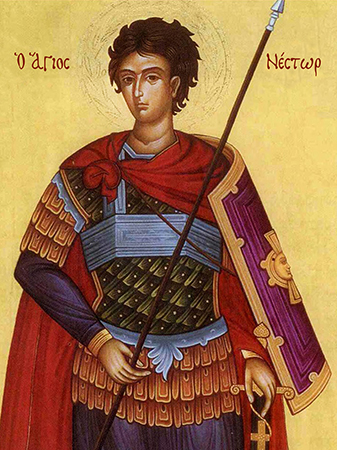
Among Lyaeus›s innocent victims were many Christians: when no one volunteered to duel with Lyaeus, by the emperor›s orders Christians were arrested and forced to duel with him. Seeing this horrifying amusement of the pagan world, Nestor›s heart was torn with pain, and he decided to come forward for a duel with the gigantic Lyaeus. But first, he went to prison to see St. Demetrios and sought a blessing from him to do this. St. Demetrios blessed him, signed him with the sign of the Cross on the forehead and on the chest and prophesied to him: «You will defeat Lyaeus, but you will suffer for Christ.» Thus, young Nestor went to duel with Lyaeus.
Maximian was present with a multitude nestor34 of people; everyone felt pity for the young Nestor, who would surely die, and tried to dissuade him from dueling with Lyaeus. Nestor crossed himself and said: «O God of Demetrios, help me!» and with God›s help, he overcame Lyaeus, knocked him down, and threw him onto the sharp spears, where the heavy giant soon found death. Then all the people cried out: «Great is the God of Demetrios!» But the emperor, shamed before the people and sorrowing for his favorite Lyaeus, was greatly angered at Nestor and Demetrios, and commanded that Nestor be beheaded and Demetrios run through with lances. Thus, the Christian hero Nestor ended his earthly life and took up his habitation in the Kingdom of his Lord in the year 306.
 
HYMN OF PRAISE: The Holy Martyr Nestor
St. Nestor was outraged at evil
And was zealous for the Christian Faith.
The young disciple of St. Demetrios
Seemed young and weak against the terrible Lyaeus,
But he traced the sign of the Cross on himself
And impaled the powerful Lyaeus on a spear.
He had been given power from above,
Like David against Goliath.
«You will conquer, but you will be tortured,
And will lay down your life for Christ.»
Thus Demetrios prophesied to him,
And as he said, so it came to pass.
Nestor jubilantly went to torture,
And wonderfully magnified the wondrous Christ
With sweet words and sweet hymns,
And fervent prayers for the Church.
Great in spirit, small in years,
He did not grieve over his young life;
His blood strengthened the Church,
And Nestor was eternally glorified.
 
Apolytikion in the Fourth Tone
Thy Martyr, O Lord, in his courageous contest for Thee received the prize of the crowns of incorruption and life from Thee, our immortal God. For since he possessed Thy strength, he cast down the tyrants and wholly destroyed the demons› strengthless presumption. O Christ God, by his prayers, save our souls, since Thou art merciful.
 
Kontakion in the Second Tone
Well didst thou contest; hence, thou hast now inherited immortal renown, wise Nestor, and thou art become Christ the Master›s excellent soldier by the holy and fervent prayers of the Martyr Demetrios. Thus, with him, cease not to pray for all of us. 
 
 
thanks to:
 

Holy, Glorious Demetrius the Myrrh-gusher of Thessalonica ~ Commemorated on October 26


Holy, Glorious Demetrius the Myrrh-gusher of Thessalonica


The Great Martyr Demetrius the Myrrh-gusher of Thessalonica was the son of a Roman proconsul in Thessalonica. Three centuries had elapsed and Roman paganism, spiritually shattered and defeated by the multitude of martyrs and confessors of the Savior, intensified its persecutions. The parents of Saint Demetrius were secretly Christians, and he was baptized and raised in the Christian Faith in a secret church in his father’s home.   By the time Demetrius had reached maturity and his father had died, the emperor Galerius Maximian had ascended the throne (305). Maximian, confident in Demetrius’ education as well as his administrative and military abilities, appointed him to his father’s position as proconsul of the Thessalonica district. The main tasks of this young commander were to defend the city from barbarians and to eradicate Christianity. The emperor’s policy regarding Christians was expressed simply, “Put to death anyone who calls on the name of Christ.” The emperor did not suspect that by appointing Demetrius he had provided a way for him to lead many people to Christ. Accepting the appointment, Demetrius returned to Thessalonica and immediately confessed and glorified our Lord Jesus Christ. Instead of persecuting and executing Christians, he began to teach the Christian Faith openly to the inhabitants of the city and to overthrow pagan customs and idolatry. The compiler of his Life, Saint Simeon Metaphrastes (November 9), says that because of his teaching zeal he became “a second Apostle Paul” for Thessalonica, particularly since “the Apostle to the Gentiles” once founded at this city the first community of believers (1 Thess. and 2 Thess.). The Lord also destined Saint Demetrius to follow the holy Apostle Paul as a martyr. When Maximian learned that the newly-appointed proconsul was a Christian, and that he had converted many Roman subjects to Christianity, the rage of the emperor knew no bounds. Returning from a campaign in the Black Sea region, the emperor decided to lead his army through Thessalonica, determined to massacre the Christians.     Learning of this, Saint Demetrius ordered his faithful servant Lupus to distribute his wealth to the poor saying, “Distribute my earthly riches among them, for we shall seek heavenly riches for ourselves.” He began to pray and fast, preparing himself for martyrdom. When the emperor came into the city, he summoned Demetrius, who boldly confessed himself a Christian and denounced the falsehood and futility of Roman polytheism. Maximian gave orders to lock up the confessor in prison. An angel appeared to him, comforting and encouraging him. Meanwhile the emperor amused himself by staging games in the circus. His champion was a German by the name of Lyaeos. He challenged Christians to wrestle with him on a platform built over the upturned spears of the victorious soldiers. A brave Christian named Nestor went to the prison to his advisor Demetrius and requested a blessing to fight the barbarian. With the blessing and prayers of Demetrius, Nestor prevailed over the fierce German and hurled him from the platform onto the spears of the soldiers, just as the murderous pagan would have done with the Christian. The enraged commander ordered the execution of the holy Martyr Nestor (October 27) and sent a guard to the prison to kill Saint Demetrius.     At dawn on October 26, 306 soldiers appeared in the saint’s underground prison and ran him through with lances. His faithful servant, Saint Lupus, gathered up the blood-soaked garment of Saint Demetrius, and he took the imperial ring from his finger, a symbol of his high status, and dipped it in the blood. With the ring and other holy things sanctified by the blood of Saint Demetrius, Saint Lupus began to heal the infirm. The emperor issued orders to arrest and kill him. The body of the holy Great Martyr Demetrius was cast out for wild animals to devour, but the Christians took it and secretly buried it in the earth.During the reign of Saint Constantine (306-337), a church was built over the grave of Saint Demetrius. A hundred years later, during the construction of a majestic new church on the old spot, the incorrupt relics of the holy martyr were uncovered. Since the seventh century a miraculous flow of fragrant myrrh has been found beneath the crypt of the Great Martyr Demetrius, so he is called “the Myrrh-gusher.”     Several times, those venerating the holy wonderworker tried to bring his holy relics, or a part of them, to Constantinople. Invariably, Saint Demetrius made it clear that he would not permit anyone to remove even a portion of his relics. It is interesting that among the barbarians threatening the Romans, Slavs occupied an important place, in particular those settling upon the Thessalonian peninsula. Some even believe that the parents of Saint Demetrius were of Slavic descent. While advancing towards the city, pagan Slavs were repeatedly turned away by the apparition of a threatening radiant youth, going around on the walls and inspiring terror in the enemy soldiers. Perhaps this is why the name of Saint Demetrius was particularly venerated among the Slavic nations after they were enlightened by the Gospel. On the other hand, the Greeks dismiss the notion of Saint Demetrius being a Slavic saint.The very first pages of the Russian Primary Chronicle, as foreordained by God, is bound up with the name of the holy Great Martyr Demetrius of Thessalonica. The Chronicle relates that when Oleg the Wise threatened the Greeks at Constantinople (907), the Greeks became terrified and said, “This is not Oleg, but rather Saint Demetrius sent upon us from God.” Russian soldiers always believed that they were under the special protection of the holy Great Martyr Demetrius. Moreover, in the old Russian barracks the Great Martyr Demetrius was always depicted as Russian. Thus this image entered the soul of the Russian nation.     Church veneration of the holy Great Martyr Demetrius in Russia began shortly after the Baptism of Rus. Towards the beginning of the 1070s the Dimitriev monastery at Kiev, known afterwards as the Mikhailov-Zlatoverkh monastery, was founded, The monastery was built by the son of Yaroslav the Wise, Great Prince Izyaslav, Demetrius in Baptism (+ 1078). The mosaic icon of Saint Demetrius of Thessalonica from the cathedral of the Dimitriev monastery has been preserved up to the present day, and is in the Tretiakov gallery.     In the years 1194-1197 the Great Prince of Vladimir, Vsevolod III the Great-Nest (Demetrius in Baptism) “built at his court a beautiful church of the holy martyr Demetrius, and adorned it wondrously with icons and frescoes.” The Dimitriev cathedral also reveals the embellishment of ancient Vladimir. The wonderworking icon of Saint Demetrius of Thessalonica from the cathedral iconostas is located even now in Moscow, at the Tretiakov gallery. It was painted on a piece of wood from the grave of the holy Great Martyr Demetrius, brought from Thessalonica to Vladimir in 1197. One of the most precious depictions of the saint, a fresco on a column of the Vladimir Dormition cathedral, was painted by the holy Iconographer Andrew Rublev (July 4).     The family of Saint Alexander Nevsky (November 23 also venerated Saint Demetrius. Saint Alexander named his eldest son in honor of the holy Great Martyr. His younger son, Prince Daniel of Moscow (March 4), built a temple dedicated to the holy Great Martyr Demetrius in the 1280s. This was the first stone church in the Moscow Kremlin. Later in 1326, under Ivan Kalita, it was taken down and the Dormition cathedral was built in its place.     The memory of Saint Demetrius of Thessalonica is historically associated in Rus with the military, patriotism and the defense of the country. This is apparent by the saint’s depiction on icons as a soldier in plumed armor, with a spear and sword in hand. There is a scroll (in later depictions) on which is written the prayer of Saint Demetrius for the salvation of the people of Thessalonica, “Lord, do not permit the city or the people perish. If You save the city and the people, I shall be saved with them. If they perish, I also perish with them.”     In the particular spiritual experience of the Russian Church, veneration of the holy Great Martyr Demetrius of Thessalonica is closely linked with the memory of the defense of the nation and Church by the Great Prince of Moscow, Demetrius of the Don (May 19). “An Account of the Life and Repose of the Great Prince Demetrius of the Don, Tsar of Russia,” written in the year 1393, already regards the Great Prince as a saint, as also do other old Russian histories. Great Prince Demetrius was a spiritual son and disciple of Saint Alexis, Metropolitan of Moscow (February 12), and a disciple and associate of other great figures of prayer in the Russian Land: Saint Sergius of Radonezh (September 25), Demetrius of Priluki (February 11), Saint Theodore of Rostov (November 28). The Account states:
He [Great Prince Demetrius] worried much about the churches of God, and he held the territory of the Russian land by his bravery: he conquered many enemies who had risen against us, and he protected his glorious city Moscow with wondrous walls. ...The land of Russia prospered during the years of his reign.
From the time of the building of the white-walled Kremlin (1366) by Great Prince Demetrius, Moscow was called “White-Stoned.”     By the prayers of his Heavenly patron, the holy warrior Demetrius of Thessalonica, Great Prince Demetrius, in addition to his brilliant military victories, also gained the further prominence of Russia. He repelled the onslaught of the Lithuanian armies of Olgerd, he routed the Tatar army of Begich at the River Vozha (1378), and he smashed the military might of all the Golden Horde at the Battle of Kulikovo Field on September 8, 1380 (the Feast of the Nativity of the Most Holy Theotokos), set between the Rivers Don and Nepryadva. The Battle of Kulikovo, for which the nation calls him Demetrius of the Don, became the first Russian national deed, rallying the spiritual power of the Russian nation around Moscow. The “Zadonschina,” an inspiring historic poem written by the priest Sophronius of Ryazem (1381) is devoted to this event.    Prince Demetrius of the Don was greatly devoted to the holy Great Martyr Demetrius. In 1380, on the eve of the Battle of Kulikovo, he solemnly transferred from Vladimir to Moscow the most holy object in the Vladimir Dimitriev cathedral: the icon of the Great Martyr Demetrius of Thessalonica, painted on a board from the grave of the saint. A chapel dedicated to the Great Martyr Demetrius was built at Moscow’s Dormition Cathedral.     The Saint Demetrius Memorial Saturday was established for church-wide remembrance of the soldiers who fell in the Battle of Kulikovo. This memorial service was held for the first time at the Trinity-Saint Sergius monastery on October 20, 1380 by Saint Sergius of Radonezh, in the presence of Great Prince Demetrius of the Don. It is an annual remembrance of the heroes of the Battle of Kulikovo, among whom are the schemamonks Alexander (Peresvet) and Andrew (Oslyab). Saint Demetrius is regarded as a protector of the young, and is also invoked by those struggling with lustful temptations.


thanks to:

https://oca.org/saints/lives/2017/10/26/103059-holy-glorious-demetrius-the-myrrh-gusher-of-thessalonica

Thursday, October 25, 2018

The Church existed before all other things


Before Pentecost

It is sometimes inaccurate to think that the Church started on Pentecost. The teaching of the holy Fathers is that the Church existed before all other things.
  • Saint Epiphanius of Cyprus writes, "The Catholic Church, which exists from the ages, is revealed most clearly in the incarnate advent of Christ".


  • According to Saint Gregory the Theologian, "The Prophets established the Church, the Apostles conjoined it, and the Evangelists set it in order".

  • The Church existed from the creation of the Angels, for the Angels came into existence before the creation of the world, and they have always been members of the Church. Saint Clement , Bishop of Rome, says in his second epistle to the Corinthians, the Church "was created before the sun and moon"; and a little further on, "The Church exists not now for the first time, but has been from the beginning".

thanks to source:

https://orthodoxwiki.org/Ecclesiology

Tuesday, October 16, 2018

Sayings St. John Chrysostom ~ Continued Struggle to the end


   He that wrestles is still held fast, but it is enough for him that he has not fallen. When we depart hence, then, and not till then, will the glorious victory be achieved. For instance, take the case of some evil lust. The extraordinary thing would be, not even to entertain it, but to stifle it. If, however, this be not possible, then though we may have to wrestle with it, and retain it to the last, yet if we depart still wrestling, we are conquerors (St. John Chrysostom, 1979b, p. 162).


~ St. John Chrysostom (347-407)


source:

http://ww1.antiochian.org/node/22478

Wednesday, September 26, 2018

St. John Chrysostom ~ beggar and the chalice


If you cannot find Christ in the beggar at the church door, you will not find Him in the chalice.


~ St. John Chrysostom

Wednesday, September 19, 2018

God and Gender ~ Clark Carlton


God and Gender

   Few issues are as explosive in our society as those involving gender and religion. The Orthodox Christian addresses these issues within the framework of the Church's self-understanding as the Bride of Christ. Whether the issue at hand is "inclusive language," the role of women in the Church, or homosexual desire, the answer lies in the great mystery: Christ and the Church.
   

   The peoples of the ancient world worshiped female deities, accepted priestesses, and thought nothing of homosexual behavior. Israel, however, stood alone in rejecting all of these practices. The reason for this lies in God's revelation of Himself as being radically distinct from creation.
   

   We have said that the world was created ex nihilo. Between the being of God and the being of the world there is an irreducible gulf. The world is not God, has never been God, and will never be God. The fact that God has united creation to Himself in the Incarnation in no way destroys the distinction between the Uncreated and the created. In Christ we participate in the uncreated grace of God, becoming by that grace what He is by nature, yet we never cease being creatures; our created nature is never transformed into the divine nature.
   

   This difference between God and the world is expressed iconically by the disexuality of human nature. In the Divine Scriptures, God is always represented by the male and creation by the female. God is the Bridegroom, and the world--- or more precisely, the Church, which is the world recreated in Christ--- is the Bride.
   

   God, of course, is neither male nor female; He is beyond all such created concepts. Nevertheless, He has given us certain images and concepts whereby we have come to know Him. Though these concepts can never fully describe or define the indescribable God, we are nonetheless bound by them.
   

   It is true that the Scriptures occasionally use female imagery in regard to God. For example, Christ said of Jerusalem: O Jerusalem, Jerusalem... how often would I have gathered thy children together, even as a hen gathereth her chickens under her wings, and ye would not (Matthew 23:37). This is,  however, a simile. Christ called God "Father," not "Mother." Christ is the "Son" of God, not the "Daughter" of God.
   

   The use if "inclusive" or even gender-neutral language about God is an egregious violation of the integrity of the Scriptures and of the Liturgy. To call God "Mother" is nothing less than to introduce a different god. Inclusive language blurs the distinction between the Creator and creation, elevating the creation (that is, the female) to the place of God, and thereby returning us once again to the Original Sin.
   

   From this it should be evident why it is impossible for the Church to have priestesses. The male, because he is a creature, can represent God only iconically. The female, however, is creation. The Church is essentially female. If, therefore, the priest--- who is the image of Christ the Bridegroom--- is female, then what happens to the male principle? Once again, the distinction between Creator and creation is destroyed, and a new religion is born. Actually, it is an old religion that is reborn--- the religion of pantheism, which Israel and the Church rejected.
   

   The inherent disexuality of human nature and its iconic relationship to Christ and the Church also explains the Church's attitude toward homosexual desire. Notice the context in which St. Paul addresses this issue:

      Who changed the Truth of God into the lie, and worshipped
      and served the creature more than the Creator, Who is
      blessed for ever. For this cause God gave them up
      unto vile affections: for even their women did change
      the natural use into that which is against nature: And
      likewise also the men, leaving the natural use of the
      women, burned in their lust one toward another; men
      with men working that which is unseemly, and receiving
      in themselves that recompense of their error which was
      meet (Romans 1:25-27).

   For St. Paul, homosexual desire is not only a result of the Fall, it is actually paradigmatic of the Fall, much in the same way that marriage is paradigmatic of Christ's saving relationship to the Church. It is clear, therefore, that the Church cannot bless homosexual activity. Human sexuality can be rightly expressed only in Holy Matrimony or in celibacy.


The Faith: Understanding Orthodox Christianity, An Orthodox Catechism, Clark Carlton, Regina Orthodox Press, 1997 pp. 235-237.